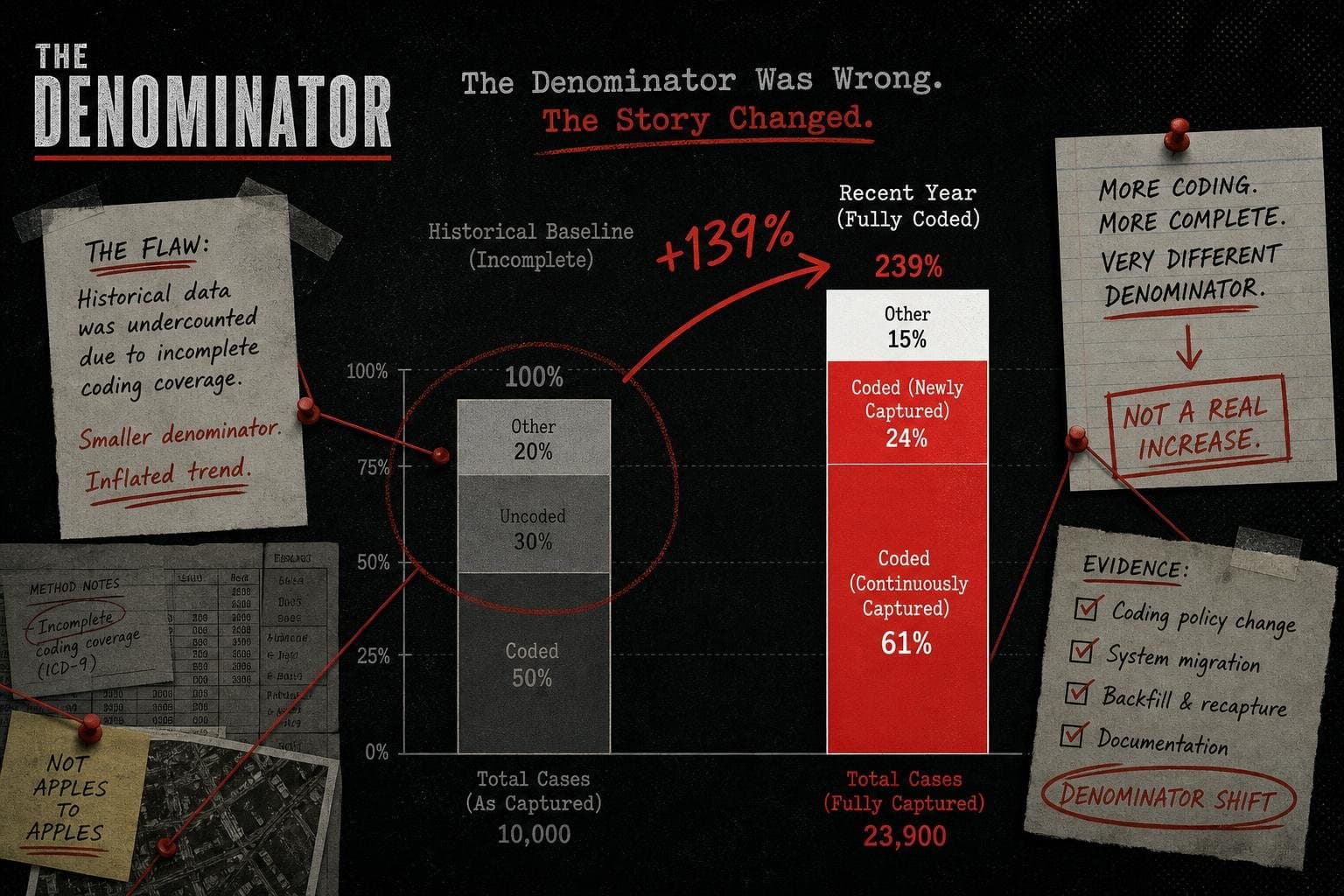

A clip from a 2022 panel discussion is circulating again on social media. In it, an attorney claims that miscarriage and cancer rates tripled and that neurological conditions rose more than tenfold — all, he says, caused by COVID-19 vaccines. The numbers come from military health records. They look official. They cite a specific database. And they are, according to Full Fact's fact-check published September 24, built entirely on a data error that was corrected years ago.
But here's what makes this case worth more than a standard debunk: the underlying methodological failure that produced these numbers is not unique to this dataset. It's a template. The same structural error — comparing a corrected current period against an uncorrected historical baseline — can be deployed anywhere there's a large administrative database with inconsistent historical coding. Understanding what went wrong here is more useful than knowing the verdict.
The Error Was in the Denominator's History, Not the Numerator's Present
The specific claim is that Department of Defense medical records showed a roughly 300% increase in miscarriage and cancer diagnoses, and a more than 1,000% increase in neurological conditions, compared to a "five-year average." That five-year average is the key phrase. It's the denominator. And it was wrong.
As Full Fact explains, the historical baseline years had underreported these conditions — not because they were rarer, but because the data for those years hadn't been fully entered or coded into the system yet. When someone compared the most recent, fully-coded year against those thin historical years, the apparent increase was dramatic. It wasn't a real increase in diagnoses. It was an increase in completeness.
This is a variant of what statisticians call a "censoring" problem, and it appears in administrative data constantly. Hospital discharge databases, insurance claims records, and cancer registries all share this feature: recent data is complete; older data may have been partially entered when it was first available and then retroactively filled in. The CDC's modeling and forecasting group explicitly flags this distinction in its own surveillance work, noting that epidemic trend estimates indicate direction only and must be read "alongside other surveillance metrics for a more complete picture" — a caveat that applies equally to any administrative health database where completeness varies across the time window. If you're pulling a historical average from a window that includes years where data entry wasn't yet finished, your baseline is artificially low. Your "trend" is mostly a measurement artifact.
When the DoD dataset was corrected — when the historical underreporting was adjusted — the actual increases were, per Full Fact, "much smaller." The claim collapsed. But here's the forensic detail worth holding: the corrected version of the story never went viral. The wrong version did. And now, in September 2026, the wrong version is circulating again, with no correction attached.
"Doesn't Show Causation" Is Doing Necessary but Insufficient Work
The usual fact-check framework for vaccine claims runs like this: (1) the numbers are wrong, and (2) even if they weren't wrong, correlation ≠ causation. That second step is important, but if you lead with it — or if audiences primarily absorb the causation caveat rather than the data-error explanation — it implies the numbers might be real but just misinterpreted. They are not real. They were artifacts of incomplete historical data. The sequence matters.
This failure mode is not limited to vaccine claims. A September 2026 Reuters investigation into noncitizen voter rolls illustrates the same dynamic in a different domain: a dramatic headline figure — DHS reviewing rolls across 47 states — circulates widely, while the methodological context (that "multiple studies and audits" found noncitizen voting to be "statistically insignificant" relative to 170 million registered voters) gets far less traction. The number does the work. The denominator sits in paragraph six.
Debunkers often reach for the causation argument because it's accessible and sounds rigorous. But it accidentally leaves the audience with the impression that the data itself was roughly right but overinterpreted. In this case, the data was not roughly right. The "five-year average" baseline was specifically not a valid comparison point.
Why This Template Keeps Working
The miscarriage-and-cancer claim has now recirculated at least twice — once in 2022, and again this month — which is enough to identify it as a durable piece of misinformation rather than a one-time error. What makes it durable?
First, it uses a real database. The U.S. Department of Defense medical records system is a legitimate data source. When someone cites it, it carries the epistemic weight of an official government dataset. The audience hears "military health records" and reasonably assumes rigorous collection. What they don't know is that rigorous collection is not the same as rigorous historical completeness.
Second, the numbers are large and specific. A 300% increase. A 1,000% increase. These aren't hedged claims — they're precise, which signals certainty. And they're dramatic, which signals importance. Consider the parallel in economic statistics: a viral Facebook graphic circulating in September 2026 claimed specific inflation figures for household goods under Biden versus Trump, citing the Bureau of Labor Statistics' own CPI-U database as its source — yet when Snopes attempted to replicate those figures using that exact database, none of them checked out. The graphic had the aesthetic of official data. It named the right source. The numbers were still fabricated or miscalculated. Precision and drama together outperform accuracy in social media circulation.
Third, the original attorney's 2022 video was filmed during an official-looking panel discussion. It has the aesthetic of testimony. This is a separate mechanism from data quality — it's presentation quality — but the two get conflated. Audiences calibrate trust partly on whether something looks like it was produced under institutional conditions.
None of these three features are unique to this claim. They recur in virtually every piece of durable health misinformation.
The Corrected Number Still Needs a Number
Here's the part that makes this story genuinely unsatisfying from an analytical standpoint: Full Fact tells us that after the DoD data was corrected, the real increases were "much smaller" — but doesn't specify what those smaller increases were.
That's understandable from a journalism-efficiency perspective; the original claim was false, and establishing falseness doesn't require establishing an alternative precise figure. But from a public health transparency perspective, it's a gap. "Much smaller" is not a number. It can't be compared to baseline rates. It can't be used to assess whether any residual signal was clinically meaningful.
This matters because the rebuttal as currently framed relies entirely on the data-error argument. If someone wanted to re-litigate the claim using the corrected dataset, there's no publicly accessible version of "here is the corrected five-year average, here is the corrected 2021 figure, here is the properly calculated rate of change." The corrected data exists — the DoD updated its records — but the corrected analysis hasn't been made accessible in a form that civilian audiences can engage with.
The structural problem here is not unique to military health records. The WHO's September 2026 report on AI ethics in health research identifies a closely related failure mode in health data more broadly: existing oversight mechanisms, the report warns, are often "not equipped to address" risks around "transparency, bias, fairness, accountability" when datasets are used in novel analytical contexts. Administrative databases being queried for purposes their original design didn't anticipate — like using a military medical records system to adjudicate vaccine policy — fall squarely into that category.
For a publication that treats the denominator as the lede, the absence of a corrected denominator in the public record is itself a story. If the DoD has corrected its historical baselines, what does the corrected comparison actually show? That number should exist. It should be findable. The fact that debunkers have to say "much smaller" rather than "the corrected analysis shows X per 100,000 service members compared to a five-year baseline of Y" is a transparency failure that sits upstream of this particular claim.
What a Well-Constructed Version of This Analysis Would Have Required
The attorney's original claim needed several things to be credible that it did not have. Working backward from the methodology:
A legitimate comparison of diagnostic rates across years in an administrative database requires, at minimum: (1) confirmation that data completeness is consistent across the comparison window — not just that the database exists, but that historical entry rates were comparable; (2) a denominator that reflects the at-risk population in each year, not just a raw count of diagnoses; (3) an adjustment for changes in diagnostic coding practices, which shift over time independent of disease burden; and (4) a confidence interval on the estimated change, given that the military population is not large enough that small-number effects are irrelevant.
The Census Bureau's economic indicator surveys offer a useful contrast in methodology disclosure: each release includes explicit notes on "estimation and sampling variance, seasonal adjustment, and measures of sampling variability," with confidence intervals flagged where the evidence doesn't meet a statistical significance threshold. That level of scaffolding is standard practice for serious data releases. None of it was present in the attorney's 300% claim. When someone presents a dramatic percentage with no methodology disclosed, the appropriate default is skepticism — not because the claim is certainly wrong, but because there's no way to evaluate it.
The Full Fact analysis confirmed what that default skepticism would have predicted: the methodology was fatally flawed, and the number was an artifact.
The Recirculation Is the Story Now
The 2022 clip was wrong when it aired. The DoD data error was identified and corrected. That correction was covered, though not widely. And now, in late September 2026, the clip is circulating again to a new audience that never saw the correction.
This is the actual current problem, and it's distinct from the original data-quality problem. The misinformation ecosystem has a longer memory for viral claims than for their corrections. A video from a panel discussion four years ago can be clipped, stripped of its 2022 timestamp, and dropped into a 2026 feed where it looks current. The correction from 2022 is harder to surface than the original claim because corrections don't get clipped and reshared at the same rate.
The pattern extends beyond health data. ProPublica's investigation into Senator Susan Collins' relationship with defense contractor Navatek ran into the same asymmetry from the opposite direction: Collins' team made a series of incorrect and misleading counter-claims after the story published, and those claims circulated through media appearances faster than ProPublica's detailed rebuttal could follow. Initial impressions, whether from a 2022 panel clip or a senator's press statement, travel farther than corrections.
The tools for addressing recirculation — platform labeling, correction threading, persistent fact-check attachments — exist in partial forms but are applied inconsistently. What doesn't exist is a reliable mechanism for ensuring that when an administrative dataset gets corrected, the corrected analysis gets published in a form as accessible as the error.
Watch for whether the DoD's


