



The Headline Number
"Mifepristone sends 1 in 10 women who use it to the emergency room with life threatening conditions." — Sen. Josh Hawley, X, May 4, 2026
The Audit
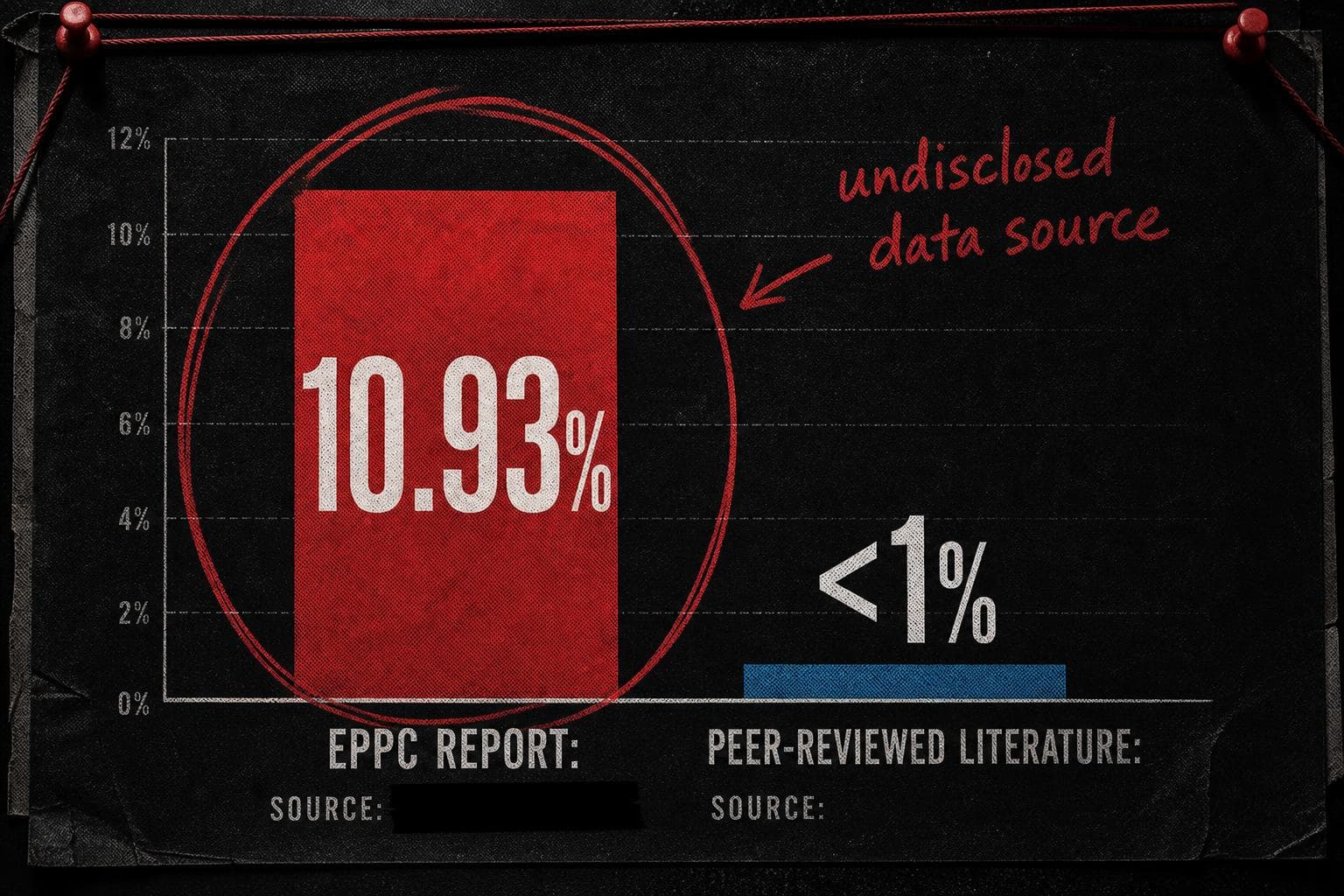
The number has a source. That's more than you usually get. The source is a 2025 report from the Ethics and Public Policy Center, a conservative nonprofit that opposes abortion, which analyzed health insurance claims data on more than 865,000 women and concluded that 10.93% experienced serious adverse events within 45 days of taking mifepristone.
That sounds rigorous. It isn't.
The first problem is definitional. "Adverse event" is a pharmacological term of art meaning a health issue that occurs after taking a drug — not one caused by the drug. Serious adverse events include anything life-threatening or leading to hospitalization, permanent damage, or death. If a woman takes mifepristone and then breaks her ankle three weeks later, that's technically an adverse event in claims data. The EPPC report does not appear to have controlled for this, and FactCheck.org reports that 360 reproductive health researchers filed an amicus brief with the Supreme Court calling the report "riddled with methodological flaws."
The second problem is transparency. The EPPC report was not published in a peer-reviewed journal, and it does not disclose its data source. You cannot replicate a study when the underlying dataset is undisclosed. That's not a minor quibble — it's the entire basis for trusting a number.
The third problem is the comparison. Peer-reviewed studies on mifepristone show serious complication rates well below 1%. The EPPC figure is roughly ten times higher than what the published clinical literature finds. When a single unpublished report from an advocacy group produces an outlier that large, the correct response is skepticism, not legislation.
Sen. Hawley's version — "sends 1 in 10 women to the emergency room" — is actually worse than the EPPC's own claim. The EPPC said serious adverse events; Hawley converted that to ER visits. Those are not the same thing, and the EPPC report doesn't appear to support the ER framing at all.
This is the pattern: a methodologically contested figure from an undisclosed dataset, laundered through a court filing, then upgraded by politicians into something more alarming than the original claim even asserted. Each step adds certainty. None adds evidence.
The mifepristone case is currently before the Supreme Court. The 5th Circuit halted mail access on May 1; the Court temporarily restored it and extended that order through May 14. Whatever the Court decides, it should not be deciding it on a number whose denominator is hidden and whose methodology has been publicly challenged by hundreds of researchers in the relevant field.
A contested stat from an undisclosed dataset is not evidence. It's a prior dressed up in a lab coat.