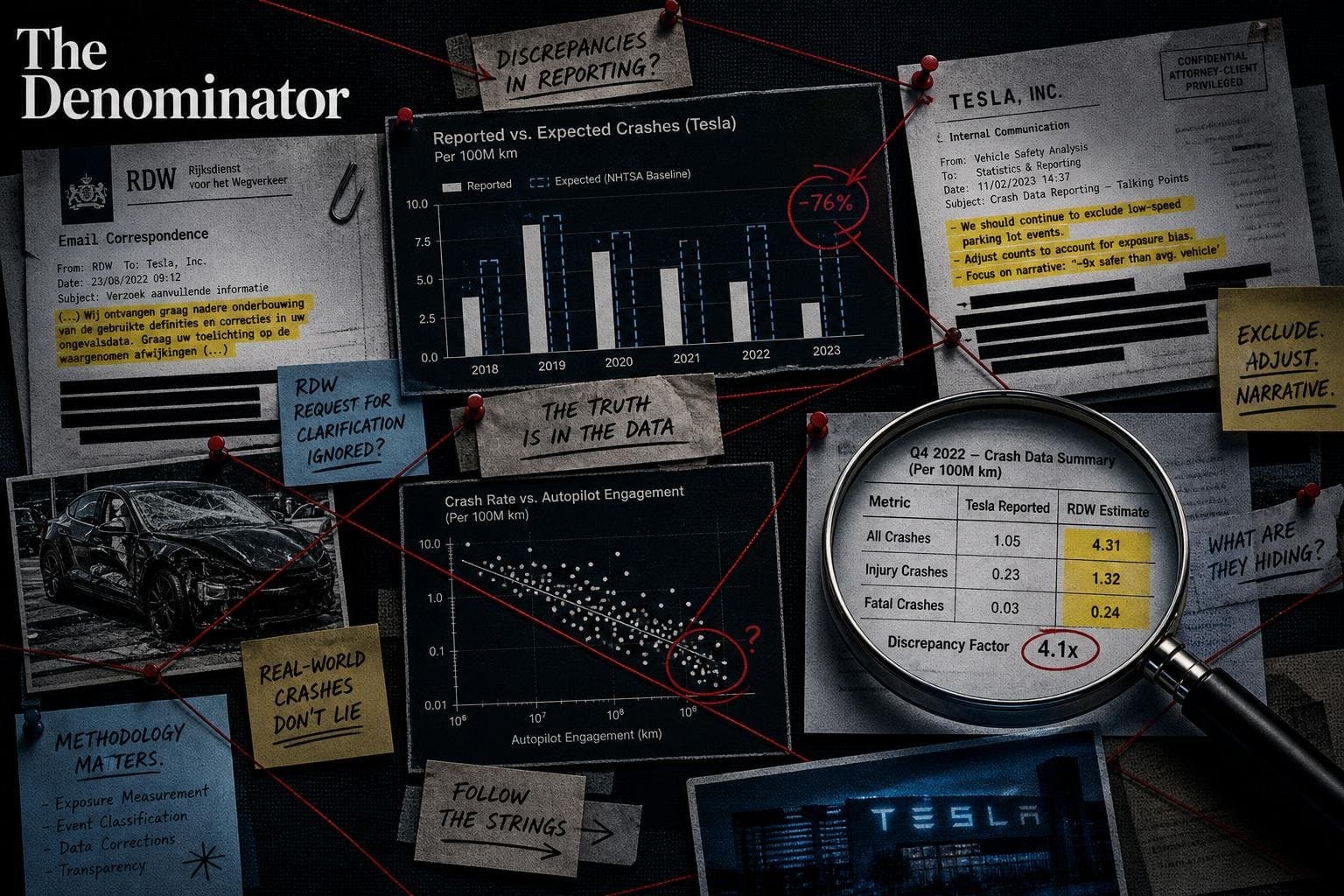

Here's the sequence, in order: a company writes its own safety study. The company sends that study to the regulator deciding whether to approve the company's product. The regulator, in its own internal correspondence, describes the relationship with the company in terms like "shared" and "mutual" objectives. The regulator approves the product. Every other regulator in the bloc is now told to treat that first approval as the benchmark.
That's not a hypothetical about regulatory capture. It's the architecture of how Tesla's "Full Self-Driving" software has been working its way toward approval across the European Union, according to a Reuters investigation published in October. The company pushed regulators to scale back the rigor of their reviews, submitted its own research claiming the technology reduces crashes, and leaned on Tesla's online fanbase to pressure officials who were slow to sign off. It worked. The Netherlands became the first EU country to approve the system, which cleared the path for a vote across all 27 member states. Seven other countries — including the Czech Republic, Belgium, and Denmark — have already granted national approvals.
The question this newsletter exists to ask is simple: compared to what? Compared to what standard of evidence, reviewed by whom, using what methodology? On that question, the Tesla story falls apart fast.
The Study Doing the Heavy Lifting Can't Carry the Weight
Reuters had seven traffic-safety researchers examine the methodology behind Tesla's safety claims. Their verdict, as reported: the research "can't support the company's claims to officials or the public." That's not a dispute about interpretation — it's a finding that the underlying study doesn't do what Tesla says it does.
This is where the correlation-causation distinction that gets waved around so loosely in most public debates actually matters in a concrete, consequential way. A company showing that cars running its driver-assistance software get into fewer crashes than some baseline isn't the same as showing the software caused the reduction. Tesla buyers, on average, aren't a random sample of drivers — they skew toward income levels, vehicle age, and driving patterns that already correlate with lower crash rates independent of any software running in the car. None of the reporting I'm working from gives us Tesla's actual sample construction, so I can't tell you exactly how they built their comparison group. That's the point. Neither, apparently, could the seven researchers who tried to check.
And that's the recurring failure mode in these fights: a company (or an agency, or an advocacy group) generates a number, attaches "crash reduction" language to it, and hands it to a decision-maker who doesn't have the capacity or incentive to audit the denominator.
A Regulator That Wrote Like a Partner, Not a Referee
The methodology critique would be bad enough on its own. What makes this a governance story rather than just a statistics story is what happened inside the Dutch approval process itself.
Reuters reviewed correspondence between Tesla and RDW, the Dutch vehicle safety regulator, that had not been previously reported. During the review, Tesla repeatedly pushed to reduce the intensity of RDW's examination and to set the terms of its own testing — with what the reporting describes as "some success." Dutch staffers, in their own internal notes, used language emphasizing a desire to collaborate with Tesla toward "shared" or "mutual" objectives. Five independent experts in autonomous-vehicle regulation who reviewed those exchanges for Reuters flagged concerns about RDW's impartiality.
RDW's public response is worth sitting with for what it doesn't say. The agency told Reuters it "assesses driver assistance systems from all manufacturers objectively and independently," and that engagement with a manufacturer "is a routine part of the assessment process and does not compromise the independence or thoroughness of our assessment." That's a denial of the conclusion, not a rebuttal of the correspondence. Tesla didn't respond to Reuters' questions at all.
The structural problem is that the Netherlands' approval isn't just one country's decision. Under the EU's process, a single member state has to sign off first, and that approval becomes the template other countries lean on for their own votes. A flawed review in one jurisdiction doesn't stay contained — it propagates. Reuters reports that other countries are now relying heavily on the Dutch research to make up their own minds, which means a methodology problem identified by seven researchers in one evaluation is functionally being treated as cleared evidence by regulators who never ran their own independent check.
What Rigorous Disclosure Actually Looks Like
It's useful to hold Tesla's undisclosed methodology up against what a transparent data release looks like, if only to see the gap.
Take the Census Bureau's Business Trends and Outlook Survey, which released new data products on October 8, 2026. The release documentation specifies the sample: approximately 1.2 million businesses, split into six panels of roughly 200,000 cases each, with respondents reporting every 12 weeks over a year, and an average completion time of about nine minutes per survey. That's not flattering marketing copy — it's the kind of detail that lets an outside statistician actually evaluate whether the resulting estimates mean what the headline says they mean.
The Bureau of Labor Statistics runs on the same logic. Its October 2026 release schedule publishes, months in advance, the exact date and time every employment, price, and compensation report will drop — no surprises, no selective timing, no choosing when to release favorable numbers. When BLS released the September 2026 Employment Situation, it did so on a schedule set long before anyone knew what that month's numbers would show.
None of this is to claim BLS or Census data is beyond scrutiny — this newsletter has spent the better part of a year finding denominators buried in BLS and Census releases. But the comparison is instructive. These agencies publish their sample sizes, their panel structures, their collection windows, before anyone argues about what the number means. Tesla submitted research to European regulators and, per Reuters, pushed to shape the terms of the review that would evaluate it. One of those processes invites an audit. The other resists one.
The Vote That Turns This From a Story Into a Decision
Reuters describes an EU-wide vote on Tesla's approval as expected soon, following the Dutch signoff and the national approvals already granted in seven member states. That vote is the moment where a methodology dispute stops being an abstract argument about research design and becomes a binding decision about what's allowed on roads carrying hundreds of millions of people.
What to watch: whether any EU member state, ahead of that vote, commissions its own independent crash-reduction analysis rather than importing the Dutch findings wholesale. Whether RDW releases the full underlying data from its Tesla review rather than relying on the general assurance of "objective and independent" assessment. And whether any of the seven researchers who flagged the methodology problem to Reuters get a formal hearing before the vote happens rather than after.
The broader lesson holds regardless of how the vote lands. A safety claim generated by the company whose product is being evaluated, reviewed by a regulator that described its relationship with that company as collaborative, is not evidence in the sense regulators normally mean the word. It's a pitch. The tell, every time, is the same one this newsletter keeps finding: nobody asked for the denominator before they signed off.


