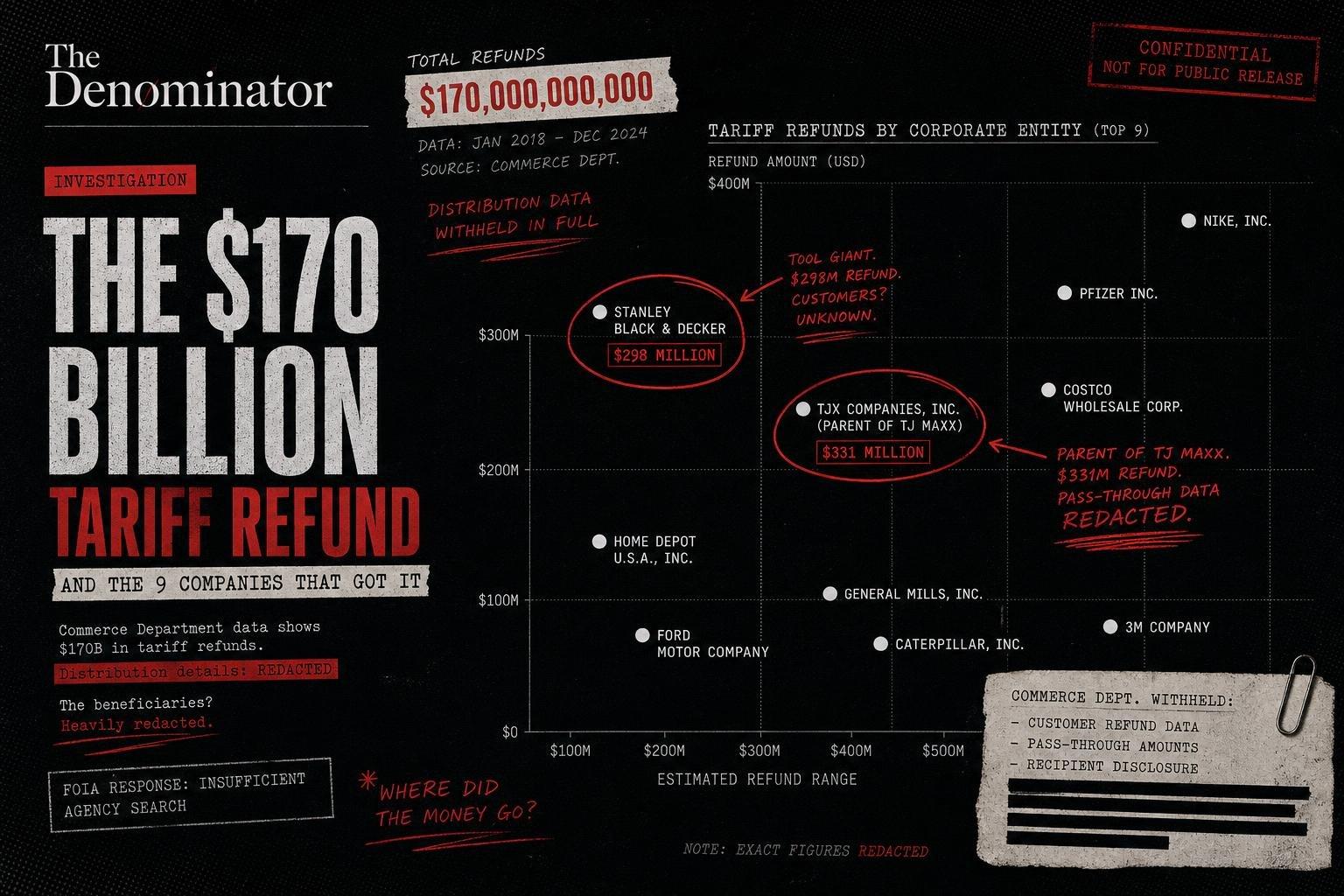

Here's a number that should make you ask a follow-up question: $298 million. That's what Stanley Black & Decker is getting back in tariff refunds, after the Supreme Court struck down President Trump's most sweeping tariffs earlier this year. The company raised prices repeatedly in 2025, telling customers the tariffs made it necessary. Now the money is coming back — not to the customers who absorbed those price increases, but into a pool used to calculate executive bonuses, according to ProPublica's review of securities filings and earnings calls.
The follow-up question is the one that actually matters: refunded relative to what? Stanley Black & Decker isn't alone. The parent company of TJ Maxx and Marshalls is getting at least $331 million back, and Titleist is among at least nine firms ProPublica identified using refund money for bonuses rather than consumer reimbursement. Dozens more have simply folded the windfall into the earnings figures that determine executive pay, without detailing a plan for the roughly $170 billion the administration has refunded industry-wide since the tariffs were overturned.
That $170 billion figure is doing a lot of unexamined work. It sounds enormous — and it is, in absolute terms — but nobody outside these companies' own disclosures can tell you how it's distributed, because the administration has denied ProPublica's requests for which companies received how much. For comparison, this is the kind of breakdown that federal statistical agencies publish as a matter of routine — the Bureau of Labor Statistics releases its monthly price indexes with full category and geographic detail attached, down to the regional level, in reports like its latest Producer Price Index release. When an agency has the mechanics to publish that kind of granularity on inflation data every month, "we don't disclose the allocation" from a tariff-refund program isn't a resourcing problem. It's a choice.
A Different Country, the Same Trick With Bigger Numbers
Compare the tariff story to a fact-check out of Brazil this week, which is a small masterclass in how a scary-sounding count becomes meaningless the moment you ask where it came from. Social media posts claimed 8 million votes cast without biometric verification proved fraud in Brazil's 2026 runoff, some posts tying the number to an extended voting deadline and even to deceased voters.
Reuters traced the number back to the electoral tribunal's own ballot data and found 8,632,488 registered voters who didn't authenticate by fingerprint during the runoff — a real figure, but one the electoral rules explicitly allow for, since a voter can be cleared to vote by stating their birth year if biometric recognition fails four times, the same procedure used in prior election cycles. More than 17 million Brazilian voters simply don't have fingerprints on file with electoral authorities, so a subset voting without biometrics isn't an anomaly — it's a known category of the electorate, no different in principle from the kind of methodological footnote that international bodies routinely publish alongside their own cross-country statistics, the sort of context the OECD attaches to its unemployment data releases so readers can see what's counted and what isn't before comparing numbers across countries.
A separate academic count of machine logs put the number of non-biometric votes at 15.8 million — nearly double the viral figure — which tells you the 8 million number wasn't even internally consistent with other legitimate tallies, let alone evidence of fraud. And the specific claim about votes cast after a court-ordered deadline extension? The real number there was 34,393 total late votes across all voting methods, of which only 5,446 lacked biometric confirmation, per Reuters' review of the underlying logs. Somebody took a 5,446-vote footnote and inflated it by three orders of magnitude to manufacture an 8-million-vote scandal.
Same Failure, Different Direction
I want to be clear that these two stories aren't politically symmetrical in subject matter, but they are symmetrical in method. In the tariff story, a large real number ($170 billion) gets reported without the distribution data needed to evaluate who benefits. In the Brazil story, a large number gets reported with a distribution attached — except the attachment is fabricated, built by taking a legitimate administrative category and relabeling it as proof of something it was never evidence for.
Both failures exploit the same reader instinct: big number, must be meaningful. Neither failure requires lying outright. The tariff companies aren't lying when they report $170 billion in industry refunds — they're just declining to show their work on where it went, the opposite instinct from, say, the WHO's practice of reporting raw case counts alongside year-over-year comparisons in its outbreak updates, like its latest polio surveillance statement, which lays out 25 new cases since its last meeting against 52 in all of 2025 and 99 in 2024 — numbers you can actually check against each other. The Brazil posts aren't inventing the existence of non-biometric votes — they're taking a real, rules-compliant category and attaching a false cause to it.
What to watch next: whether more companies disclose their refund allocations in Q4 earnings calls over the coming weeks, and whether the administration ever releases the per-company refund data ProPublica has been denied. Until one of those two things happens, "$170 billion in refunds" is a number with no denominator — and no amount of outrage about the numerator fixes that.


