


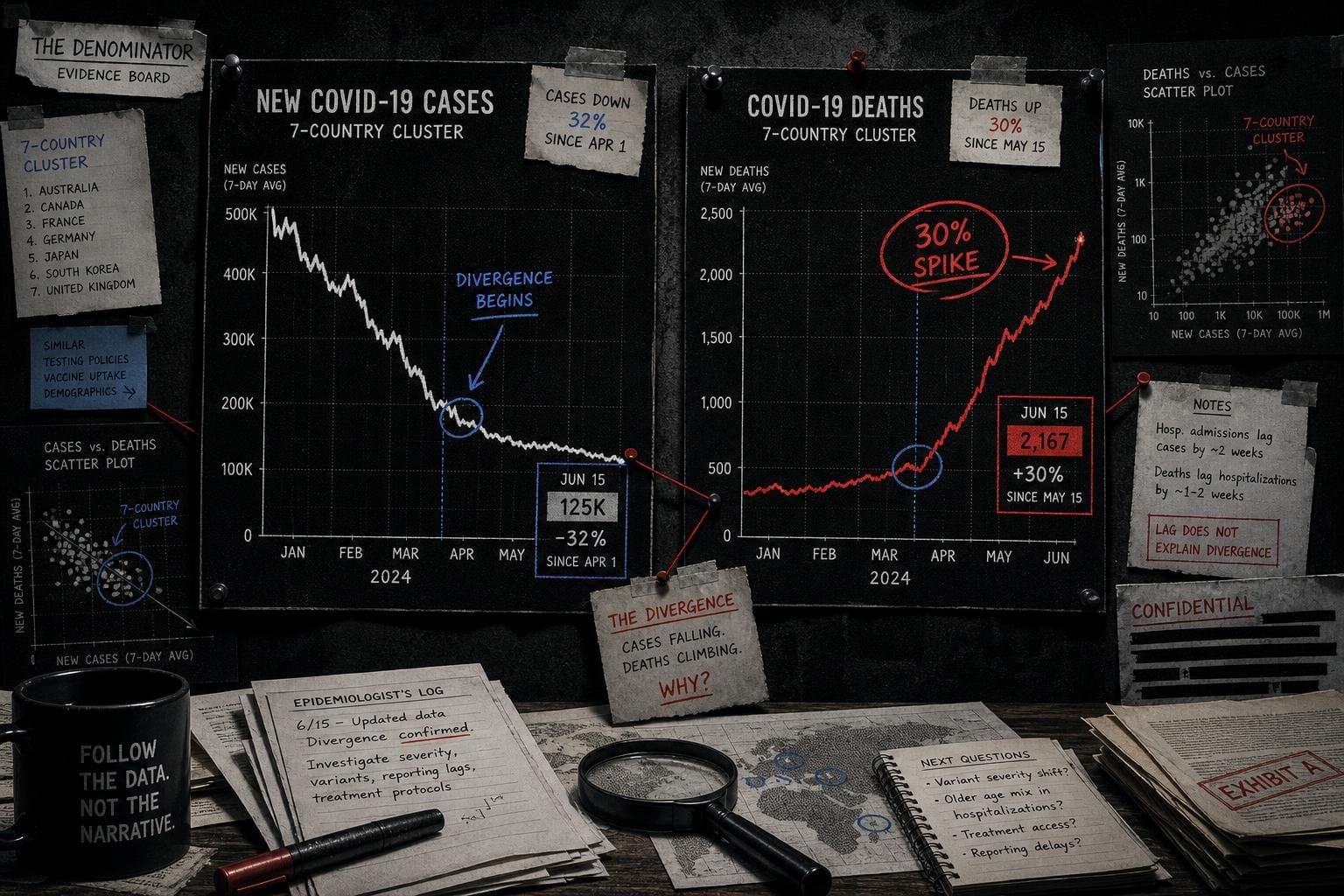

Here's a number that should stop you: in 2025, the world reported fewer cholera cases than the year before, and 30% more deaths. Not a typo. Not a rounding quirk. The WHO's latest epidemiological report puts the 2025 tally at 451,499 reported cases and 7,870 deaths across 47 countries — the highest annual death count WHO has recorded since 1999.
When deaths rise faster than cases, you're not looking at a bigger epidemic. You're looking at a worse one for the people who catch it.
The Denominator Problem Inside the Denominator Problem
Start with the obvious caveat, because WHO states it plainly: these are cases reported to WHO, not cases that occurred. The agency says the actual global burden is "substantially higher" than the surveillance numbers show, since many cases in affected countries never reach a clinic, let alone a national reporting system. So the 451,499 figure isn't the denominator of cholera infections worldwide — it's the denominator of cholera infections that made it into a formal count. Case counts falling could mean fewer infections. It could also mean worse surveillance in the hardest-hit places. WHO's own report doesn't resolve which, and neither should you pretend it does.
What makes the death figure more trustworthy, relatively speaking, is concentration. Seven countries — Angola, Bangladesh, the Democratic Republic of the Congo, Nigeria, South Sudan, Sudan and Yemen — account for roughly 90% of all reported cases and deaths globally, per WHO. That's not a flat global trend; it's a crisis compressed into a handful of fragile states, several of them mid-conflict. The WHO African Region alone saw cases climb 34% and deaths climb 58% compared with 2024 — a steeper death increase than the case increase, again pointing toward care quality rather than just spread.
Where the Fatality Math Actually Lands
Here's the part that deserves more attention than the headline 30%. Among patients who reached a health facility, the global case fatality rate was below 1% — WHO's own benchmark for adequate care. That's a genuinely good number, and it tells you cholera is eminently treatable when people get there in time. The failure is in the "get there" part: more than one in five reported cholera deaths happened outside a health facility entirely. That's not a statistic about the disease. It's a statistic about access.
Twelve countries exceeded that 1% in-facility fatality threshold in 2025, which WHO doesn't fully enumerate in the public release — so I won't guess which ones, but the pattern is consistent with the same seven-country cluster driving the case and death totals.
On the response side, there's a genuine good-news number buried in here, and I want to flag it because this newsletter spends most of its time debunking inflated claims, not dismissing real progress. Global production of oral cholera vaccines more than doubled between 2022 and 2025, rising from roughly 30 million to about 80 million doses annually, WHO reports. Last year the International Coordinating Group approved 71 million doses for affected countries, including 20 million for preventive campaigns that resumed after a suspension lasting more than three years. More vaccine supply is a real, measurable input. Whether it's enough to bend the death curve next year is a separate question the 2025 numbers can't answer yet, because the preventive campaigns only just restarted.
Don't Let the Headline Number Do the Causal Work
WHO's own statement attributes the death rise to gaps in water, sanitation, surveillance, and care access — a correlational read based on which countries are driving the numbers, not a controlled study isolating cause. That's a reasonable inference from the data, but it's an inference, not a measured causal estimate; nothing in the release isolates how much of the 30% increase in deaths traces to conflict-driven care disruption versus surveillance changes versus genuinely worse outbreaks. Reported-to-WHO figures also changed year over year in ways the report itself flags as incomplete, which means the clean "cases down, deaths up" framing is doing more rhetorical work than the underlying surveillance system can fully support.
The number worth tracking going forward isn't the global case count. It's the in-facility fatality rate in those twelve countries where it topped 1%, and whether the resumed preventive vaccination campaigns move it back down when WHO reports 2026 figures. That's the test of whether this year's vaccine supply increase actually reaches the people dying outside the clinic doors — not just the people who make it inside.