


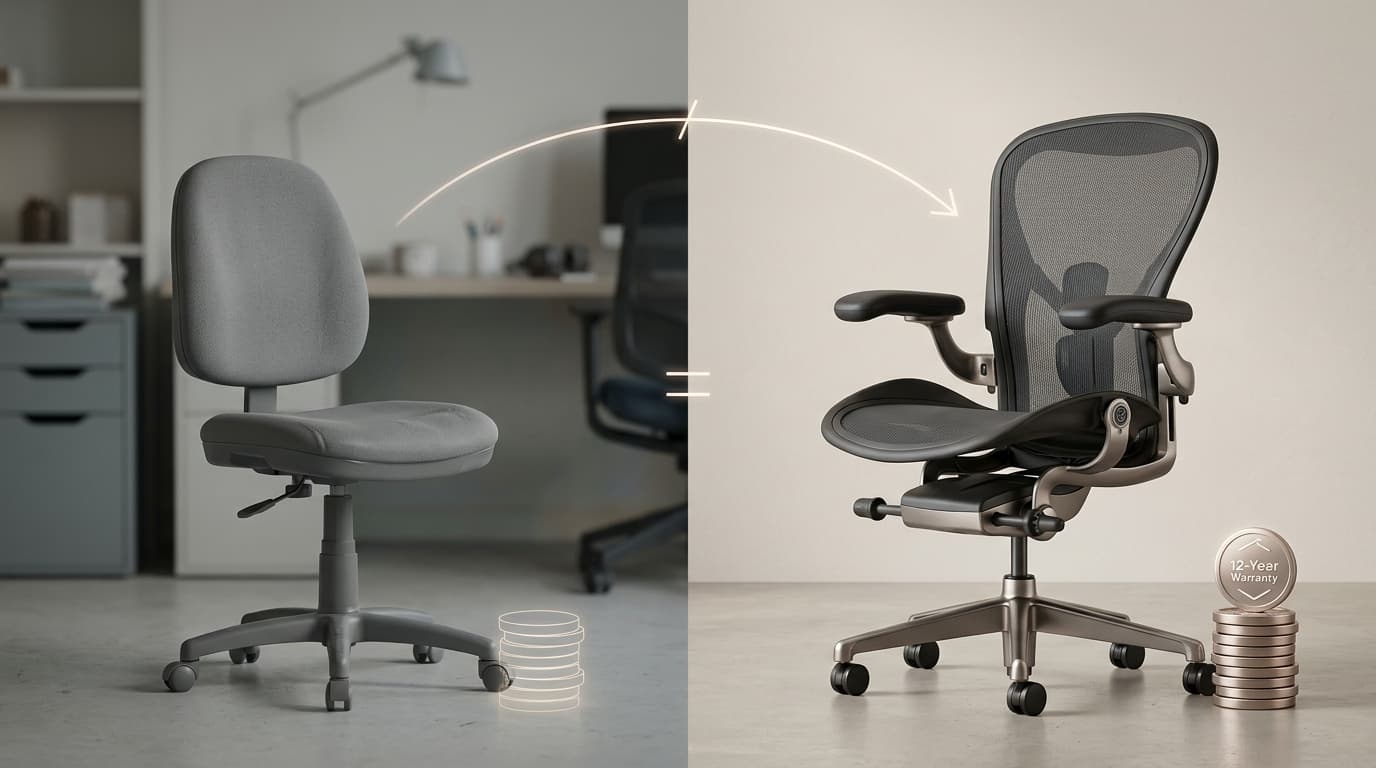

Most remote professionals will spend north of $3,000 on a new monitor setup without blinking, then spend eight hours a day destroying their back on a $200 chair from a big-box store. That math doesn't work.
The home office equipment category has matured considerably — there are now genuinely excellent options at every price point, and the gap between "good enough" and "exceptional" is measurable in both comfort and longevity. After cross-referencing the latest testing from Wired, PCMag, and CNET, here's what's actually worth buying.
The Chair Is the Non-Negotiable
If there's one place to spend real money, it's here. Wired's reviewer, who has tested 65 chairs over seven years of remote work, lands on the Branch Ergonomic Chair Pro as the best balance of price and features for most people — but flags the Herman Miller Aeron as the benchmark that everything else gets measured against. PCMag's testing points to the Herman Miller Vantum as a top pick, specifically citing its ergonomic design and 12-year warranty as justification for the premium.
That warranty detail matters more than it sounds. A chair you sit in for eight hours a day is infrastructure, not furniture. A 12-year warranty signals that the manufacturer has confidence in the build — and that you're not replacing it in three years when the lumbar support collapses.
The pattern across every serious review: adjustability is the actual differentiator at the premium tier. Not aesthetics, not brand name — the ability to dial in lumbar depth, armrest height, seat pan depth, and recline tension to your specific body. The Independent's testing included input from a physiotherapist who emphasized that proper chair fit — feet flat, hips at 90 degrees, monitor at eye level — is what prevents the neck and lower back problems that accumulate over years of desk work. The chair enables that position. A bad one fights it.
Brands consistently earning top marks across independent testing: Herman Miller, Steelcase, Humanscale, and Branch. If a chair isn't on that list and costs over $800, I'd want a very specific reason why.
The Desk That Actually Gets Used
Standing desks have been oversold for years, but the electric sit-stand category has quietly gotten very good. The key insight from CNET's 2026 standing desk roundup: the Uplift V3 earns best overall, with the Branch Standing Desk flagged as particularly strong for home office and commercial use.
The honest case for a quality electric desk isn't that standing is dramatically healthier — it's that movement is. The ability to shift positions throughout the day, without friction, is what actually changes behavior. Manual crank desks sound fine in theory; in practice, testing across multiple reviewers confirms what the Reddit r/StandingDesk community has been saying for years: you'll use an electric desk. You won't use a manual one.
What to look for at the premium tier: dual-motor frames (meaningfully more stable under load), programmable height presets, and a weight capacity that handles your full monitor setup without wobble. The Uplift V3 checks all of those. It's ridiculously expensive compared to the IKEA alternatives — and worth it if you're going to be at this desk for the next decade.
The Principle Behind Both Picks
The through-line here isn't brand loyalty or spec-chasing. It's this: the equipment you interact with physically, for hours every day, compounds. A great chair at $1,500 amortizes to under $0.50 per workday over a decade. A bad one costs you in chiropractor visits, lost focus, and the creeping misery of a body that never quite recovers overnight.
The professionals who get this right treat their home office as a long-term investment, not a one-time purchase. They buy the chair that fits their body, the desk that removes friction from movement, and they stop thinking about either one — which is exactly the point.
The next category worth this level of scrutiny: monitor arms and display setups, where the quality gap between budget and premium is just as stark and just as consequential for daily comfort.