



There's a moment every serious home cook eventually hits: you're breaking down a chicken, or slicing a ripe tomato, and the knife just glides. No pressure, no sawing, no bruised flesh. You stop and think — oh, this is what a knife is supposed to feel like.
That moment is the entire argument for spending real money on a blade.
German vs. Japanese: The Choice That Actually Matters
The premium knife world splits cleanly into two philosophies, and understanding the difference saves you from buying the wrong thing.
German knives — Wüsthof, Zwilling, Henckels — are built for forgiveness. Good Housekeeping's kitchen lab testing found the Wüsthof Classic 9-piece set's blades hold their edge well under regular use, thanks to full-tang construction and razor-sharp stainless steel. They're heavier. You can use them hard, throw them in a drawer (please don't), and they'll survive. The acacia block set runs premium, but the chef's knife alone tests as one of the best in class. For a household where multiple people cook and nobody's precious about blade care, this is the right call.
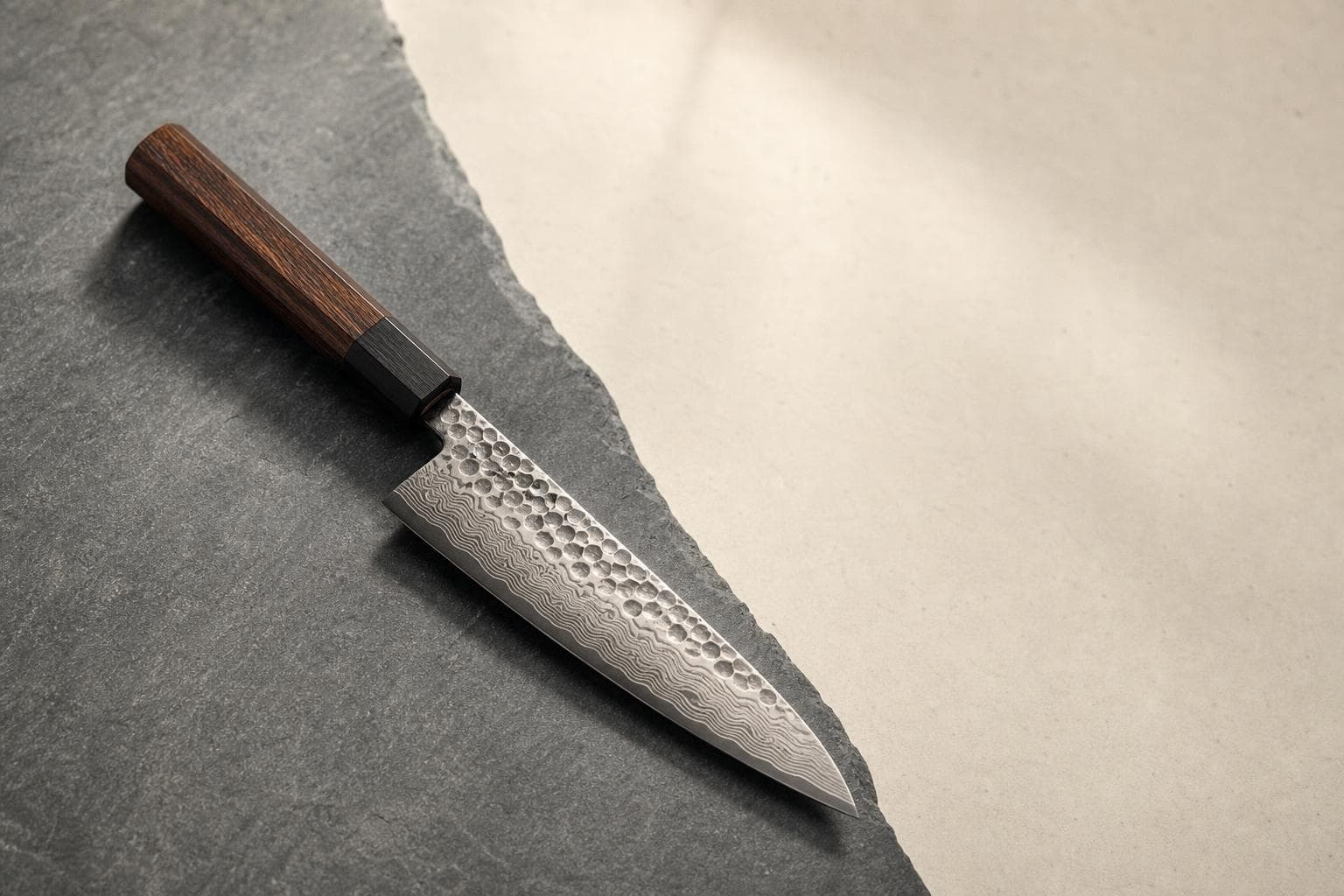
Japanese knives are a different animal. Bon Appétit's testing puts the Kazan Arare by Shibata Gyutou at the top of the category — SG2 high-carbon stainless steel core, ebony handle, hammer-marked blade, 5.9 oz. It's described as "almost unbelievably sharp" out of the box. The Misono UX10 earns the hybrid pick for cooks who want Japanese precision with slightly more forgiving maintenance. These knives reward attention. They sharpen to a finer edge, hold it longer on delicate work, and will chip if you use them on frozen food or treat the edge carelessly.
The Reddit consensus, aggregated by RedRecs, is blunt about this: skip sets, buy individual knives, and learn to sharpen. German steel is described as "BIFL" (buy it for life) and forgiving; Japanese as sharper but demanding. Both camps agree that a $200 knife on a $15 honing rod beats a $400 knife that never gets maintained.
The Damascus Trap
Damascus knives are everywhere right now, and the category is genuinely split between art and theater.
JW Steel Crafts' breakdown makes the distinction clearly: genuine Damascus is forge-welded layers of high-carbon steel, producing both the visual pattern and a harder, more resilient edge. The cosmetic version is a factory-stamped blade with acid-etching applied on top — same Instagram photo, completely different performance. Their read: if a 67-layer Damascus knife costs $28, it's almost certainly etched. The price floor for genuine construction with a quality VG-10 core starts around $80–$100 entry-level, $150+ for reliable name brands.
The Shun Premier 8" sits at $180–$220 and uses a 68-layer VG-MAX core — that's the real thing, and it shows in edge retention. The KYOKU Shogun Series offers 67-layer VG-10 with cryo-treatment under $100, with the trade-off being a less refined handle feel. Both are legitimate. The $28 version on a flash-sale page is not.
Worth noting: the high-end knife segment is growing at 6.5% annually and projected to reach $640 million by 2030, per market analysis cited in that same piece. Buyers are increasingly citing edge retention and longevity — not aesthetics — as the primary purchase driver. The market is maturing past the "pretty knife" phase.
What to Actually Buy
If you want one knife that changes your daily cooking: the Wüsthof Classic 8-inch chef's knife, full stop. Lab-tested, edge-retaining, built to last decades with basic maintenance. Ridiculously expensive for a single knife by normal-person standards. Worth every penny.
If you want to go deeper into Japanese steel: the Misono UX10 gyuto is the hybrid pick for cooks who want precision without the full fragility of a traditional single-bevel blade. The Shun Premier is the showpiece that also performs — the rare knife you'll want on the counter even when you're not cooking.
Either way, budget for a quality honing steel and a whetstone. The knife is the investment. The sharpening habit is what protects it.