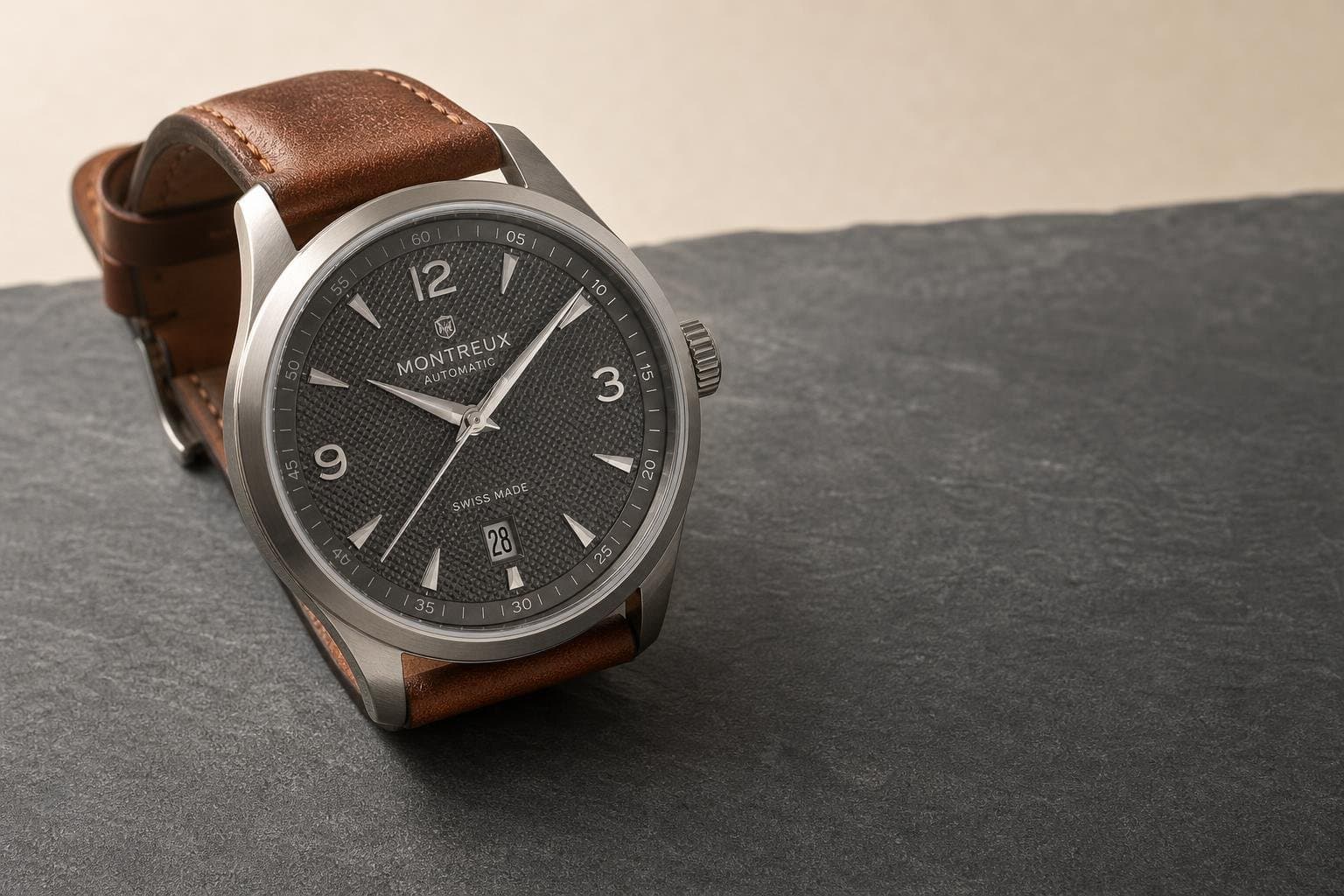

Most people buying their first serious watch make the same mistake: they spend $200 on something that looks expensive and falls apart in 18 months. Fashion watches from brands like MVMT and Daniel Wellington use movements costing $2 to $5, housed in alloy cases that corrode on schedule. The watch world has a name for this trap. It also has a solution.
That solution lives in a specific price band — roughly $500 to $5,000 — where Swiss mechanical movements, genuine case materials, and decades of wearability converge without requiring a second mortgage. The hard part isn't finding watches in this range. It's knowing which ones actually earn their price tags.
The Movement Is the Whole Argument
Every serious conversation about a Swiss watch under $5,000 eventually comes back to what's inside. And right now, the most important movement in that conversation is one most buyers have never heard of.
The Sellita SW200 has become the movement of choice for independent Swiss watch brands that want Swiss Made certification without dependence on the Swatch Group. The backstory matters: when ETA — the Swatch Group's movement subsidiary and longtime supplier to brands from Tudor to Breitling — announced it would phase out deliveries to third-party brands in 2002, it threatened to strand hundreds of independent Swiss watchmakers. Sellita stepped into that gap, engineering a direct replacement for the ETA 2824-2 that has since become the backbone of the Swiss mid-market.
The specs are legitimately impressive for the price range. The SW200-1 runs at 28,800 vph, carries 26 jewels, and delivers a 38-hour power reserve, with a COSC Chronometer-certified version available at -2/+2 seconds per day accuracy. The upgraded SW200-2 Power+ extends that reserve to 48 hours. These are not compromises — they're the same specifications you'd find in watches costing considerably more. When a brand in the €600–1,500 range tells you their watch is Swiss Made, this is almost certainly the movement making that claim true.
The practical implication: if you're evaluating a watch in the $800–$3,000 range and the brand won't tell you what movement powers it, that's a red flag. Brands confident in their movements talk about them.
What's Actually New Worth Considering
The sub-$5,000 Swiss market isn't static. Two recent releases illustrate how established brands are pushing the category forward.
Hodinkee's hands-on review of the Hamilton Khaki Field Mechanical 36mm frames it as the return of a vintage military legend — and that framing is earned. Hamilton has long occupied the credible middle ground of Swiss watchmaking: genuine Swiss movements, military heritage, prices that don't require a conversation with your accountant. The 36mm case size is a deliberate callback to vintage proportions, which is either exactly right for your wrist or a dealbreaker depending on your preference. For buyers who find the current industry obsession with 40mm+ cases exhausting, this is a meaningful option.
On the more characterful end, Gear Patrol covered the Oris Lou Gehrig Edition, a limited release built on the brand's Big Crown Pointer Date platform. Oris is one of the genuinely interesting stories in Swiss watchmaking — an independent brand that has resisted Swatch Group acquisition and continues producing mechanical watches with real personality. The Lou Gehrig Edition's vertically brushed silver dial is inspired by Gehrig's "Iron Horse" nickname, and the watch is loaded with the kind of considered detail that separates a real collector's piece from a marketing exercise. Oris sits comfortably under $5,000 for most references, and the Big Crown platform is a proven, serviceable design.
The Framework That Actually Works
Here's the buying logic I'd apply to this category, distilled:
Start with the movement. Swiss Made with a Sellita SW200 or ETA 2824-based caliber is a floor, not a ceiling. Anything below that standard at a premium price is a marketing story, not a watch.
Case material is non-negotiable. Alloy cases corrode within 6 to 18 months of regular wear. Stainless steel is the minimum for anything you intend to wear daily. Titanium and solid bronze are legitimate upgrades with different tradeoffs.
Independent brands often outperform their price. Oris, Hamilton, and similar brands that sit outside the major conglomerates tend to put more of the purchase price into the watch itself rather than into retail infrastructure and marketing overhead. The Vancouver Timepiece Show, now in its second year, reflects exactly this enthusiasm for independent and enthusiast-driven watchmaking — a growing community that knows where the value actually lives.
Buy for longevity, not novelty. The watches in this price range that hold their value — and more importantly, hold their appeal — are the ones built around proven movements, honest case construction, and designs that don't depend on a trend cycle to look good.
The $500–$5,000 Swiss watch market is genuinely one of the best value propositions in luxury goods right now. You're not buying a status symbol. You're buying a mechanical object that will outlast your phone, your laptop, and probably several jobs. That's worth understanding before you spend the money.


