
A lawsuit filed in California federal court this month said the quiet part out loud: once Paramount+ and HBO Max share an owner, "there is less reason to have each service undercut the other on price or programming value," as the complaint put it, according to The Hollywood Reporter. That's not a conspiracy theory from aggrieved subscribers. It's a pretty accurate description of how bundling works, and Skydance just confirmed the timeline in its first earnings report since closing the $110 billion Warner Bros. Discovery deal.
The numbers themselves, filed with the SEC, are oddly thin — a reporting quirk of a merger that closed mid-quarter. Because the WBD acquisition didn't finalize until October 6, the Q3 results only capture the legacy Paramount business: $7.03 billion in revenue, up 5% year-over-year, and net earnings of $73 million, a swing from a loss a year earlier, per Variety. None of Warner's numbers are in there yet. What's in the letter instead is strategy — and the strategy is the real story.
The Bundle Isn't a Value Play, It's a Merger Milestone
Skydance confirmed it will launch a combined Paramount+/HBO Max bundle in early 2027, with co-CEO David Ellison telling analysts the company aims to fully combine the two services within roughly a year, according to Bloomberg. The shareholder letter framed it as delivering "even greater value" for consumers. Maybe. But Ellison himself undercut the consumer-value framing after the deal closed last month, saying plainly that "long-term, the plan is basically to bring them together," per The Hollywood Reporter.
Two services that used to compete for the same subscriber dollar are being walked, deliberately, toward a single checkout page. Disney took a similar path with Hulu — two brands, increasingly shared infrastructure — and nobody called that a lawsuit-worthy conspiracy. The difference here is that the plaintiffs got their complaint refiled in the same news cycle as the earnings call, which means Skydance is now defending its pricing roadmap in court filings and investor letters simultaneously. That's an uncomfortable position for a company that just spent $110 billion betting its two streaming services would be worth more together than apart.
The Synergy Math Is Bigger Than the Business It's Replacing
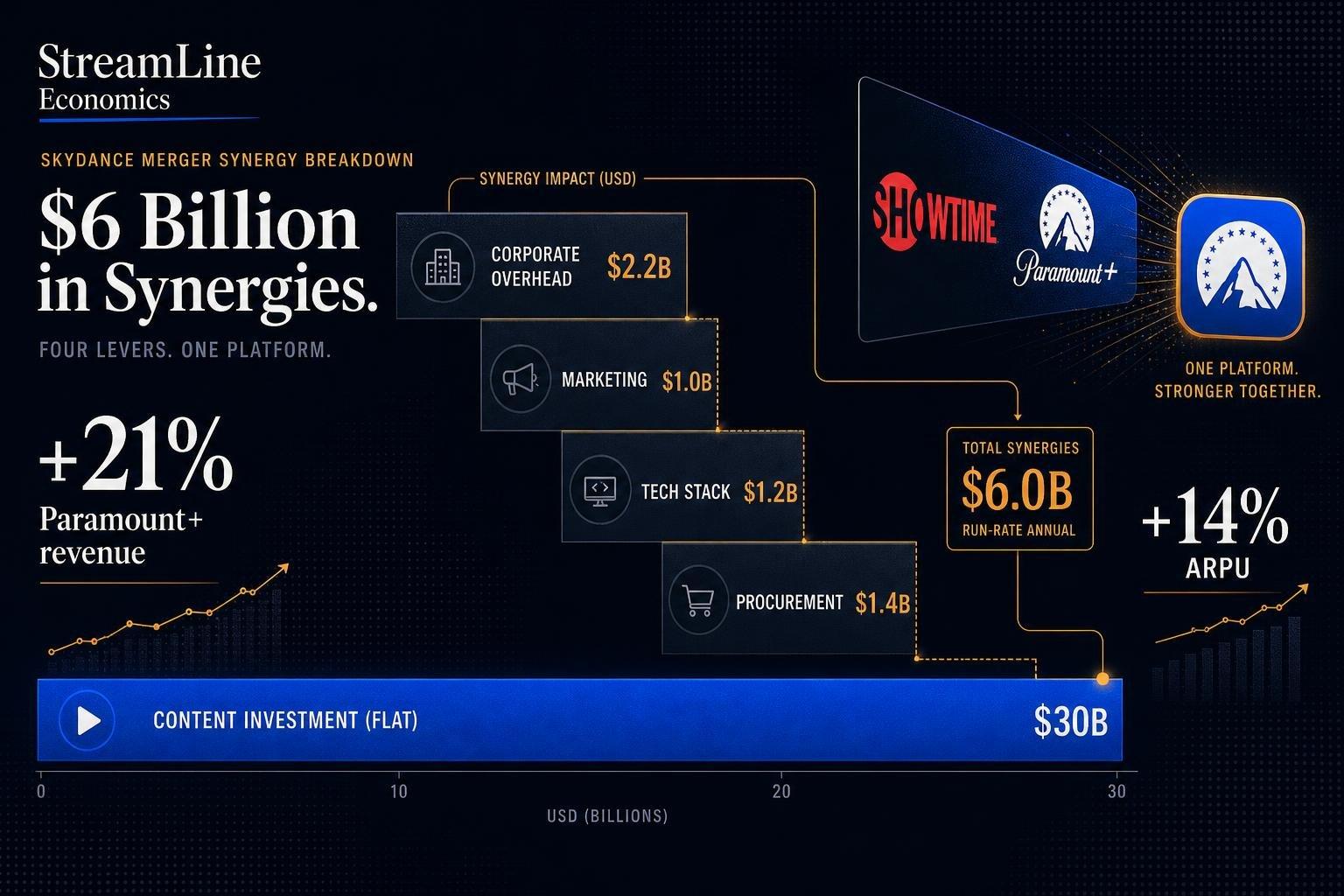
The cost-cutting detail is where this earnings report earns its keep. Skydance says it's targeting at least $6 billion in annualized run-rate synergies within three years, carved out of a combined expense base north of $50 billion, according to The Hollywood Reporter. The breakdown: $2.2 billion from corporate overhead and real estate, $1 billion from marketing (leaning on its own platforms instead of paid promotion), $1.2 billion from unifying tech stacks, and $1.4 billion from procurement. Content spending, notably, stays roughly flat at $30 billion a year — the one line item Skydance isn't trying to shrink, because content is the thing subscribers actually pay for.
Buried in the same letter is a more revealing admission: Paramount's film slate is "expected to double its output in 2026 with 15 releases" and is performing well, while "we expect the Warner Bros. film slate in Q4 to underperform," per Variety. That's the acquiring company publicly grading its new acquisition below its existing business, one month after closing. Paramount+ revenue grew 21% year-over-year — its fastest quarterly pace this year — with ARPU up roughly 14%, a genuinely strong number on its own. But it's strong in isolation; it says nothing yet about whether folding Warner's assets in makes the combined company healthier or just bigger.
What Happens Before the Bundle Lands
Watch two dates. Skydance has promised an investor day in the first half of 2027 to lay out the combined company's real numbers, and the bundle itself is supposed to launch early that same year, per The Hollywood Reporter. Between now and then, the lawsuit will keep testing whether "value bundle" is legally distinguishable from "price coordination between two services under one roof." Separately, Variety's reporting on whether Netflix eyes an NBCUniversal acquisition suggests the Skydance deal didn't settle the industry's consolidation question so much as restart the clock on who moves next. The merger math always promised savings before it promised quality. This earnings letter is the first one where Skydance had to say that part on the record.


