


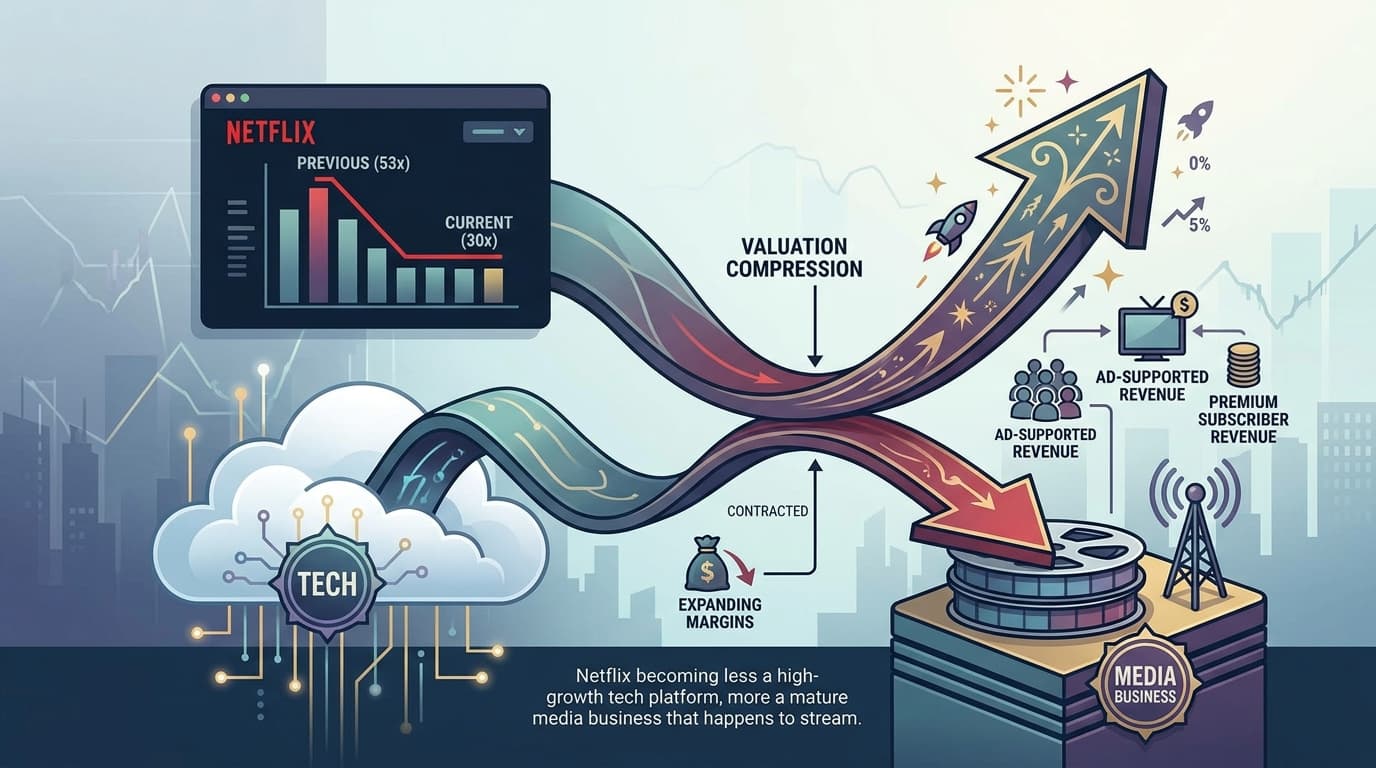

The stock price got the attention. The multiple tells the actual story.
Netflix's forward price-to-earnings ratio sat at 53.7 at the end of June 2025, according to Motley Fool analysis. It's now trading around 30. That's not a minor recalibration — it's the market quietly revising its thesis on what Netflix actually is: less a high-growth tech platform, more a mature media business that happens to stream.
The compression matters because valuation multiples encode expectations. At 53x forward earnings, investors were pricing in sustained subscriber acceleration, expanding margins, and continued pricing power. At 30x, they're pricing in something closer to a cable company with better software — reliable, profitable, but not compounding at the rate that justified the premium.
I'd argue this is the honest reckoning the industry needed. Netflix earns roughly $11.64 per subscriber per month — a solid number, but one that faces real ceiling pressure as the ad-supported tier grows. Ad-supported subscribers generate revenue differently than premium subscribers: the platform captures advertiser spend rather than direct consumer payment, which shifts Netflix's business model incrementally toward the same audience-monetization logic that cable networks spent decades optimizing. That's not necessarily bad. But it's not the "we disrupted TV forever" narrative that justified a 53x multiple.
The competitive context adds pressure. Disney's streaming bundle crossed 221 million total subscriptions against Netflix's 220 million as of mid-2022 — a data point that's now several years old, but established that Netflix's subscriber dominance was never as durable as the growth story implied. The race is closer than the cultural conversation around Netflix suggests.
Watch for Netflix's next earnings call to see whether management addresses the multiple compression directly or pivots to operating income framing — a shift toward profitability metrics over growth metrics would confirm that the company is managing investor expectations toward the mature-business model the valuation already implies.