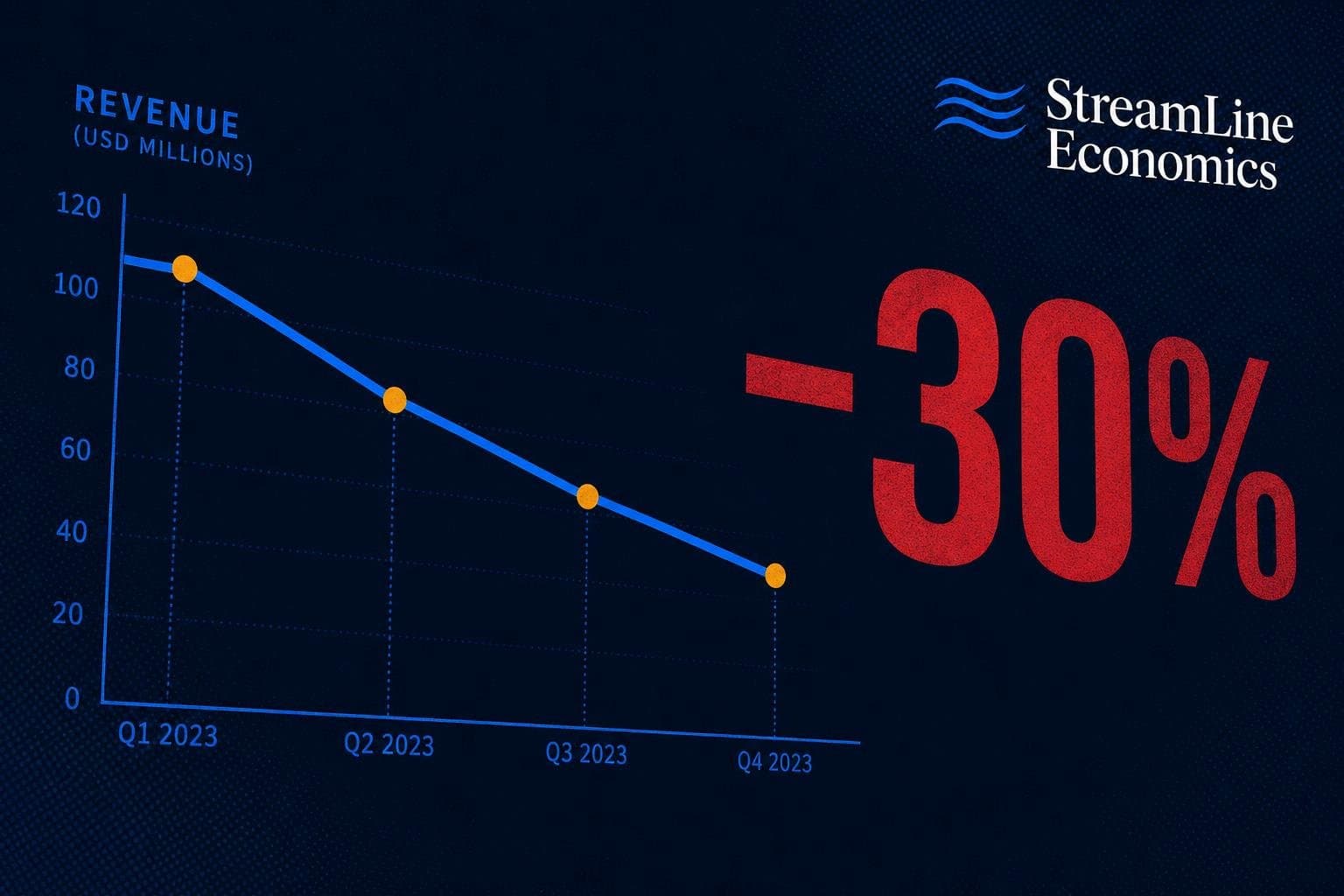

Here's the number that should worry Netflix shareholders more than any other from this week: four. That's how many consecutive quarters the company's sales growth has now decelerated, according to Bloomberg. Not one bad quarter. A trend.
Netflix beat Wall Street's Q3 estimates on paper — revenue of $12.87 billion, up 11.8% year-over-year, and earnings per share of 87 cents against a forecast of 82 cents, per Hollywood Reporter. But the stock didn't care. Shares fell nearly 6% to $64.66 in after-hours trading, according to Reuters, and by Wednesday premarket, Variety reported shares under $64, a two-year low and a decline of nearly 30% year-to-date. When I wrote last week about Netflix firing its content chief while still turning a profit, that was the tell. This is the confirmation: the market no longer rewards Netflix for beating a lowered bar.
The Growth Deceleration Is the Real Headline
Netflix's own numbers tell the story plainly. A year ago, quarterly revenue growth ran near 17%. Now it's 11.8%, and the company is guiding to 11.5% for Q4 — below what Wall Street had modeled, according to Variety. Layer on top of that a cut to the full-year advertising forecast, down to roughly $2.7 billion from the previously guided $3 billion, which Netflix attributed to a slower-than-expected rollout of ad product capabilities, per Hollywood Reporter.
That ad shortfall matters more than its dollar size suggests. Advertising was supposed to be Netflix's next profit lever — the thing that lets it monetize price-sensitive subscribers without raising the core subscription price indefinitely. A $300 million miss on a business that's still ramping is a signal the infrastructure isn't maturing as fast as the pitch deck promised.
Executives Are Betting the Fix Is More of the Same
What's notable isn't just that growth slowed — it's what Netflix says it's going to do about it. Co-CEO Ted Sarandos told investors the plan is to double down on "core business" content, framing last week's leadership shakeup — the ouster of content chief Bela Bajaria in favor of Peter Rice — as a step toward sharper execution rather than strategic reinvention, per Reuters. "I know that we could do better," Sarandos said on the call, according to both Reuters and Variety.
That's a bet that the answer to slowing growth is a better slate of premium TV and film — not a structural pivot into the format that's actually taking viewing share. Analysts aren't buying it uniformly. New Street Research's Dan Salmon wrote that the Street "should remain skeptical of a long-term strategy that simply sees NFLX double down on its legacy core strength" while staying "largely absent from the fastest areas of video entertainment growth," namely mobile and short-form, according to his note cited by Variety. PP Foresight's Paolo Pescatore offered a milder version of the same critique, telling Reuters that Netflix is "a well-oiled, highly profitable machine, but focused on too many unwanted distractions," and needs to "get back to basics."
Those two analysts are essentially arguing opposite diagnoses, which tells you something about how unsettled the read on Netflix actually is right now. One camp says Netflix is spreading itself too thin outside its lane; the other says it's dangerously narrow and ceding the fastest-growing part of the attention economy to YouTube and TikTok. Netflix, for its part, is choosing to interpret the shakeup as validation of the narrower bet — fewer distractions, sharper content, trust the flywheel.
What This Means Going Forward
The 1,000 layoffs and the executive overhaul weren't really about this quarter's numbers — they landed before the earnings call did. What this week's report confirms is that the underlying pressure is real and ongoing, not a one-quarter blip Netflix can explain away with engagement caveats about "quantity, quality and variety of viewing," language the company used in its shareholder letter, per Hollywood Reporter.
Watch Q4 results for two things: whether the ad business stabilizes closer to that revised $2.7 billion target, and whether Peter Rice's first slate decisions show up in subscriber engagement data by spring. If growth keeps decelerating under new content leadership, the "we could do better" line stops sounding like confidence and starts sounding like an excuse that's already run out of road.


