
Netflix beat earnings by a penny last week. Then its stock fell nearly 9%.
That gap — between a technical beat and a market that still punished the company — tells you something important about where Netflix actually stands. The Q2 numbers look fine in isolation: revenue of $12.56 billion, earnings of 80 cents per share, a narrow beat on the bottom line. But Wall Street wasn't grading on a curve. It was looking at the trajectory, and the trajectory is decelerating.
The Growth Curve Is Bending the Wrong Way
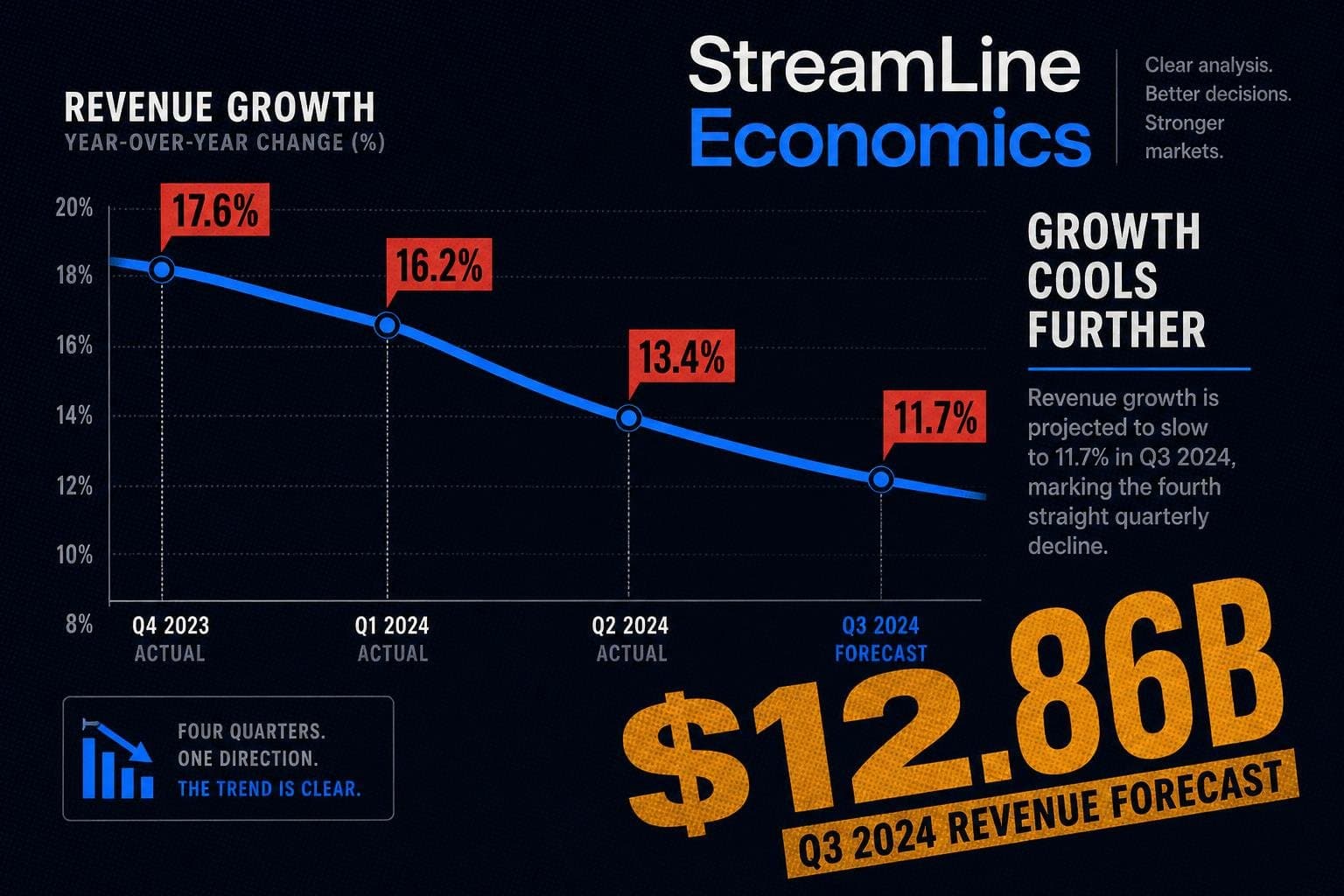
The SEC filing tells the story cleanly. Netflix's year-over-year revenue growth ran at 15.9% in Q2 2025, climbed to 17.6% by Q4 2025, then dropped to 16.2% in Q1 2026 and 13.4% in Q2 2026. The Q3 forecast — $12.86 billion in revenue, implying roughly 11.7% growth — extends that deceleration. Analysts had expected $13 billion; Reuters reported the miss sent shares down close to 8.6% in after-hours trading.
This is not a crisis quarter. Operating margin held at 33.4% in Q2, and the Q3 forecast projects 33.2% — a company that has genuinely cracked the profitability problem. But Netflix has been selling investors on a growth story, and growth stories don't get credit for holding margins steady. They get punished for slowing down.
Bloomberg noted that Netflix stock has declined more than 40% over the last year, compounded by investor anxiety following the company's failed pursuit of Warner Bros. Discovery. The earnings report didn't reverse that anxiety — it added to it.
The Transparency Retreat Arrives at a Suspicious Moment
Here's where the business logic gets interesting. Netflix announced this week that it's discontinuing its biannual "What We Watched" viewership reports, shifting to annual releases starting in 2027. The final semi-annual report, covering January through June 2026, dropped alongside the earnings results.
The timing is hard to read as coincidental. The decision comes directly after Bloomberg reported that Netflix originals see a sharp viewership decline in their second seasons — a story Netflix executives pushed back on during the earnings call. Co-CEO Ted Sarandos argued that second-season fall-off is "actually slightly improved this year relative to last year." Maybe. But if that's true, less frequent data releases make the argument harder to verify, not easier.
Netflix also acknowledged in its shareholder letter that engagement metrics need reframing. Deadline reported the letter stated: "We know not all hours are equal. Time spent is just one aspect of strong engagement — quality and variety also matter." That's a reasonable point about content value. It's also a convenient pivot away from raw viewing-hours comparisons at a moment when subscribers watched 97 billion hours in the first half of 2026, up just 2% over the same period in 2025.
Reducing data frequency while simultaneously arguing that the data tells the wrong story is a move worth watching. When companies get more opaque about metrics, it's worth asking who benefits from that opacity.
The Ad Business Has to Carry More Weight Now
Netflix's path forward runs through advertising. The company still expects to double its 2025 ad revenue levels, targeting $3 billion for the full year. That's a meaningful number — but it's also arriving into a market where ad buyers are pushing back hard on streaming inventory pricing.
The broader upfront market context matters here. Variety reported that Amazon closed its upfront negotiations with growth in volume, but media buyers described the overall market as tepid and pressed for significant rate rollbacks on streaming inventory. The core complaint: streaming supply is enormous, audiences are diffuse, and buyers don't see the scarcity that justifies premium pricing.
Netflix is simultaneously trying to grow ad revenue and maintain ad pricing — two goals that get harder to pursue together as the platform adds more ad-tier subscribers and more inventory. Co-CEO Greg Peters also addressed the question of a free, ad-supported tier, saying Netflix has "no near-term plans" to launch a FAST offering but isn't ruling it out. That's a hedge worth noting: Tubi captured 2.3% of all U.S. TV viewing in April, and Fox recently announced plans to acquire Roku, which captured 3% that same month. Free streaming is getting serious competition investment, and Netflix is watching from the sidelines for now.
What to Watch in Q3
The Q3 forecast — $12.86 billion in revenue and 82 cents diluted EPS — is the number Netflix now has to hit after a quarter that already disappointed. Missing again would accelerate the narrative that the company has structurally shifted from a growth stock to a mature media business. The ad revenue trajectory toward that $3 billion annual target will be the cleaner signal: if Netflix can demonstrate that advertising is genuinely scaling, it has a credible answer to slowing subscriber-driven growth. If ad revenue disappoints alongside another soft revenue quarter, the "we're building the next phase" argument gets much harder to sustain.
The margins are real. The growth deceleration is also real. Right now, investors are paying more attention to the second fact than the first.


