
For years, Netflix treated box office reporting the way most companies treat their tax returns: something to be avoided, minimized, and disclosed only when legally necessary. That posture is changing — and the reason has almost nothing to do with artistic credibility.
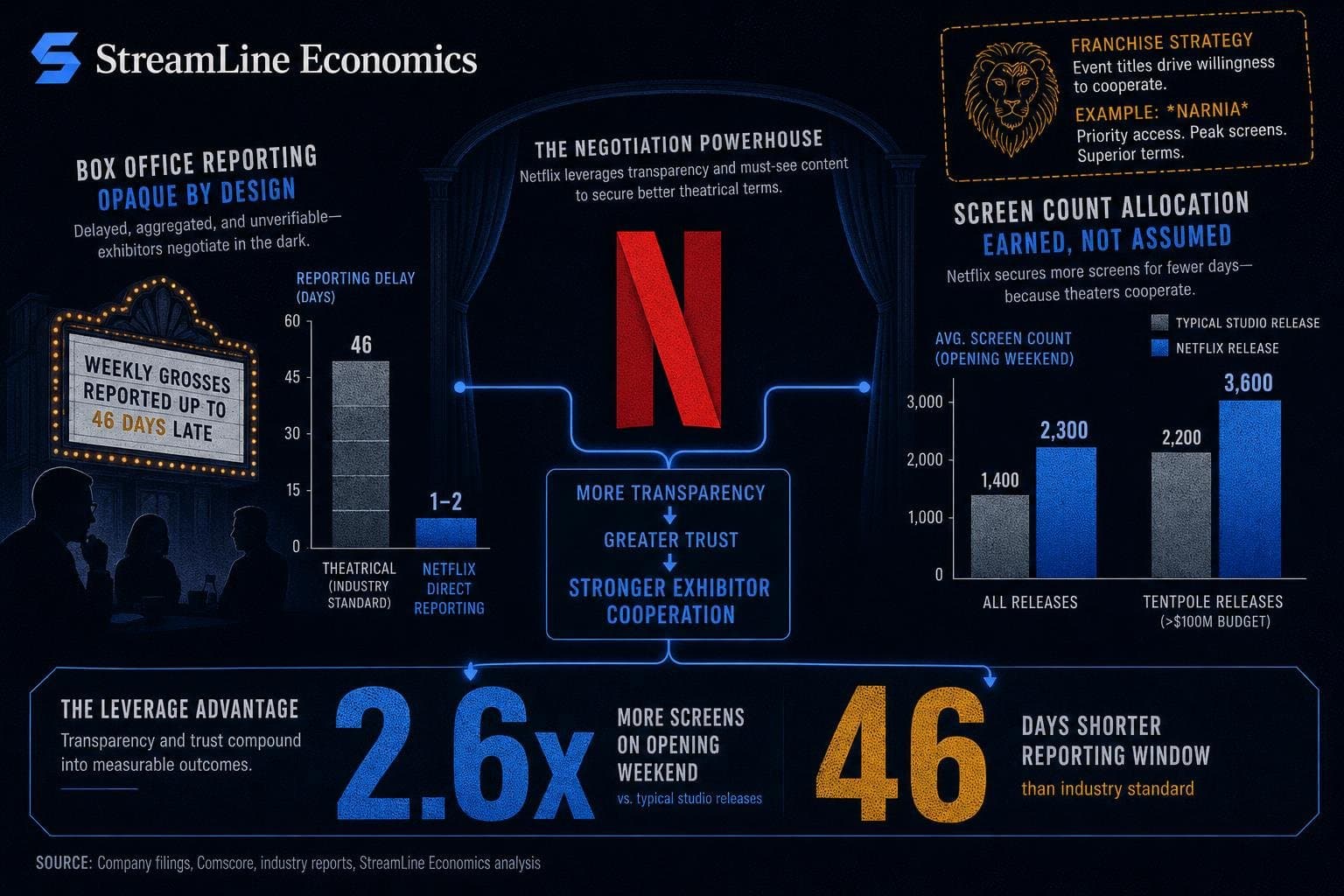
Deadline reported this week that Netflix will begin publicly reporting grosses for six upcoming theatrical releases: La Bola Negra, The Further Mis-Adventures of Cliff Booth, Peter Berg's Mosquito Bowl, Danny Boyle's Ink, Greta Gerwig's Narnia: The Magician's Nephew, and Charlie and the Chocolate Factory. The shift, per Deadline, comes specifically because Netflix has two wide releases next year in Narnia and Charlie and the Chocolate Factory — titles that will need major exhibitor cooperation to succeed. The logic is straightforward: if you want AMC to give you 4,000 screens, you probably shouldn't be the company that refuses to tell AMC how the last movie performed.
This is a negotiating posture, not a philosophical conversion.
The Transparency That Serves Netflix's Interests
Netflix's historical opacity on box office was never about protecting creative integrity. It was about protecting the subscriber narrative. When a theatrical release underperformed, silence was cheaper than disclosure. When it overperformed, Netflix could selectively tout internal metrics — "hours viewed," "households reached" — that no one could cross-reference against industry standards.
The company has played this game for years. Deadline notes that Netflix never officially reported what its August 2025 hit K-Pop Demon Hunters Singalong grossed, even after it hit No. 1 at the weekend box office. Industry estimates put its two-day haul at $19 million — a number Netflix let float without confirmation. That's not modesty; that's information control.
What changed is the scale of the upcoming slate. Narnia and Charlie and the Chocolate Factory are the kind of franchise bets that require genuine theatrical infrastructure — not the four-walling arrangements with smaller exhibitors that Netflix has historically used to technically qualify films for awards. Wide releases at that level require AMC, Regal, and Cinemark to be willing partners, and those chains have spent years frustrated by Netflix's refusal to commit to exclusive theatrical windows or share meaningful data.
The 46-day theatrical window Netflix is offering for La Bola Negra — theaters October 16, streaming December 2, per Deadline — represents a meaningful concession from a company that once fought publicly with AMC over The Irishman's window. Netflix is buying goodwill now because it needs it for the bigger titles coming.
What the Box Office Actually Tells You About Streaming Strategy
The conventional read on Netflix going theatrical is that the company is chasing prestige. The financial read is different: theatrical releases are subscriber acquisition tools with a box office revenue line attached.
A film like Narnia, directed by Greta Gerwig off the cultural momentum of Barbie, generates press coverage, social conversation, and brand awareness that no amount of algorithm-driven recommendation can replicate. The theatrical run is essentially a months-long marketing campaign that also happens to sell tickets. If the film grosses $200 million worldwide in theaters, that's real money — but the more valuable output is the number of people who then sign up for Netflix to watch it at home.
This is why the 46-day window matters more than it might appear. It's long enough to extract meaningful box office revenue and generate sustained cultural conversation, but short enough that the streaming payoff follows while audience interest is still warm. Netflix isn't becoming a studio in the traditional sense; it's optimizing the theatrical window as a subscriber funnel with better economics than a pure marketing spend.
The broader content market context reinforces this. At the Unifrance Rendez-Vous market in Le Havre this week, Variety reported that Wild Bunch's head of TV attributed declining international content acquisitions partly to streaming platforms "struggling to reach their subscriber targets." The peak-TV buying spree is over. Platforms are being more selective, which means the titles they do commit to need to work harder — theatrically, culturally, and as subscriber drivers.
The Exhibitor Relationship Is the Real Asset Being Built
Meanwhile, this weekend's box office offers an instructive parallel. Practical Magic 2 opened to roughly $30 million across 4,146 North American screens, ending Spider-Man: Brand New Day's six-week run at No. 1. Warner Bros. got those screens because it has decades of exhibitor relationships built on consistent data sharing and negotiated windows. Netflix is trying to buy its way into that same infrastructure — not with decades of goodwill, but with the promise of franchise-scale titles that exhibitors can't afford to refuse.
The transparency play is ultimately about access. Report the grosses, honor the windows, and the major chains will give you the screen counts you need for Narnia to open like a real blockbuster rather than a glorified limited release.
Watch for how AMC and Regal respond to the La Bola Negra October window — that exhibitor reaction will signal whether Netflix's goodwill campaign is working before the bigger franchise bets arrive.


