


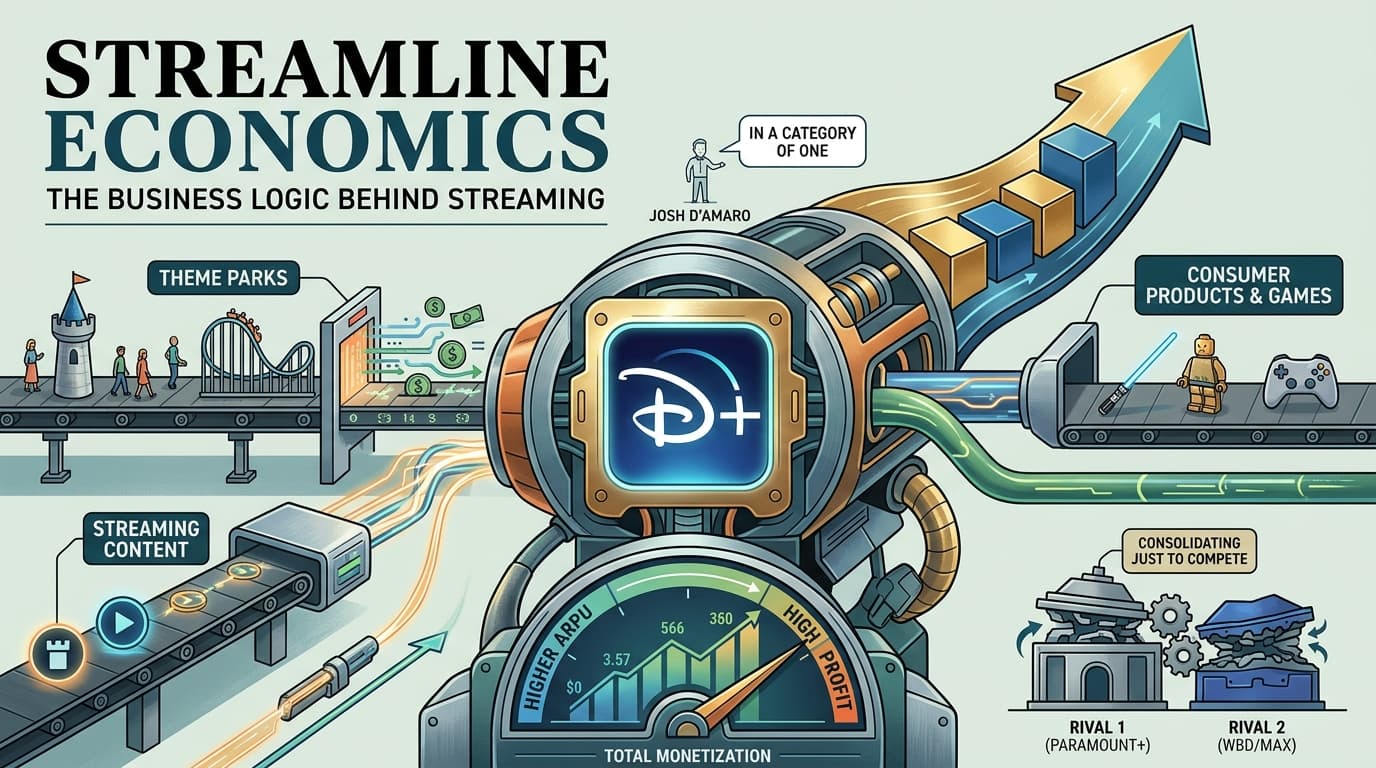

New Disney CEO Josh D'Amaro used his first shareholder address to reframe Disney+ — not as a streaming service competing with Netflix, but as the commercial spine of the entire company.
At Disney's annual meeting Wednesday, D'Amaro declared that Disney+ would become the "digital centerpiece" of the company, explicitly connecting the app to theme park experiences and games. That's a meaningful strategic signal. It suggests Disney's streaming ambitions aren't primarily about subscriber headcount — they're about building a platform that monetizes the same customer across multiple revenue lines simultaneously.
The business logic is straightforward. A subscriber who books a park reservation through Disney+, buys a game, and streams a show generates far more revenue per user than one who only pays the monthly fee. D'Amaro told shareholders that Disney is "in a category of one" — a pointed contrast to rivals he described as "consolidating just to compete." That's a direct shot at the Paramount-Warner Bros. Discovery merger currently in progress, and it's also a statement about Disney's preferred competitive strategy: depth of monetization over breadth of content volume.
This matters for how you read Disney's content decisions going forward. If Disney+ is a customer acquisition and retention tool for a broader ecosystem — not just an entertainment product — then cancellations, renewals, and programming choices will increasingly be evaluated against their ability to drive cross-platform engagement, not just streaming watch time. A show that fills park attendance or sells merchandise carries different internal economics than one that simply holds subscribers.
The timing of this repositioning is notable. D'Amaro comes from running Disney Experiences, the parks-and-resorts division. His instinct is to treat IP as a platform asset, not a content asset. That's a different orientation than his predecessor Bob Iger, who spent his final years focused on streaming as the primary growth vehicle. The shift in emphasis — from streaming-first to ecosystem-first — could reshape how Disney allocates its content budget over the next several years.
Meanwhile, the broader studio picture offers useful context. Warner Bros. and Sony posted profit growth in 2025 while other legacy studio divisions declined — a reminder that content profitability remains uneven across the industry even as the global box office recovered to $33.6 billion last year. Disney topped the global box office, but domestic revenue only edged up 1 percent to $8.7 billion, still well below pre-pandemic levels. The pressure to find revenue beyond the theater and beyond the monthly subscription fee is real.
Watch for how Dana Walden, Disney's newly named President and Chief Creative Officer, operationalizes D'Amaro's platform vision. Her mandate spans film, TV, streaming, and games — the full stack that D'Amaro wants Disney+ to connect. The first concrete test will be whether programming decisions start visibly reflecting cross-platform economics, or whether the "digital centerpiece" framing stays at the level of shareholder-meeting rhetoric.