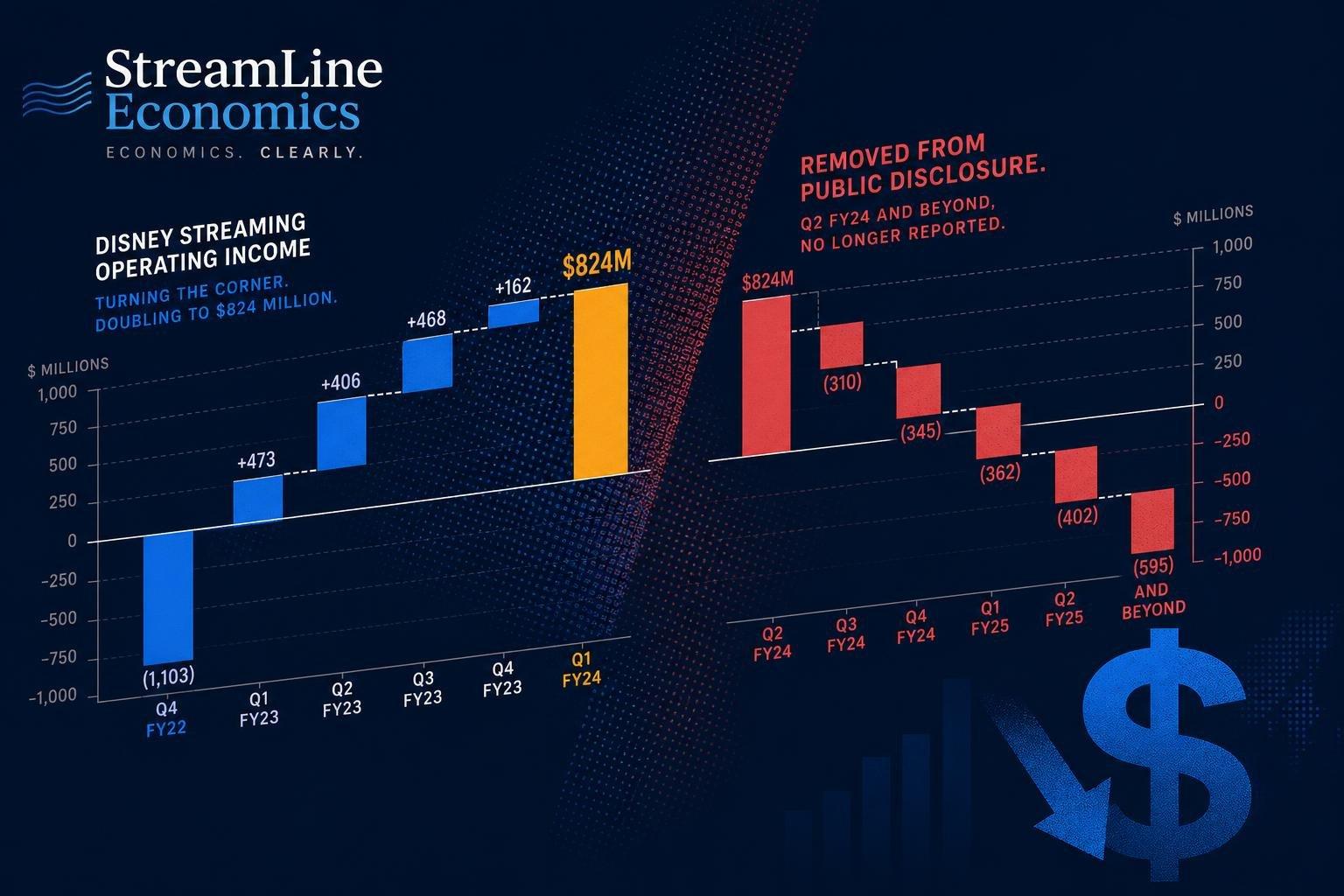

Walt Disney's streaming operating income doubled to $824 million last quarter. That's not a modest beat — it's the kind of number a company usually puts in bold on an investor slide and repeats three times on the earnings call. Instead, Disney used the moment to announce it will stop disclosing that figure going forward, according to Reuters.
Think about the timing. Subscription video revenue jumped 19% to $6.1 billion. Disney+ and Hulu combined revenue rose 22% to $5.13 billion, with operating income more than doubling, per Variety's breakdown of the quarter. You don't retire a scoreboard the week you're winning unless you've decided winning this particular way is no longer the point — or unless you'd rather nobody check your math once the spending ramps back up.
The Spending Is Going Up Right As the Transparency Goes Down
Here's the part that should make subscribers pay attention: Disney said cash content spending will rise 9% next fiscal year, to roughly $26 billion, with more money going into international programming and sports rights, Reuters reported. CFO Hugh Johnston framed the disclosure change as giving the team "greater flexibility to manage the cost base of the entire portfolio and invest appropriately" — which is executive-speak for: don't ask us to justify individual line items against a clean profit number anymore, per Reuters.
That's a real tradeoff for investors and subscribers alike. SVOD operating income was the one figure that let you check whether a $26 billion content budget was actually buying profitable growth or just buying engagement. Strip it out, and Disney gets to talk about Marvel catalog viewership — which Bloomberg reported more than doubled on Disney+ as fans caught up on Spider-Man and Avengers titles tied to this year's theatrical releases — without anyone tying that engagement back to a margin line. Engagement is a vibe. Operating income is a receipt. Disney just took the receipt away while the spending commitment grew.
New CEO Josh D'Amaro, eight months into the job, is also promising $3 billion in annual run-rate operating expense savings by fiscal 2029, achieved partly through layoffs already underway, Variety noted. So the pitch to Wall Street is: trust us to cut costs over here while we spend more over there, and don't worry about checking our work on the metric that used to tell you whether it was working.
Disney Isn't Alone — This Is Becoming the Industry's Default Posture
I'd argue this fits a broader pattern I flagged back in August, when Disney stopped reporting subscriber counts right after streaming profit doubled. Opacity is becoming the house style once a platform crosses into real profitability — not because the business is weak, but because clean numbers invite scrutiny that executives would rather avoid during a heavy reinvestment phase.
Skydance, the newly combined Paramount-Warner Bros. Discovery entity, is doing something structurally similar in its first shareholder letter as a public filer. Rather than lead with a unified streaming operating margin, the letter leans on self-defined rankings — "second largest media distributor by share of total U.S. TV time" and producer of "7 of the top 10 most watched series," sourced to Nielsen data the company itself frames, according to the SEC filing. Those are real numbers, but they're reach metrics, not profit metrics. Skydance does disclose that combined DTC pro forma revenue grew 15% and that it's targeting a 3.0x leverage ratio by 2029, which is more candor than Disney offered this week — but it's still an $80 billion debt load being managed through audience-share bragging rights rather than a clean streaming margin number, per the filing.
Even the combination of Warner Bros. Television and Paramount Television Studios into a single mega-studio, announced to run more than 100 productions under unified leadership, the Hollywood Reporter noted, gets framed in creative language — "a formidable creative engine" — rather than cost-synergy language, even though combining studios is fundamentally a cost play.
What to Watch
Disney completes the Disney+ and Hulu platform merger into a single app before the end of December, per the company's own guidance in Variety's report. That's the moment analysts will have the least visibility and the most reason to ask hard questions on the next call — whether Disney restores some version of streaming profit disclosure once the metric gets messier to track across a combined service. Watch also whether Skydance's Q4 letter, due early next year, starts showing a combined DTC operating margin instead of pro forma revenue growth alone. If it doesn't, that's two of the industry's biggest players independently deciding the same thing: streaming profit is good enough to spend more on, but not good enough to keep showing you clearly.