


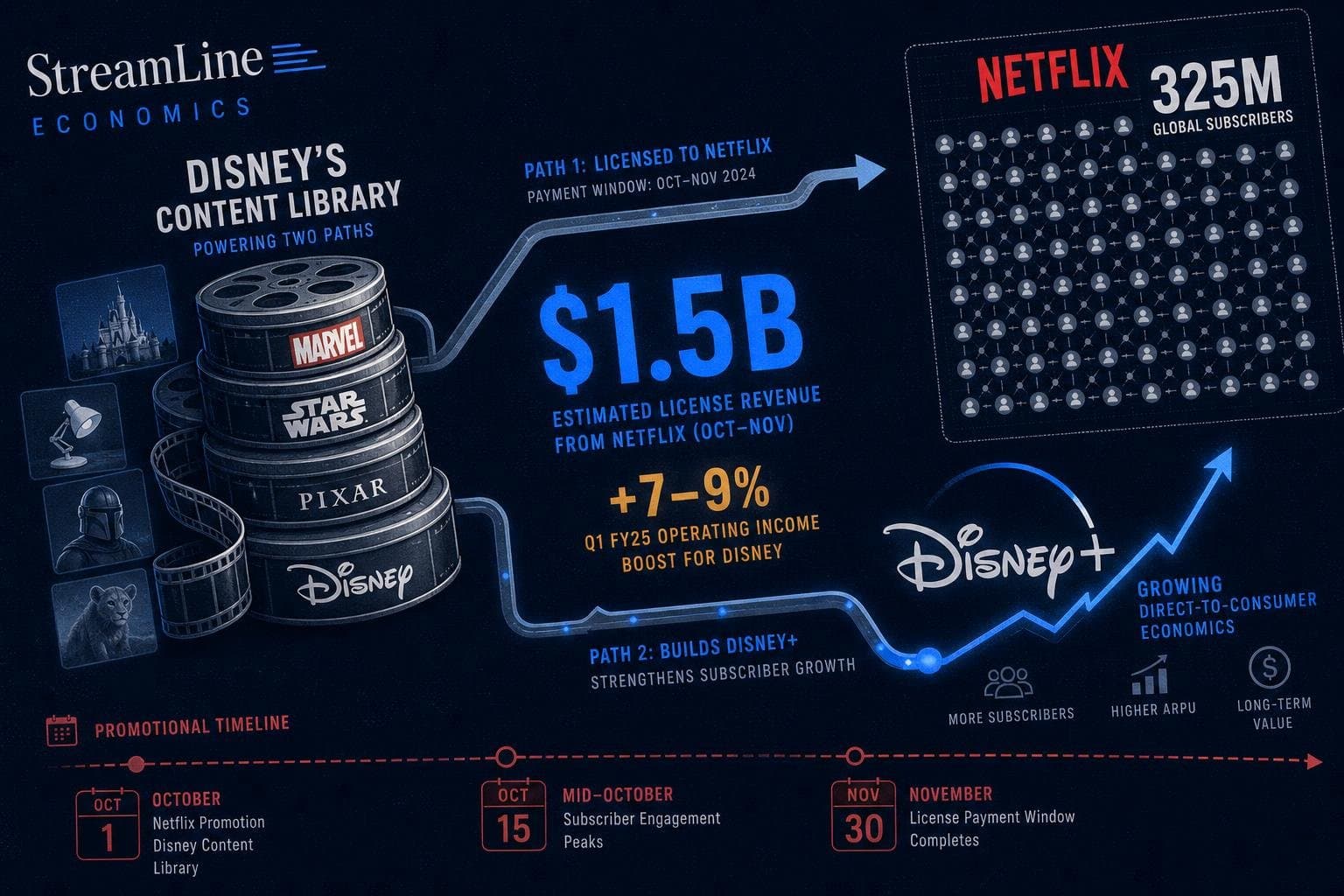

Here's a sentence that would have sounded insane five years ago: Disney just handed Netflix five "Ice Age" movies, two seasons of "Percy Jackson and the Olympians," and a chunk of its Pixar library — and Netflix didn't have to buy exclusivity to get any of it. Disney wanted this deal as much as Netflix did, because Disney isn't selling content anymore. It's renting attention.
The Deal Nobody Needed to Explain as Charity
The agreement, reported by Reuters and detailed further by Variety, sends a slate of Disney titles to Netflix on a nonexclusive, time-limited basis. The structure tells you everything about the logic. "Percy Jackson and the Olympians" seasons one and two land on Netflix starting October 4 for a three-month window — timed directly to build buzz before season three premieres on Disney+ on November 20, per Variety's reporting. All five "Ice Age" films get the same treatment, streaming on Netflix starting October 4 ahead of "Ice Age: Boiling Point" hitting theaters in February 2027. Disney-branded Pixar and animation titles like "Soul," "Elio," and "Raya and the Last Dragon" follow in early 2027.
Variety's framing cuts through the spin: Disney sees Netflix's base of more than 325 million subscribers as a billboard it can rent, and Netflix is "happy to write the checks." That's not a truce between rivals. It's Disney recognizing that its own platform can't generate the same promotional reach, and that renting Netflix's scale for ninety days is cheaper than trying to match it. Disney-branded flagship titles stay exclusive to its own channels — this is strictly a library-and-promotion play, not a surrender on core IP.
Sarandos Just Admitted Why Netflix Needs Deals Like This
The timing matters. Days before the Disney licensing deal became public, Netflix co-CEO Ted Sarandos told the Bloomberg Screentime conference that the company is "not growing as fast as I want us to," according to Bloomberg. He added that Netflix is "also doing things that create a lot of headwind to that number" — language that reads like an executive bracing investors for a number he already knows disappoints.
Put those two stories next to each other and the picture sharpens. A platform with 325 million-plus subscribers shouldn't need Disney's "Ice Age" reruns to move the needle on growth. But growth at Netflix's size increasingly comes from engagement and retention rather than net-new signups, and licensed library content is cheap, proven engagement. Disney pays Netflix for promotional reach; Netflix gets low-cost hours of watch time from titles it didn't have to produce. Both companies are solving different problems with the same transaction, which is usually the sign of a deal that actually makes sense rather than one that got oversold in a press release.
The Bigger Story Is That Scale Is Now a Rentable Asset
This week's other headline — Paramount Skydance closing $52 billion in debt financing to fund its takeover of Warner Bros. Discovery, as Bloomberg reported — looks unrelated on the surface. It isn't. Both stories are about the same underlying shift: the era of pure platform exclusivity as a subscriber-acquisition strategy is giving way to an era where content gets monetized wherever the audience already is. David Ellison's newly renamed Skydance Corp. is absorbing two studios' worth of library and streaming assets specifically because, as S&P Global's Jawad Hussain told Variety, the priority now is "to get the leverage down" — meaning turning library content into revenue as fast as possible, by whatever channel pays, matters more than guarding it behind a single paywall.
Deadline's running tally of 2026 cancellations and renewals, tracked here, reinforces the same pattern from another angle: platforms are trimming originals that don't pay for themselves while keeping proven library titles in rotation across multiple outlets. The content budget conversation isn't about making more. It's about making the content you already paid for work harder, on more screens, for more buyers.
Watch what happens after the Skydance-Warner deal closes on October 6, and whether "Percy Jackson" season three's Disney+ premiere on November 20 actually shows a measurable bump from its Netflix promotional window. If it does, expect every major studio to start treating its library the way Disney just treated this one — not as a moat, but as inventory for rent.