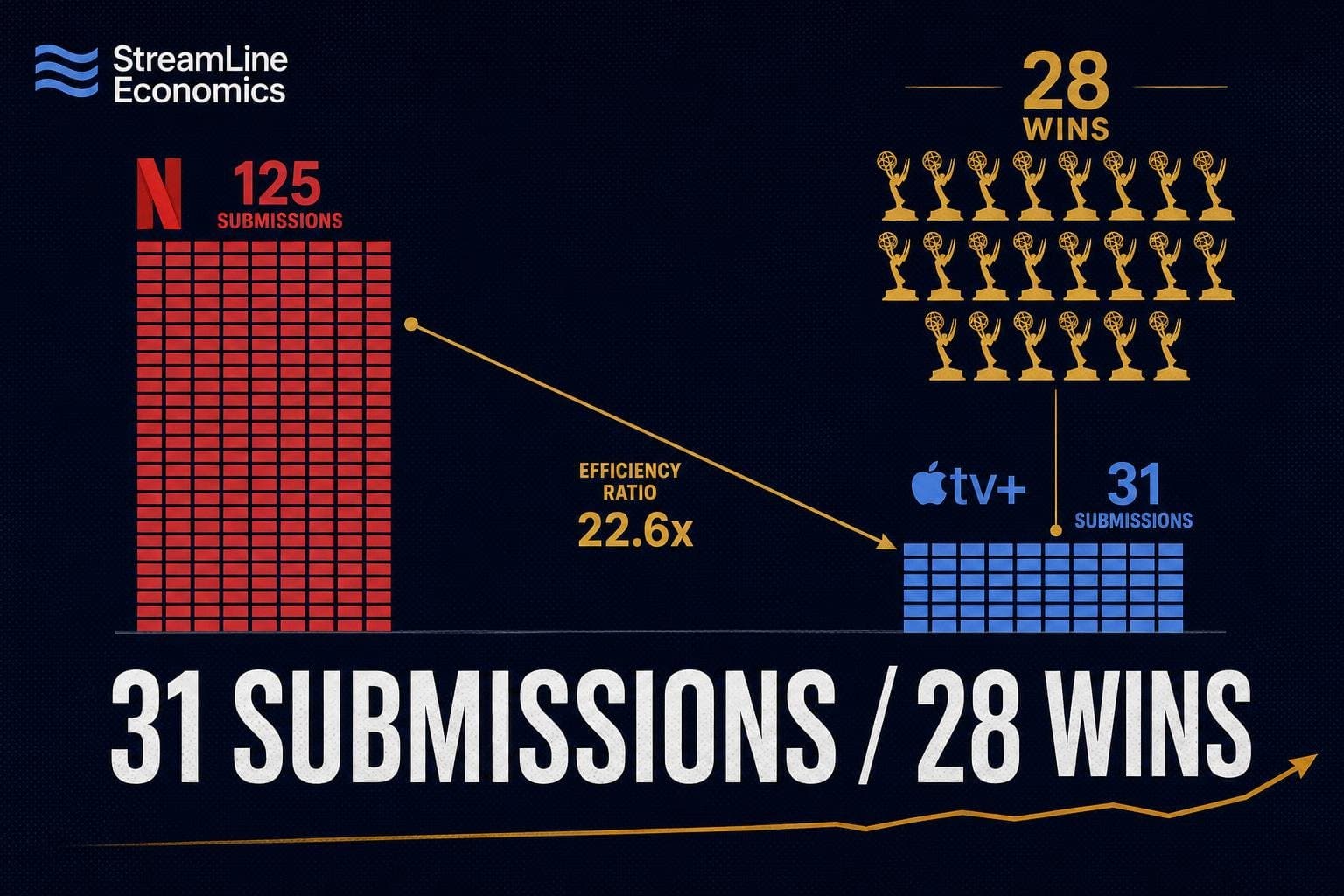

Wells Fargo just downgraded Netflix stock, citing an engagement problem. Apple just walked out of the 78th Emmy Awards with 28 statuettes — more than Netflix, more than HBO. These two facts are not unrelated.
The Efficiency Story Nobody Is Telling
Apple's Emmy haul is remarkable on its own terms: Widow's Bay broke the record for comedy wins in a single year, Pluribus delivered Rhea Seehorn an Outstanding Lead Actress in Drama trophy, and Slow Horses added a directing win. But the number that should make Netflix executives uncomfortable isn't 28 — it's 31.
That's how many shows Apple submitted for Emmy consideration. Netflix submitted 125. HBO submitted 86. Apple won more total Emmys than either of them with roughly one-quarter the submission volume.
This is content economics in its purest form. Apple TV+ is running what amounts to a boutique strategy inside a platform that doesn't depend on streaming revenue to survive — Apple's services division funds the whole operation. The result is a content portfolio where nearly every swing connects, because the company can afford to greenlight fewer shows and spend more attention on each one. Netflix, by contrast, is playing a volume game: 125 submissions means 125 bets, most of which don't pay off at awards time and many of which don't move the engagement needle either.
Netflix's Engagement Problem Is Real, and Wall Street Noticed
Wells Fargo analyst Steven Cahall didn't mince words in a report titled "Engagement Risk": "NFLX has lacked big original series & it's showing." Netflix shares fell nearly 5 percent after the downgrade. The bank moved to underweight, citing Netflix's declining position in the Nielsen Gauge and a slight year-over-year drop among its top 100 titles.
Cahall's diagnosis points to a strategic tension Netflix has been quietly navigating: the push into video podcasts, creator deals, and games may be diluting the original scripted content that built the platform's subscriber base. In other words, Netflix is spending money on content diversity at the exact moment it needs a breakout hit to remind people why they're paying $22 a month.
The remedies Cahall floats — a content spend reboot, third-party sports licensing from Fox or NBCUniversal, or M&A — all carry their own costs and timelines. A content spend reboot takes years to show up in viewing numbers. Sports rights are expensive and structurally complicated; Bloomberg has reported that Amazon already outspends Netflix and YouTube combined on sports. Catching up there isn't a quick fix.
The Paramount Deal Termination Adds Another Wrinkle
Buried beneath the Emmy coverage this week: Paramount and Netflix are ending their animated film agreement. The pact originated with Skydance Animation — which came under Paramount's umbrella after the merger — and produced Swapped, one of Netflix's most-watched movies ever at 144.9 million global views.
The two companies will honor existing commitments: Brad Bird's Ray Gunn and an untitled Jack and the Beanstalk project from director Rich Moore will still land on Netflix. And the broader content licensing relationship — series like Matlock, NCIS, and SEAL Team — continues. But the pipeline of new animated features from Skydance is closing.
For Netflix Animation, this matters. Animated films punch above their weight in family subscriber retention — they drive the kind of repeat viewing that keeps households subscribed through content droughts. Losing a pipeline partner that just delivered a top-all-time viewership number is a real subtraction, even if it's dressed up in the joint statement's diplomatic language about mutual agreement and ongoing collaboration.
What the Scoreboard Actually Means
The through-line connecting all three stories is the same: Netflix is in a period where its content strategy is being stress-tested from multiple directions simultaneously. An engagement dip that Wall Street is now pricing in. An awards season where a competitor with a fraction of its submission volume outperformed it. A content partnership ending just as the engagement question gets louder.
None of this is a crisis. Netflix's content spend is at record levels, as Cahall himself acknowledges, and the international slate remains a genuine wildcard — a breakout Korean or Spanish-language series can move global numbers in ways that are genuinely hard to forecast. The company has been written off before and delivered unexpected hits.
But Apple's Emmy performance illustrates something worth watching: in a market where subscribers are increasingly selective about which services they keep, prestige and quality concentration may matter more than volume. Apple submitted 31 shows and won the night. The question Netflix needs to answer before its next earnings call isn't how many shows it has in production — it's how many of them anyone will remember six months from now.
Watch for Netflix's Q3 earnings report, where engagement metrics and content spend guidance will either validate Cahall's concerns or give the company a data-driven rebuttal. That's the number that settles this argument.


