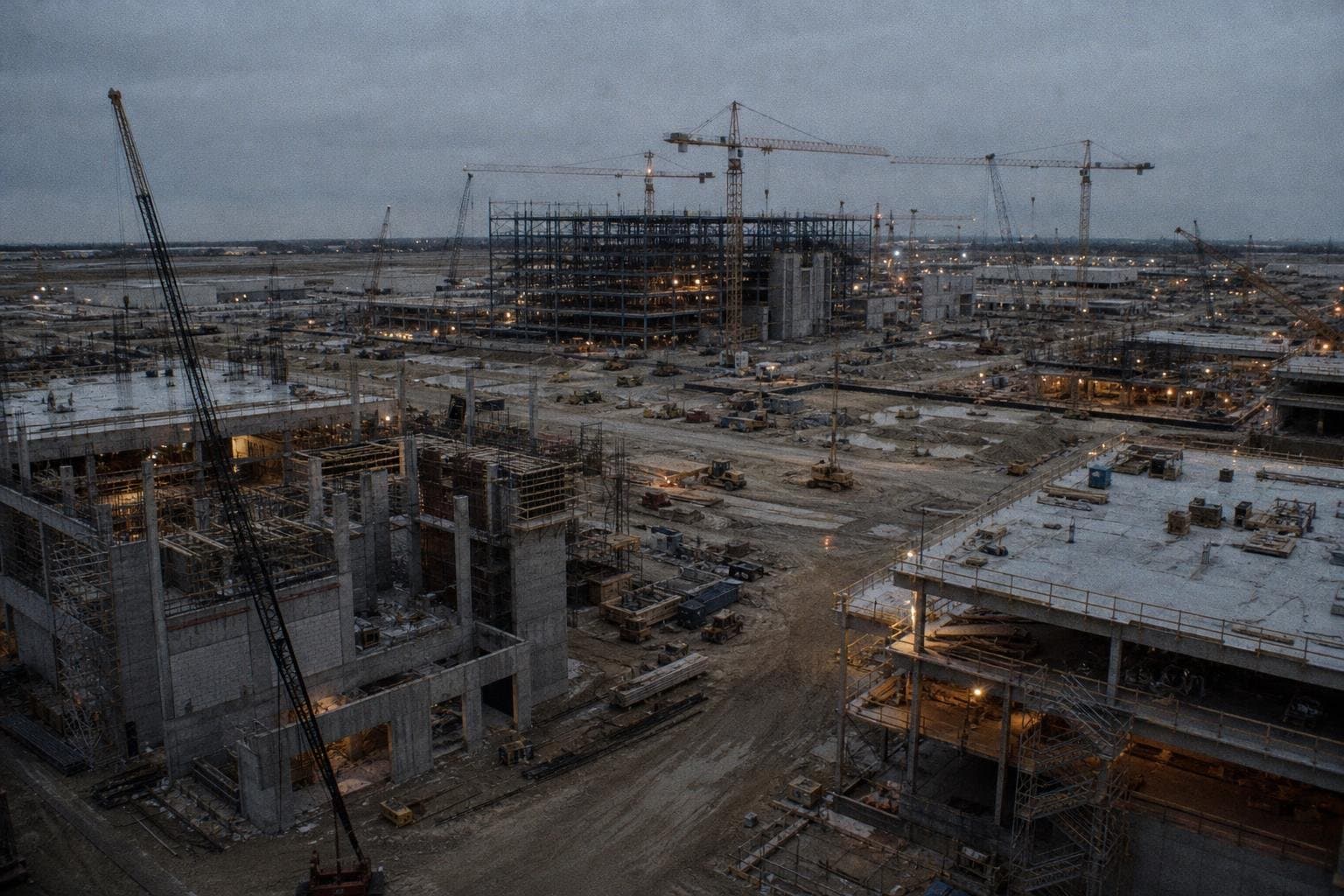

Nearly 20. That's how many semiconductor facilities Taiwan Semiconductor Manufacturing Co. now has in development worldwide, according to CEO C.C. Wei on the company's October 15 earnings call — 13 advanced fabs and packaging plants in Taiwan, plus another five or six overseas, against a historical baseline of four or five projects running at once (Asia Times). That's roughly four times the company's normal construction cadence, running simultaneously. The headline numbers from the same call look spectacular: net profit up 69% to T$763.1 billion, fourth-quarter revenue guidance of $52.3 billion to $54.3 billion, and a reiterated full-year 2026 revenue growth forecast of about 44% (Reuters). But the gap between the top-line story and the balance-sheet story is exactly where this column lives, and this quarter the gap has a number attached to it.
The Discount on Going Global
TSMC's overseas expansion — Arizona chief among it — is diluting consolidated gross margin by close to two percentage points in 2026, and management expects that drag to widen to three to four points as more non-Taiwan facilities ramp production, CFO Wendell Huang told analysts (Asia Times). Third-quarter gross margin already fell to 66.4% from 67.7% the prior quarter, attributed mainly to the early ramp of 2-nanometer production, which made up 8% of wafer revenue (Asia Times). Two separate cost pressures — new-node ramp and geographic dilution — are landing in the same quarter, and TSMC's own guidance says the second one gets worse before it gets better.
This is the part that doesn't show up in the press-release version of "record quarter." Taiwan's economics benefit from decades of concentrated supply chains, trained labor, and tooling density that Arizona, by definition, cannot replicate on day one. TSMC says scale, productivity gains, and supplier cooperation will eventually narrow that premium. That's the plan. It is also, notably, not yet the result — the company does not disclose return on invested capital for individual factories, so outsiders have no way to check whether Arizona is closing the gap or just getting larger alongside it (Asia Times). Capital spending for 2026 stays locked at $60 billion to $64 billion (Reuters) — a number that has to stretch across twenty simultaneous builds instead of five.
Meanwhile, Samsung is adding to the same crowded Texas corridor: the company plans to break ground on a second Taylor, Texas fab in November, with its first facility there expected to begin operations by year-end (Digitimes). Two foundries racing to staff, supply, and permit overlapping construction sites in the same state is its own kind of stress test — on labor markets, on local utilities, on equipment lead times — independent of either company's balance sheet.
Beijing's Mirror Move Changes the Export-Control Calculus
The same week TSMC was explaining its margin math, China's Ministry of Commerce and Ministry of Science and Technology published a draft catalog proposing export controls on 40 technologies, including 23 tied to artificial intelligence — model weights, source code, chip designs, and computing clusters above certain performance thresholds (Bloomberg). The draft splits into 14 outright prohibitions and 26 items requiring a license, and China activated a parallel registration requirement the same day for technology transfers and licensing deals under review (Tech Insider). It's a draft, open for public comment, not law — worth remembering before anyone treats it as an active embargo.
What's notable is the target: not finished products, but technology transfer — the overseas joint ventures, licensing arrangements, and plant construction that let foreign companies build Chinese-designed products on foreign soil (Tech Insider). Washington has spent years restricting what flows into China's fabs. Beijing's draft is a first sketch of restricting what flows out of them. If finalized, it would hand China a regulatory mirror to the Entity List it has lived under — a tool that could complicate, rather than directly block, the kind of multinational manufacturing arrangements that TSMC and Samsung are currently betting billions on.
What to Watch
The next real data point on TSMC's overseas cost premium arrives with Q4 results, due in mid-January, when Huang's "widening to three to four points" prediction either shows up in the actuals or gets walked back. On the China side, the public comment period on the 40-tech draft is the thing to track — how long it runs, what gets stripped out, and whether the AI chip-design provisions survive contact with industry pushback before the catalog becomes enforceable rather than aspirational.


