
Three weeks ago, I wrote about how $265 billion in pledges don't build fabs — construction schedules do. TSMC's CFO just handed us the clearest illustration of that gap yet.
After reporting second-quarter results that beat expectations, Wendell Huang sat down with reporters and said the company is "very happy" with Arizona progress — which is why it decided to increase total U.S. investment to $265 billion. In the same breath, he acknowledged a shortage of construction workers and infrastructure constraints that the company will need government help to solve. That's the TSMC playbook in miniature: announce the number, then footnote the physics.
What's Actually Built vs. What's Been Announced
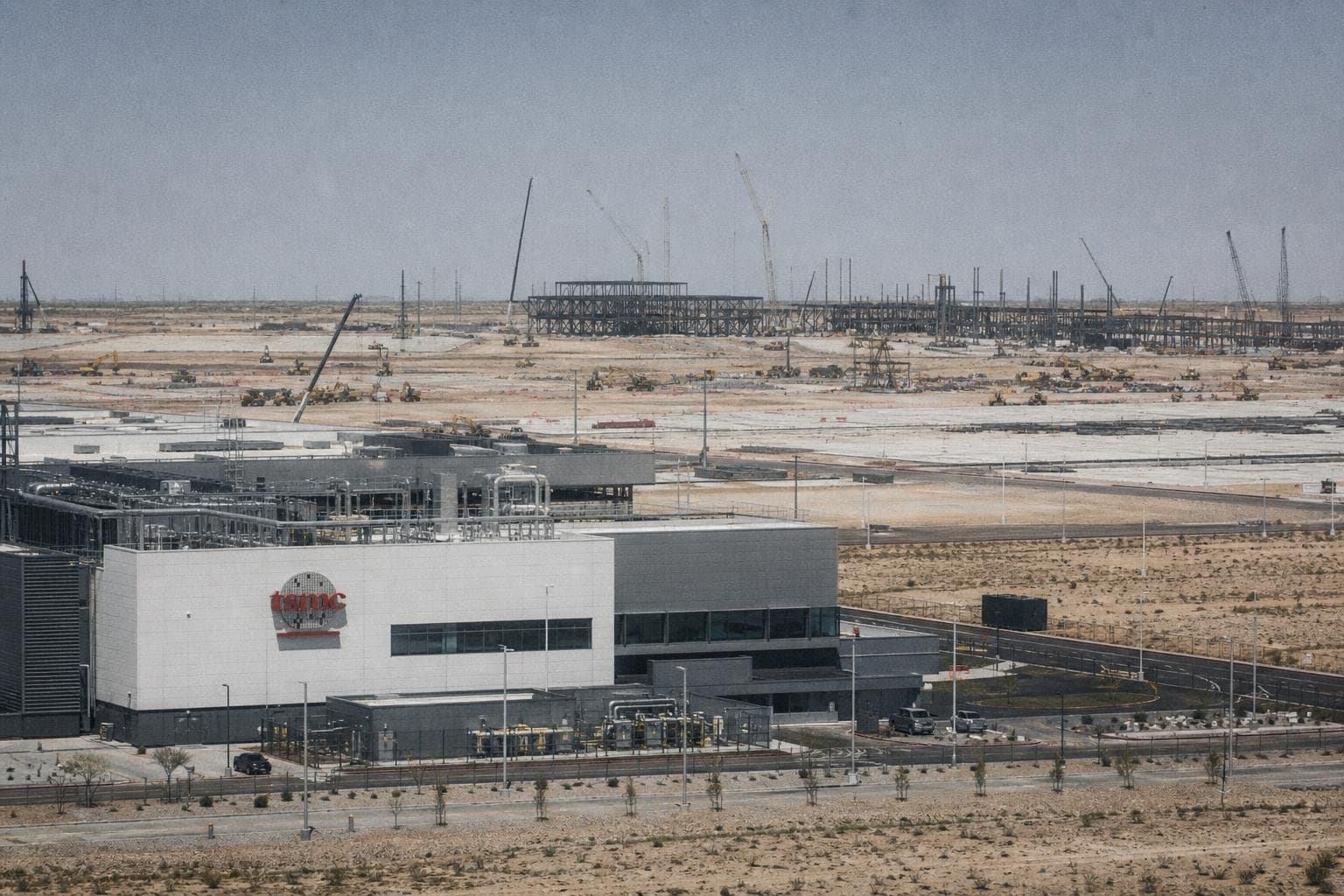
Let's run the tape. Per Reuters, here's the current state of the Arizona footprint:
- Fab 1: Operational. Huang says yields are "as good as" TSMC's flagship Taiwan facility — which, if true, is the most genuinely encouraging data point in this entire story.
- Fab 2: Equipment move-in beginning shortly.
- Fab 3: Under construction.
- Fab 4 + advanced packaging facility: Preparatory site work started.
That's four facilities in some stage of progress. The announced total is twelve fabrication and advanced packaging facilities plus an R&D center. Huang offered no timeline for when the additional investment — the $100 billion increment that pushed the total to $265 billion — would translate into completed capacity.
Twelve facilities. Four with any visible progress. No timeline for the remaining eight. This is what "very happy with progress" looks like when you unpack it.
The Demand Story Is Real. The Constraint Story Is Also Real.
To be fair to TSMC, the demand signal driving this expansion is not manufactured. Bloomberg reported that the company beat sales and profit expectations for the June quarter and raised its growth forecasts — and that it still faces challenges fulfilling all customer orders. The AI megatrend, as TSMC's own executives have taken to calling it, is expected to drive growth for at least the next several years. When the world's dominant advanced chip manufacturer says it can't keep up with orders, that's not spin.
The competitive pressure is also real. Bloomberg noted that the $265 billion commitment is partly designed to "ward off ambitious rivals" — a signal that TSMC is watching Samsung and Intel's foundry ambitions, however troubled those may be at the moment, and using the Arizona expansion as a statement of intent as much as a capacity plan.
But here's the accountability problem: demand forecasts and competitive positioning are exactly the kind of rationale that sounds airtight at an earnings call and looks different three years later when construction timelines slip. TSMC cited construction worker shortages and infrastructure gaps in the same statement where it announced the $100 billion increase. Those aren't minor friction points — they're the binding constraint on whether twelve facilities ever becomes twelve facilities. Huang said the company would "work closely with the government to solve these issues," which is a polite way of saying the expansion depends on policy and labor market outcomes that TSMC doesn't control.
The Taiwan Parallel Nobody Wants to Discuss
There's a detail in the Reuters report that deserves more attention than it's getting: while TSMC is committing $265 billion to Arizona, it is simultaneously building 13 leading-edge and advanced packaging fabs in Taiwan over the next several years. Thirteen. At home.
That's not a criticism — TSMC is a Taiwanese company with deep roots in a place where it has decades of infrastructure, a trained workforce, and supply chain density that Arizona won't replicate for a generation. But it does reframe the Arizona expansion as one thread in a much larger global buildout, not the pivot to U.S. manufacturing that the political framing implies. When Trump says the U.S. will have 50% of global semiconductor manufacturing capacity by the time he leaves office, the arithmetic requires either a dramatic acceleration of the Arizona timeline or a dramatic deceleration of everyone else's — neither of which Huang's comments support.
What to Watch Before the Next Earnings Call
The Fab 1 yield claim is the one number worth tracking closely. If TSMC's first Arizona fab is genuinely producing at Taiwan-equivalent yields, that's a meaningful proof point that U.S. advanced manufacturing can reach world-class performance — not just break ground and hold press conferences. The company should be pressed for specific yield data, not just a CFO's characterization of "as good as."
Fab 2 equipment move-in is the next concrete milestone. Equipment installation is the step that precedes production ramp, and it's the kind of measurable event that shows up in supply chain filings and third-party reporting. Watch for that timeline against what gets said on the Q3 earnings call.
And watch whether the construction worker shortage gets any policy response. Huang flagged it publicly, which means TSMC is signaling it needs help. If Commerce or the White House doesn't move on workforce pipeline issues in the next quarter, the gap between twelve announced facilities and four in-progress ones will start to widen — regardless of how strong the demand signal is.
The demand is real. The money is pledged. The physics, as always, is the variable nobody wants to put in the headline.


