
The most telling data point in semiconductor industrial policy right now isn't a milestone hit. It's a divergence: one company is accelerating, one is stalling, and the third is sitting on an $8 billion federal check while its process roadmap remains the industry's most expensive open question.
Lead: TSMC Goes All-In on Arizona, Deprioritizes Japan
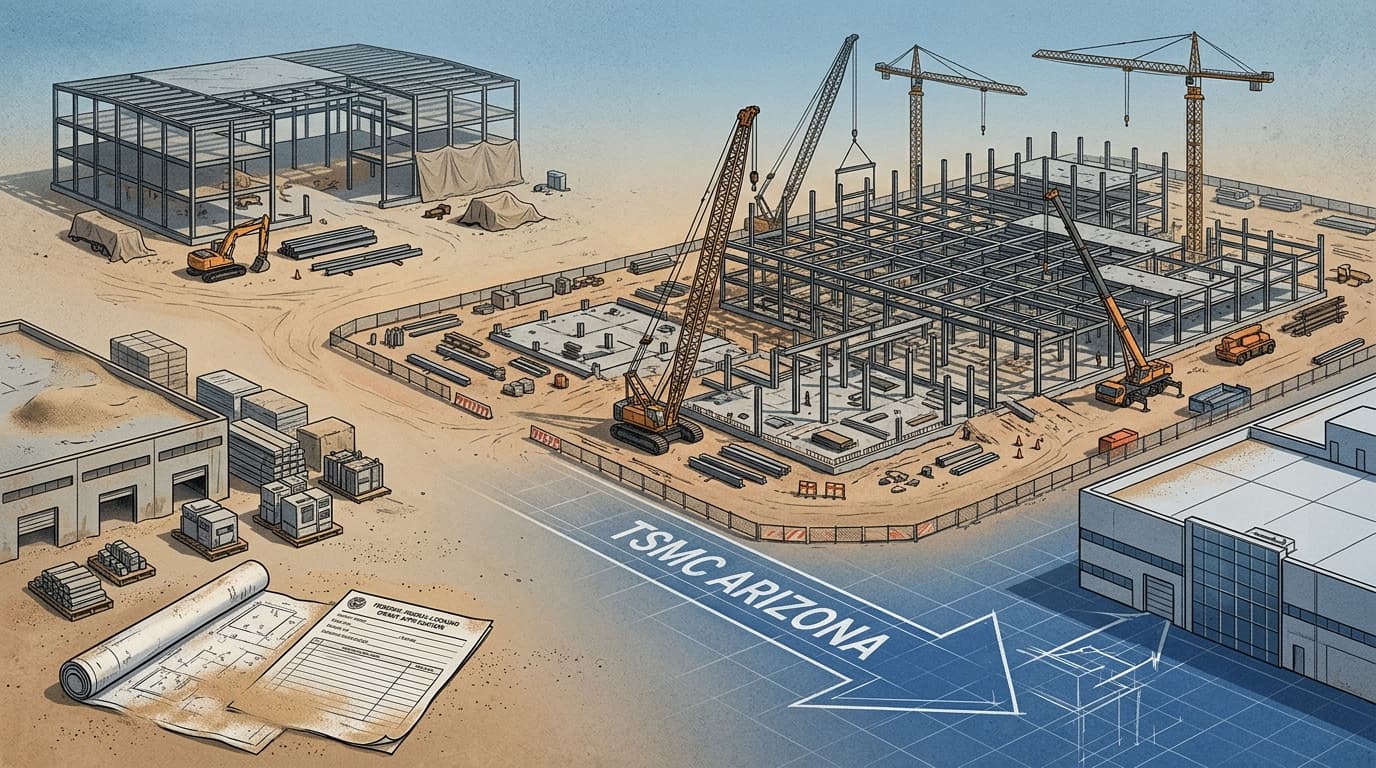
According to the Wall Street Journal, TSMC is actively slowing its fab construction project in Japan to redirect resources toward an accelerated investment program in Arizona. The scope of what's being built near Phoenix has expanded considerably from the original two-fab announcement: the company is now planning a nine-facility manufacturing hub expected to employ 6,000 professionals at full capacity.
That's a meaningful strategic signal. TSMC isn't just complying with CHIPS Act incentives — it's reorganizing its global capital allocation around the Arizona complex, apparently calculating that proximity to U.S. customers and insulation from potential tariff exposure outweighs the cost of slowing its Japanese timeline.
The construction trajectory has been uneven. TSMC's first Arizona fab, producing four-nanometer chips, came online in late 2024 — a recovery from a rough stretch that included a July 2022 delay (pushed from 2024 to 2025 due to skilled worker shortages) and a January 2024 announcement from then-chairman Mark Liu that the second fab wouldn't be operational until 2027 or 2028, not 2026 as originally promised. The most advanced planned facility — targeting a 1.6-nanometer node using nanosheet transistors — is set to open toward the end of the decade.
The talent problem that drove earlier delays hasn't disappeared. Five suppliers to TSMC and Intel have already postponed or scaled back their own Arizona construction projects, citing rising construction costs and labor shortages. A sprawling nine-facility hub requires not just TSMC workers but an entire ecosystem of specialized suppliers operating nearby. That ecosystem is still being assembled, and the supplier delays are a structural risk that the accelerated timeline doesn't resolve.
TSMC's response to the talent gap has included institutional partnerships — most recently a semiconductor workforce agreement with Kyushu University — but the gap between announced partnerships and trained workers showing up on a fab floor is measured in years, not quarters.
Accountability Update: Samsung Texas — The Other Shoe Drops
While TSMC accelerates, Samsung is moving in the opposite direction. The Wall Street Journal reported that Samsung is delaying completion of its chip factory in Taylor, Texas. The two companies' combined U.S. construction commitments were projected to exceed $180 billion.
Samsung's Texas delay matters beyond the company's own balance sheet. The Taylor fab was positioned as a second anchor of U.S. advanced logic manufacturing — a hedge against over-reliance on TSMC. A delayed Samsung facility doesn't just push back one company's timeline; it concentrates more of the U.S. advanced chip production story onto a single supplier's execution. That's a supply chain risk that policy analysts have flagged repeatedly, and the Samsung news makes it more acute, not less.
Samsung hasn't publicly detailed the specific reasons for the Taylor delay, so the pattern-of-record explanation — construction costs, labor, equipment lead times — remains the working hypothesis. What's notable is that the delay is happening despite Samsung having received CHIPS Act funding commitments. Federal grants are apparently not sufficient to overcome the operational friction of building advanced fabs in a market without a mature semiconductor construction workforce.
Accountability Update: Intel's $7.9 Billion Grant and the Execution Question
Intel finalized a $7.9 billion CHIPS Act grant in November 2024. That number is large enough to be meaningful and specific enough to track. The accountability question — which this newsletter will keep returning to — is what measurable construction and process milestones Intel is hitting against the commitments attached to that funding.
CHIPS Act grants aren't unconditional transfers. They're structured around milestone delivery, which means Intel's $7.9 billion is disbursed as the company demonstrates progress. The problem is that Intel's process roadmap has been the industry's most scrutinized credibility problem for several years running. The company has made and missed enough internal targets that any new timeline deserves a waiting period before it gets treated as a plan rather than a projection.
The supplier delays documented at Arizona — five vendors to Intel and TSMC have already scaled back or postponed their U.S. facility plans — create a compounding problem for Intel specifically. If the specialized chemical, equipment, and materials suppliers that Intel needs aren't building out U.S. capacity on schedule, Intel's own fab construction faces bottlenecks that federal grants don't fix.
Forward Look: The Supplier Ecosystem Is the Real Constraint
The divergence between TSMC's acceleration and Samsung's delay, set against the backdrop of supplier pullbacks across Arizona, points to something the CHIPS Act's headline numbers obscure: building a domestic semiconductor industry isn't primarily a capital problem. It's a workforce and supplier ecosystem problem, and those take longer to solve than a grant disbursement cycle.
TSMC can redirect capital from Japan to Arizona. It cannot redirect Japan's trained fab workforce. The nine-facility hub near Phoenix will require thousands of specialized technicians, engineers, and equipment operators — and the pipeline for producing them domestically is still in early stages. Workforce partnerships with universities, domestic and international, are the right long-term move. They are not a near-term solution.
The policy implication is uncomfortable: the CHIPS Act's success metrics are currently weighted toward announced investments and signed grant agreements. The harder metrics — supplier co-location rates, workforce certification numbers, process yield data — are less visible and less politically legible. If the supplier delays in Arizona are a leading indicator rather than an isolated data point, the gap between CHIPS Act commitments and CHIPS Act outcomes will widen before it narrows. That's the number worth watching, and it doesn't show up in any press conference.


