


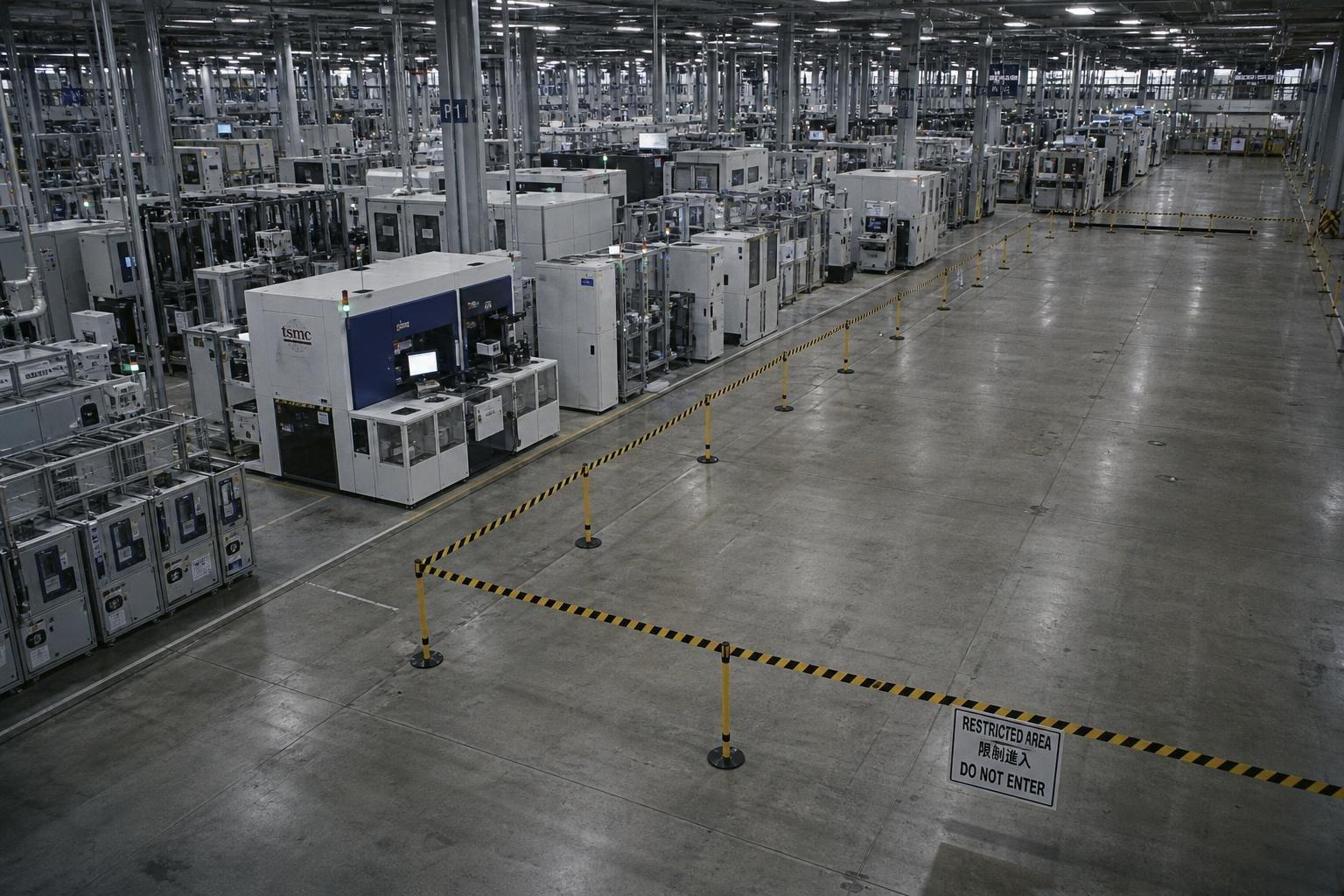

For three years, Chinese chip designers found workarounds to the walls Washington kept building. This week, the biggest wall-builder wasn't the Commerce Department. It was TSMC.
According to two people familiar with the matter cited by Reuters, TSMC has started suspending previously permitted advanced manufacturing orders from Chinese chip designers, instructing that any order using 16-nanometer processes or smaller be halted unless the customer holds a US export license. Chinese designers will generally be restricted to 28nm and 40nm — process nodes a full generation or two behind what's needed for serious AI accelerators — provided those chips skip high-bandwidth memory and advanced packaging entirely. Most AI silicon worth worrying about runs on 7nm or smaller, per Reuters, which is exactly the range TSMC is now fencing off.
This isn't TSMC getting patriotic. It's TSMC complying with new Bureau of Industry and Security rules that took effect last Thursday, which eliminated a compliance route that had let some Chinese designers get advanced manufacturing without individual licenses — essentially a technical self-certification loophole that let a company check its own chip's compute characteristics and proceed if it stayed under a threshold. TSMC told Reuters it will comply with BIS regulations "as applicable" and declined further comment. That's the sound of a company doing the bare minimum required while making sure a reporter gets it in writing.
The Collateral Damage Is Regional, Not Just Chinese
The interesting part of this story isn't Beijing. It's everyone standing next to Beijing. Bloomberg reports that China-linked operators account for a significant share of data-center capacity across Southeast Asia, meaning this round of restrictions is landing on regional neighbors who built profitable businesses serving mainland China's AI compute demand. Export controls designed to choke one country's chip supply chain don't respect that country's borders when the compute itself is regional infrastructure. If a data center in Malaysia or Indonesia was quietly leasing capacity to Chinese AI firms, that revenue line just got a lot more fragile.
This is the pattern I keep coming back to with this enforcement regime: every time Washington closes a technical loophole, the pain radiates outward to parties who weren't the intended target and had no seat at the table when the rule was written. The subsidiary loophole closed earlier this year. The cloud loophole is still being argued over. Now the manufacturing-level loophole — the one that let Chinese designers simply have TSMC build the chip rather than wrestle with domestic foundries — is closing too. Each closure is a genuine tightening. None of them, on their own, proves the broader strategy is working, because China's response to each closure has been to accelerate domestic alternatives rather than give up.
Arizona's Capacity Math Just Got a New Data Point
While TSMC was restricting Chinese access to leading-edge nodes, it was also locking in power for its own leading-edge expansion in the US. TSMC signed a power supply agreement with Arizona Public Service on November 16 that anticipates 1.88 gigawatts of demand, including an upfront credit-support payment scheduled for January 2027, according to GuruFocus. The stated target tied to that power commitment is roughly 150,000 advanced-node wafers per month by 2035 — a nine-year horizon, not a near-term one.
I'd flag that figure the same way I flagged the Arizona power story two weeks ago: a utility interconnection agreement is a real commitment with real financial penalties attached, which makes it more credible than a press-release pledge. But 2035 is far enough out that treating 150,000 wafers per month as a settled outcome today would be exactly the kind of PowerPoint-to-silicon leap this newsletter exists to flag. Power deals get signed well ahead of construction completion precisely because utilities need the lead time; that doesn't mean the fab capacity arrives on schedule.
Separately, Europe is running its own version of industrial chip policy at a different scale. The European Commission has approved more than €33 billion in combined public and private semiconductor investment across over 20 state-aid decisions, per TechRepublic, spanning power electronics, specialized materials, and advanced packaging rather than leading-edge logic. It's a useful contrast: Brussels is still in the "approved investment" phase while Washington has moved to active enforcement against a named rival. Different tools, different timelines, same underlying question of whether government money and government restrictions actually change who can build what.
What to watch next: whether Chinese chip designers request the individual export licenses TSMC says they now need, and whether the Commerce Department actually grants or denies any of them. A license request that sits unanswered for months is its own kind of answer.