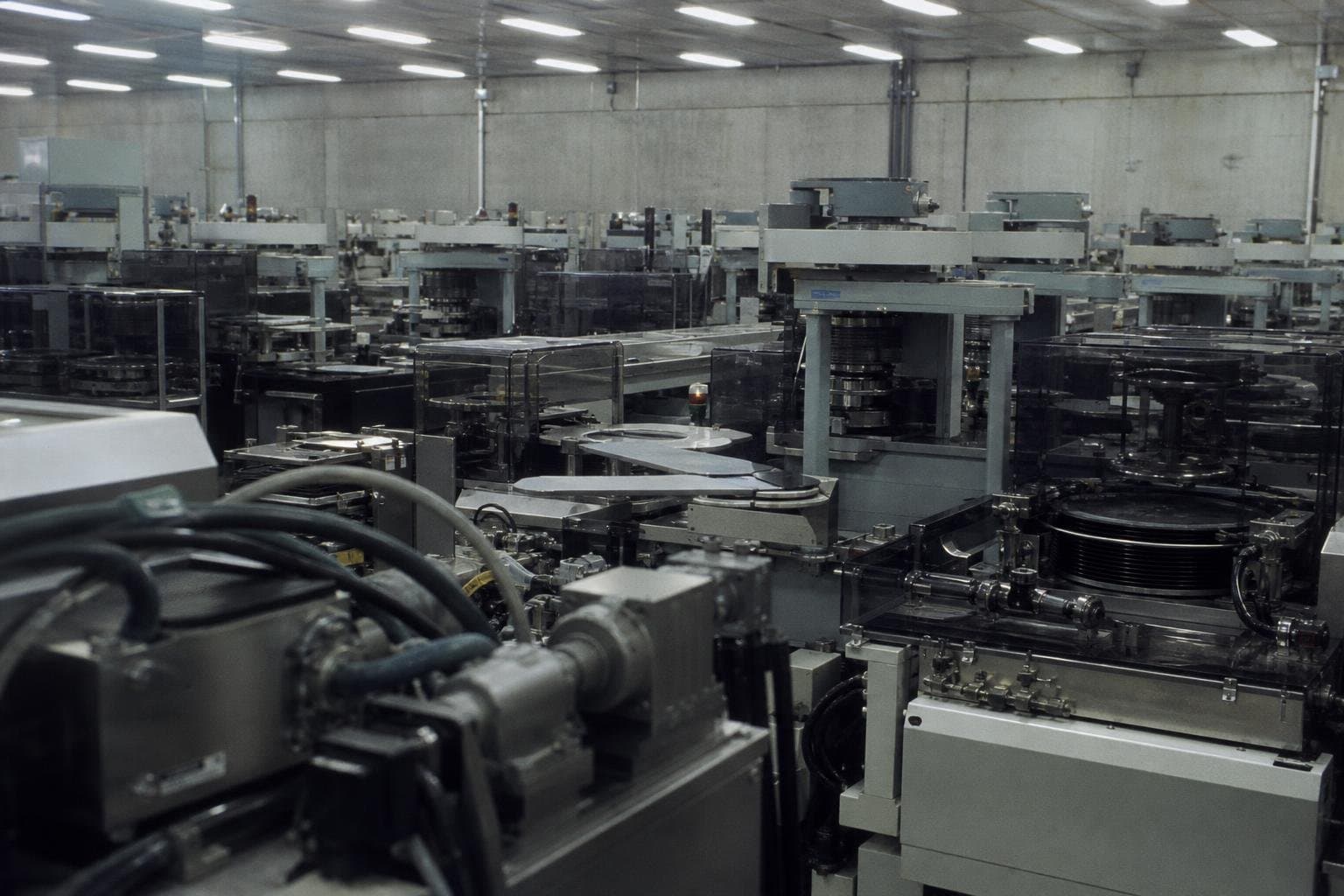

For three years, Washington has treated export controls as a one-way valve: choke China's access to advanced lithography and leading-edge chips, watch Beijing scramble for workarounds. Reuters reported on October 22 that TSMC has quietly flipped that script on itself — surveying suppliers for factory-automation equipment that uses fewer or no rare-earth magnets, specifically to insulate its fabs from China's own export licensing regime on rare-earth materials. The world's most important chipmaker is hedging against the possibility that the country it depends on for critical inputs could squeeze it the same way Washington has tried to squeeze China.
The mechanics matter here. Rare-earth magnets power the motors in the kind of highly automated industrial equipment that keeps a modern fab running — the robotics, the wafer handlers, the tool bays. China put certain rare earths, magnets, and processing technology under export license requirements last year, and according to Reuters' sourcing, three people familiar with the matter say TSMC has been quietly surveying alternatives since. The effort is still early-stage, hasn't produced a broad rollout, and TSMC declined to comment — so file this as a hedge in progress, not a solved problem. But the fact that it's happening at all is the real story. Export controls were sold as a tool that constrains the target. Here the target has built a dependency chokepoint of its own, on a mineral category the U.S. and its allies still don't produce or refine at meaningful scale domestically.
Washington's Response Has Been Rhetoric, Not Capacity
The policy response so far tracks a pattern I've flagged before on this chokepoint: statements of intent, not measurable supply. Reuters notes that Taiwan's economy minister pledged in February to fund the Industrial Technology Research Institute to develop rare-earth technologies, and the American Institute in Taiwan's director said in June that Washington is "working with" Taiwan and other partners to diversify rare-earth sourcing. Neither of those is a mine, a separation facility, or a magnet line. The gap between "working with partners" and actual processing capacity is exactly the kind of gap this newsletter exists to track, and fourteen months into public acknowledgment of the problem, I don't see a capacity number attached to either government's commitment.
Meanwhile, the CHIPS Act's R&D Side Is Still Limping
This rare-earth scramble is landing against a backdrop I covered back in August: the CHIPS Act's manufacturing incentives are moving, its research mandate largely isn't. The Government Accountability Office's August 6 report, as detailed by IEEE Spectrum, found that as of April 2026 only 24 of 144 milestones across 49 manufacturing projects had been completed and funded — real progress, if modest — while the Commerce Department still hadn't published a plan for meeting the Act's R&D requirements, and had canceled the $7.4 billion contract with the National Semiconductor Technology Center's original operator to run it in-house instead. Donna Dubinsky, a former Natcast trustee quoted in that report, put it bluntly: without a functioning R&D push, future chip technology leadership "is going to be in Belgium. It's going to be in Tokyo. It's going to be in Korea."
The Commerce Department has since put a number on the table: on October 2026, NIST announced letters of intent for up to $389 million in CHIPS R&D awards to four companies, aimed at power semiconductors for grid and data-center infrastructure, with Commerce taking a minority equity stake in each recipient as a funding condition. That's real money moving toward a real gap — energy semiconductors for AI-era power demand is a legitimate need — but $389 million against a multi-billion-dollar R&D mandate that's been stalled for over a year is a down payment, not a correction. Letters of intent aren't signed awards, and signed awards aren't shipped silicon.
The Pattern Repeats: Capacity Lags the Press Release
Even the workforce side of this story rhymes. IEEE Spectrum reported that the semiconductor industry will need 189,000 new workers by 2030 against a projected supply of roughly 62,000 — a gap community colleges are trying to close through apprenticeships tied to fabs like TSMC's Arizona site, which employs about 3,000 people today and will need roughly 6,000 once its next two fabs open. Building the tools, training the technicians, and sourcing the magnets all share the same shape: the announcement comes fast, the physical capacity comes slow, and the organizations with leverage — whether that's China on rare earths or Commerce on R&D disbursement — hold that leverage until someone actually builds the alternative.
Watch two things over the next quarter: whether TSMC's rare-earth-free equipment survey produces an actual supplier contract rather than a continued "early stage" status, and whether Commerce converts any of its four October letters of intent into signed CHIPS R&D awards with disclosed milestones. Letters of intent, like fab groundbreakings, are the easy part.


