


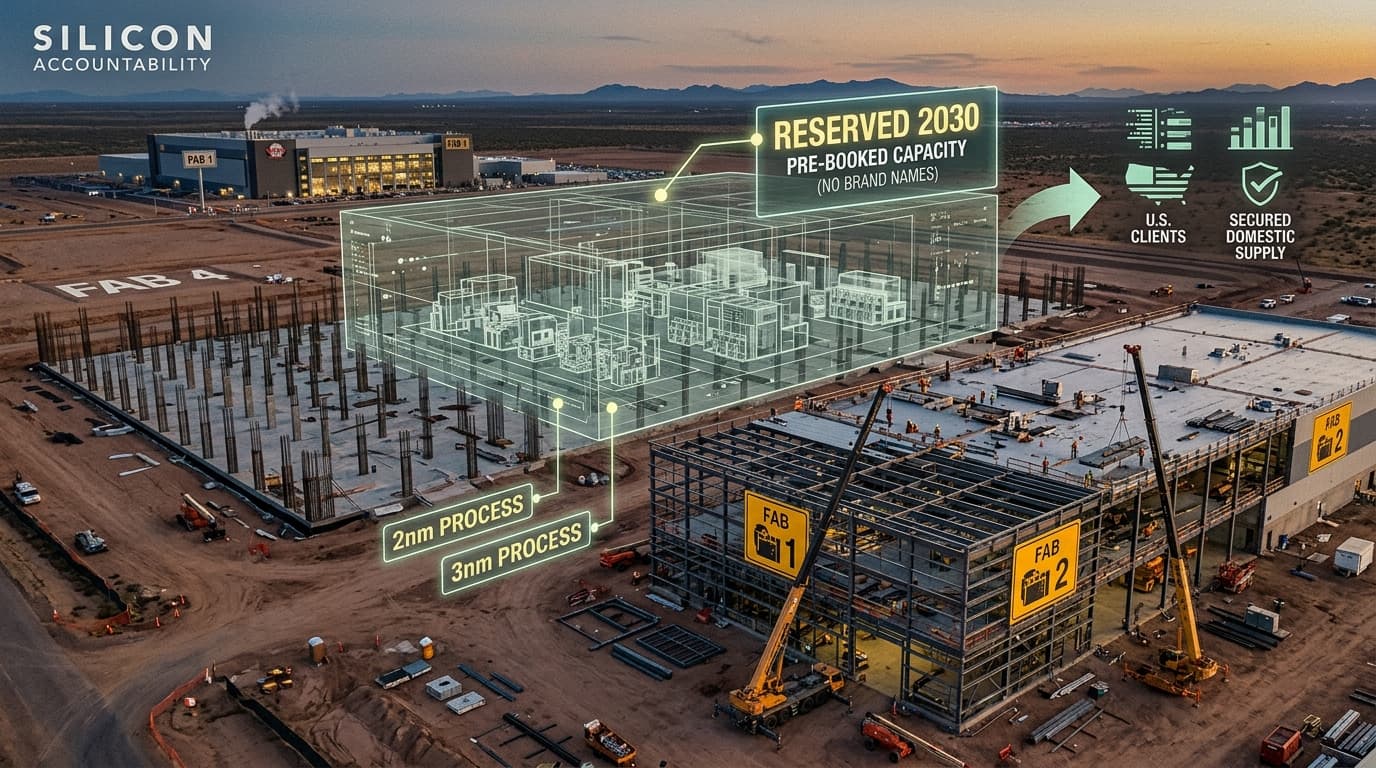

The most telling detail in this week's semiconductor news isn't a yield number or a funding announcement. It's a booking pattern: TSMC's Arizona Fab 4, which won't produce chips until the end of the decade, is already fully reserved. Customers — reportedly including Apple and other major U.S. manufacturers — are paying to hold capacity on a fab that exists today primarily as a construction timeline and a process node target.
That's either a sign of extraordinary customer confidence in TSMC's execution, or a sign of how desperate U.S.-based chip buyers are to secure domestic supply. Probably both. Either way, it's a more honest indicator of where the Arizona buildout stands than any press release.
The Arizona Ramp Is Real, But "Operational" Is Doing Heavy Lifting
Fab 1 went into production in Q4 2024 — that milestone is confirmed. Fab 2 is structurally complete and scheduled to begin production by 2028, with TrendForce reporting that 3nm mass production at Fab 2 is being targeted for the second half of 2027. That's a meaningful pull-forward from earlier projections, and the construction efficiency story behind it is worth tracking: build timelines have reportedly compressed from roughly three years for Fab 1 to somewhere between 1.5 and 2 years for subsequent fabs, gradually approaching what TSMC achieves in Taiwan.
That compression matters because it's the variable that makes or breaks the whole Arizona thesis. TSMC's competitive advantage isn't just process technology — it's the speed and precision with which it can stand up new capacity. If Arizona is genuinely closing that gap, the strategic picture looks different than it did two years ago. If the compression is being reported optimistically and the 2027 3nm target slips, the fully-booked Fab 4 story starts to look less like confidence and more like customers who had no better options.
Mechanical and electrical installation timelines at the future P3 and P4 fabs are also being pulled forward, which is the kind of supply chain signal worth watching more closely than official announcements. Construction sequencing is harder to spin than a roadmap slide.
Arizona Turned Profitable in 2025 — Germany Didn't
One number that hasn't gotten enough attention: TSMC's Arizona operations turned profitable in 2025. That's a genuine milestone, and it's worth separating from the hype around it. Profitability at this stage likely reflects the economics of Fab 1 ramping with committed customers at premium pricing — it doesn't yet tell us whether the full six-fab Arizona buildout pencils out at scale without sustained subsidy support.
The contrast with TSMC's European venture is instructive. Germany's ESMC joint venture posted a net loss of NT$688.6 million in 2025, widening from NT$556.9 million the prior year. Japan's JASM operation has had its own delays. The pattern suggests Arizona is the strongest of TSMC's overseas bets right now — but "strongest" is relative when the comparison set includes operations that are still losing money and still working through construction and ramp challenges.
TSMC's China operations, for what it's worth, reportedly lead all overseas fabs in profitability. That's a geopolitical wrinkle that U.S. industrial policy hasn't fully resolved.
The Accountability Milestone to Watch: Fab 2's 3nm Yield, Not Its Production Date
Here's the accountability framing that matters going forward. The semiconductor industry has a well-established habit of announcing production start dates and quietly omitting yield rates. "Mass production" can mean anything from high-volume commercial output to a handful of wafers that technically qualify as production under the most generous definition.
The 2H27 3nm target for Fab 2 is the next major checkpoint. But the question to ask when that date arrives isn't whether TSMC hit the production start — it's what percentage of wafers are coming out usable, and whether Apple and the other fully-booked customers are actually pulling the capacity they reserved or quietly negotiating deferrals.
Fab 4's end-of-decade timeline and its A16/2nm process target give this story a long tail. Watch for TSMC's quarterly earnings calls through 2026 and 2027 for any language around Arizona utilization rates and customer pull-ins — that's where the real signal will be, buried under the investor relations optimism. Any mention of customers "adjusting" their Arizona reservations should be treated as a yellow flag, not a routine business update.
The PowerPoint version of Arizona is already written. The silicon version is still being poured.