
The semiconductor industry runs on one reliable constant: things take longer than promised. Fabs slip. Yields disappoint. Governments announce funding that arrives years late, if at all. So when a project starts compressing its own timeline rather than expanding it, the instinct should be to ask why — and whether it holds.
TSMC's Arizona buildout is doing exactly that.
Fab 2's Timeline Compression Is Real, But the Numbers Need Context
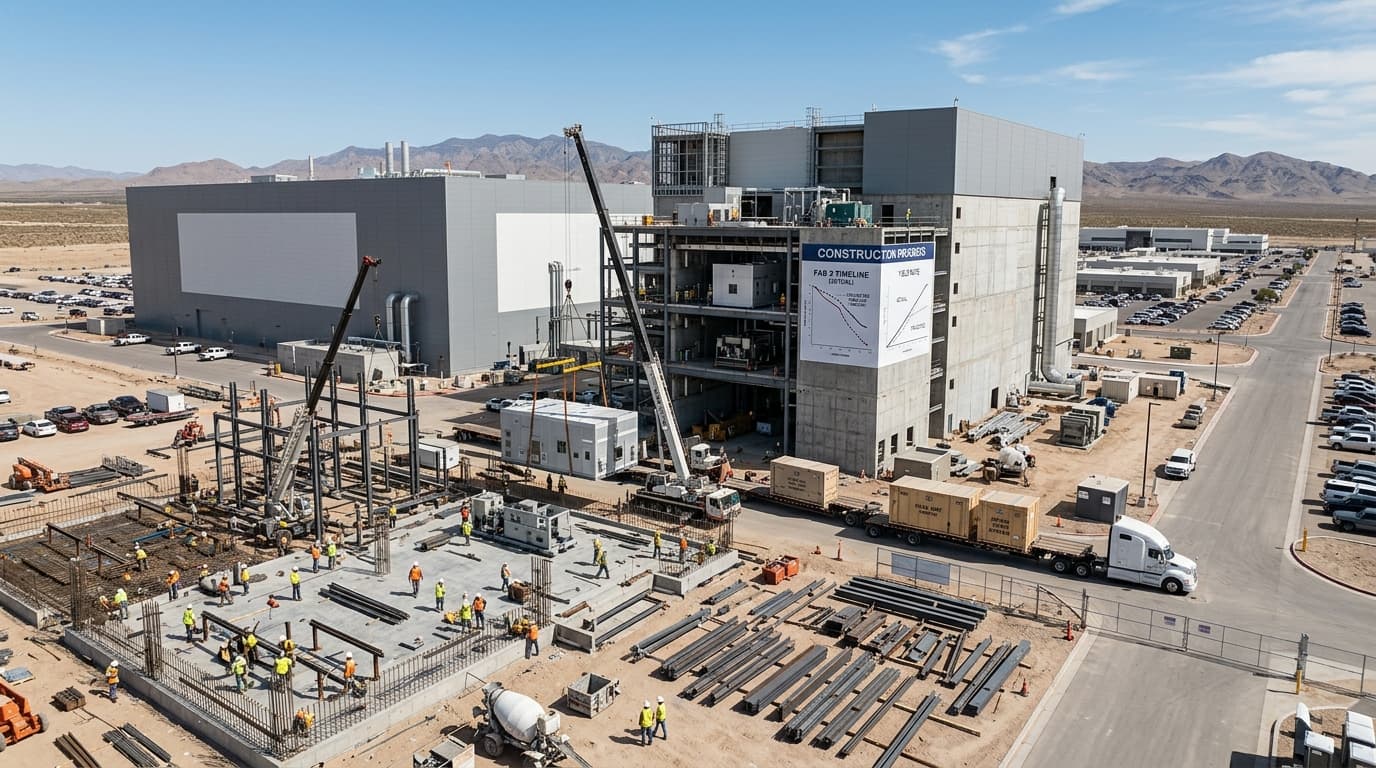
According to TrendForce reporting from March 24, TSMC is targeting second-half 2027 for 3nm mass production at its Arizona Fab 2, and supply chain sources indicate build timelines have compressed from roughly three years for the first fab down to approximately 1.5 to 2 years — approaching the construction cadence TSMC maintains in Taiwan.
That's a meaningful operational shift, not a rounding error. The original Fab 1 (P1) was a case study in what happens when a Taiwanese company tries to transplant its construction culture to a U.S. labor market without the institutional infrastructure to support it. Skilled trades shortages, permitting friction, and supply chain gaps all contributed to delays that pushed full operational status well past initial projections. Wikipedia's project timeline reflects the early optimism: the Arizona plant was originally estimated to reach full operation in 2024 on 5nm, a target that slipped considerably.
The compression on Fab 2 suggests TSMC has solved at least some of those problems — or has learned to route around them. Whether that means importing more of its own contractor ecosystem, renegotiating with local labor, or simply having a more realistic baseline this time is not yet clear from available sourcing. I'd argue it's probably all three, with the Taiwan-trained contractor pipeline doing the heaviest lifting.
The demand signal is also worth flagging: TrendForce reports that all four of TSMC's planned U.S. fabs are described as fully booked. That's a strong commercial foundation, though "fully booked" at this stage typically means letters of intent and long-term supply agreements rather than purchase orders against delivered wafers. The distinction matters when you're assessing whether the buildout has real industrial backing or is running on policy-driven commitments that could soften if the geopolitical rationale shifts.
The Phoenix Effect: Real Estate Follows the Fab
One downstream indicator worth tracking as a proxy for construction confidence: Bisnow's Phoenix coverage notes that following TSMC's land acquisitions, the company accelerated its build timeline for Fab 2, which had originally been slated for 2028. The real estate market is pricing in the acceleration — industrial and commercial development around the North Phoenix site has moved in anticipation of a supplier and workforce ecosystem that doesn't fully exist yet.
This is either a healthy leading indicator of genuine momentum, or it's the kind of speculative build-out that creates stranded assets if timelines slip again. Phoenix has seen this movie before with other large industrial anchors. The difference here is that TSMC's customer commitments — Apple, NVIDIA, AMD among the reported anchor clients — provide a demand floor that most industrial projects don't have.
What the CHIPS Act Funding Picture Still Doesn't Clarify
The sourcing available this week doesn't include updated figures on TSMC's CHIPS Act disbursements against its announced $6.6 billion preliminary agreement with the Commerce Department. That's a gap worth flagging. Preliminary agreements are not checks. The disbursement schedule is tied to construction milestones, workforce commitments, and security review conditions — and the Commerce Department has not published a detailed milestone-by-milestone tracker in a format that allows external accountability.
I'd argue this is the single biggest transparency failure in CHIPS Act implementation so far. The program has made large headline commitments to TSMC, Intel, Samsung, and others. What it hasn't done is publish a clear accounting of how much has actually been disbursed, against which milestones, and what happens when a recipient misses a benchmark. Without that, "fully booked fabs" and "accelerated timelines" are hard to evaluate against the public investment backstopping them.
The Forward View: Three Milestones That Will Tell Us Whether This Is Real
The 2H27 mass production target for 3nm at Fab 2 is now the central accountability date for TSMC Arizona. Between now and then, three intermediate signals will indicate whether the compression is holding:
Equipment installation cadence at Fab 2, late 2026. ASML EUV tool deliveries and installation timelines are visible through shipping data and ASML's own order disclosures. If the tools aren't arriving on a schedule consistent with 2H27 production, the target slips before TSMC says anything publicly.
CHIPS Act disbursement disclosure, Q3 2026. Commerce has indicated it will provide periodic updates on funding deployment. Watch for whether those updates include milestone-specific data or remain at the level of aggregate announcements.
Intel's process roadmap credibility, ongoing. TSMC's Arizona momentum is partly a function of Intel's continued struggles to establish itself as a credible U.S. foundry alternative. If Intel's 18A process demonstrates genuine yield progress in the second half of this year, the policy and commercial logic underpinning TSMC's U.S. expansion gets more complicated — not less justified, but more contested. The two stories are linked in ways the CHIPS Act framing tends to obscure.
The anomaly of a semiconductor project running ahead of schedule deserves scrutiny, not celebration. The right response is to bookmark the 2H27 date and start building the checklist now.


