


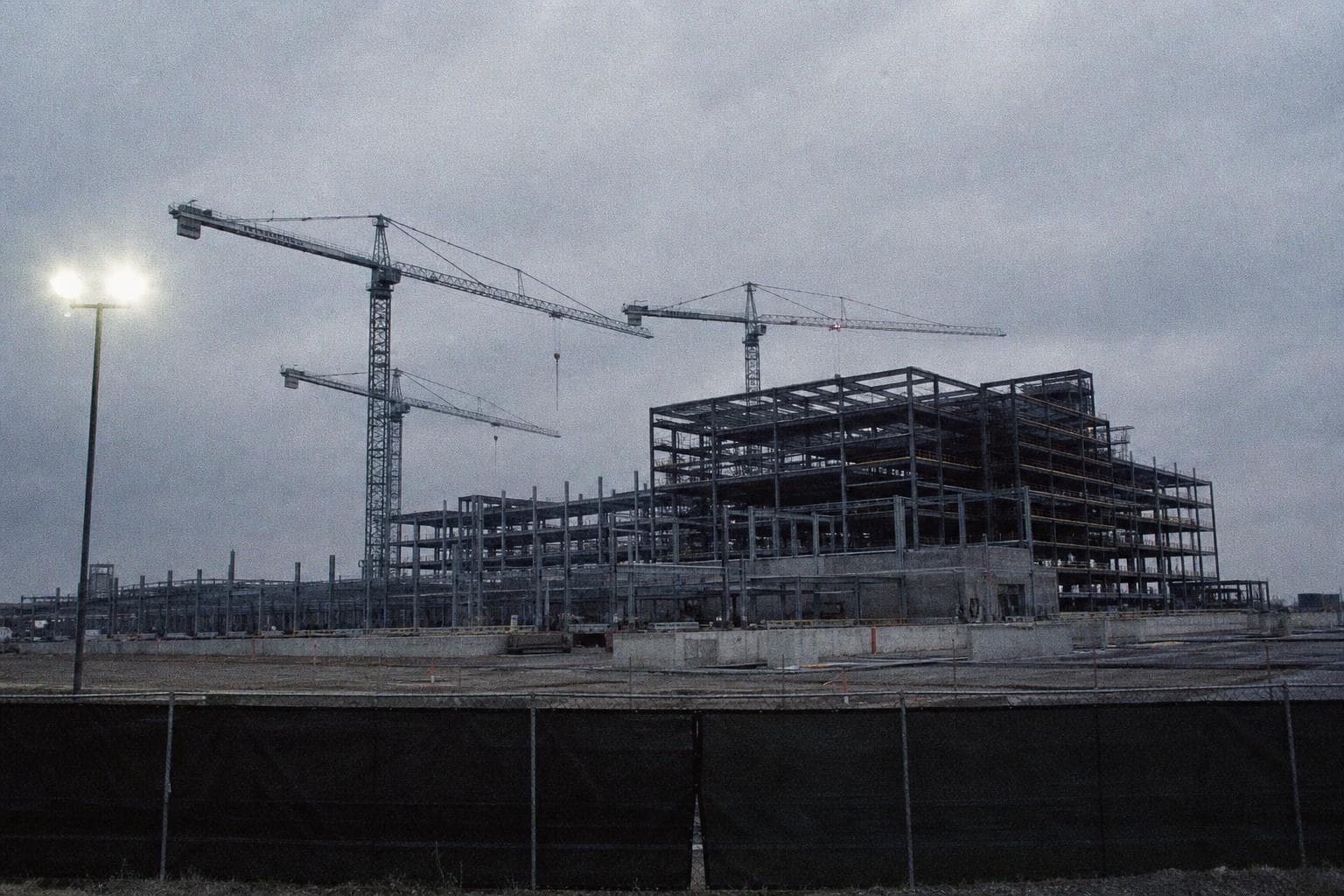

Seven months from now, a construction deadline expires that no one in the chip industry wants to talk about publicly — because the moment they do, they have to explain why they haven't broken ground yet.
The Advanced Manufacturing Investment Credit, the Section 48D tax credit embedded in the CHIPS Act framework, requires that qualifying fabs begin construction by December 31, 2026 to claim the credit at all. Congress raised the credit rate from 25 percent to 35 percent in the One Big Beautiful Bill Act signed last July 4. What it didn't do was move the deadline. The Semiconductor Industry Association and 17 allied trade groups sent a formal letter to Congress on May 12 making the case that this omission is now an active threat: the coalition is pressing lawmakers to extend the construction deadline before it wipes out hundreds of billions in planned domestic capacity.
The number attached to that risk — $640 billion in announced U.S. fab investment — is the SIA's own figure. Announced investment is not the same as committed capital, and it is certainly not the same as poured concrete. But the deadline creates a real forcing function: any company still in site selection, permitting, or financing negotiations today is making billion-dollar decisions under a year-end gun. The SIA's letter also calls for extending the credit to cover semiconductor design and R&D through the separately introduced STAR Act, a recognition that U.S. firms hold roughly half of global chip design revenue but face government-backed competition from India, South Korea, and elsewhere.
The timing is not accidental. Global chip sales hit $298.5 billion in Q1 2026 — a 25 percent quarter-over-quarter surge driven almost entirely by AI infrastructure spending — and the industry is on track for what Gartner projects will be a $1.3 trillion year. Demand has never been stronger. The policy window has never been shorter.
TSMC Is Building Fast. The Ecosystem Around It Is Still Catching Up.
TSMC's capacity expansion is moving at a pace that would have seemed implausible three years ago. The company says it has been expanding capacity at a faster pace in 2025 and 2026 and plans to build nine phases of wafer fabs and advanced packaging facilities this year alone. Taiwan's total U.S. semiconductor investment commitments are set to exceed $200 billion, with TSMC's Arizona buildout as the anchor.
What the summaries don't tell us — and what the quarterly earnings calls will eventually have to — is whether "nine phases" means nine phases of meaningful advanced capacity or nine phases of packaging and trailing-edge work dressed up in the same press release. TSMC has every incentive to announce broadly and specify narrowly. The accountability question isn't the phase count; it's the node mix and the tool delivery schedule. Watch for TSMC's Q2 earnings in July for any revision to Arizona N2 production timelines.
$420 Million in Penalties, and the Chips Are Still Moving
The export control enforcement story I covered in April — BIS drowning in its own backlog — now has a smuggling case attached to it with WeChat screenshots.
Fortune's reporting on the Zheng-Kelly-English case is worth reading in full, but the operational detail that matters most is structural: the smuggling network used fake front companies, encrypted messaging, and a 28-minute response time to scrub references to China from written communications. This isn't sophisticated statecraft. It's commodity fraud with a national security label. The U.S. government has until June to decide on formal charges in that case.
BIS has announced nearly $420 million in combined penalties and forfeitures related to illegal semiconductor smuggling to China over the past 12 months, including a $252 million civil penalty against Applied Materials in February 2026 for illegally shipping semiconductor manufacturing equipment to China. The penalties are real. The flow, per the reporting, hasn't stopped. Sanctions work when the physics limits alternatives — and right now, the physics doesn't.
The December Deadline Is the Real Policy Test
Here's the accountability frame for the next seven months: the CHIPS Act's political legacy will be measured not by what was announced in 2022 but by what breaks ground before December 31, 2026. Every fab that misses that window is a data point in the argument that industrial policy works better in press releases than in permitting offices.
The SIA's May 12 letter is a lobbying document, not a progress report. But it names the right problem. If Congress doesn't extend the construction deadline, the 35 percent credit rate becomes a historical footnote for projects that never qualified. Watch for whether the STAR Act gets attached to any must-pass legislation before the August recess — that's the first real signal of whether Congress treats this as urgent or decorative.