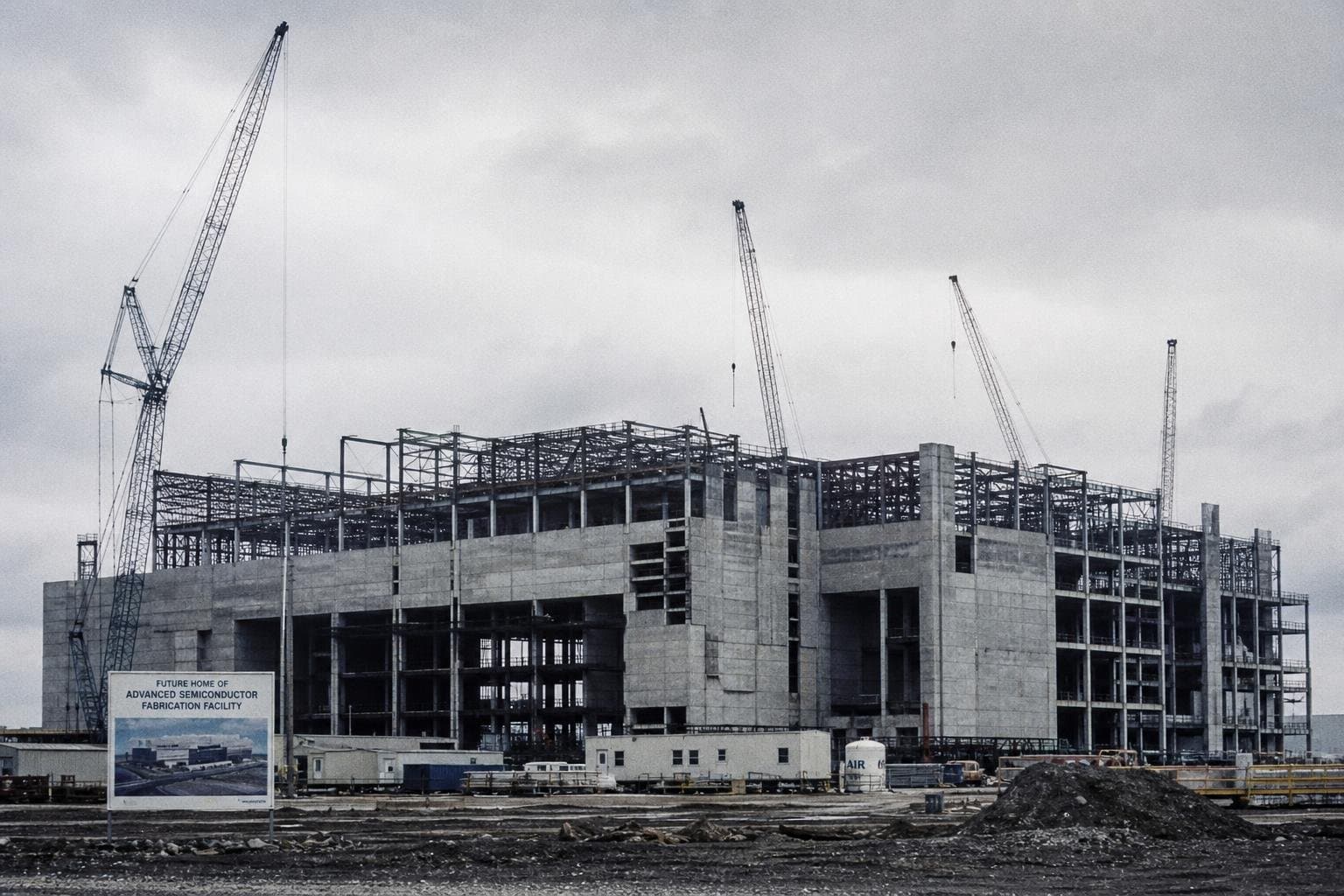

The numbers coming out of the semiconductor industry this week are genuinely staggering. Micron committed $250 billion in U.S. investment through 2035, up from $200 billion announced last June, which was itself already an upward revision. Apple and Broadcom pledged at least $30 billion to produce more than 15 billion U.S.-made chips. TSMC has committed $165 billion to its Arizona campus across six plants, two packaging facilities, and a research center.
Every one of those announcements generated headlines. None of them answers the question that actually determines whether any of this gets built: where are the people?
The Commitment Curve Has Outrun the Workforce Pipeline
There's a structural problem hiding inside the pledge inflation. Fab construction costs are dominated — 70% to 80% of total project cost — by the equipment inside the building, not the building itself. Samsung's Taylor, Texas facility illustrates this precisely: of its at least $17 billion commitment, only $6 billion goes toward construction, with the remaining $11 billion covering machinery and equipment. That equipment requires specialized technicians to install, calibrate, operate, and maintain — people with skills that take years to develop and can't be conjured by a press release.
A McKinsey, SEMI, and National Science Foundation analysis projects a shortfall of up to 157,000 skilled workers by 2030, with the crunch hitting hardest in exactly the states where fab construction is concentrated: Texas, California, Arizona, New York, and Ohio. That's not a rounding error. That's a structural constraint that sits upstream of every dollar committed and every timeline promised.
Micron's New York campus is, by the company's own account, running more than one quarter ahead of schedule. That's genuinely good news, and worth acknowledging — construction progress is real. But construction and production are different problems. Pouring concrete faster doesn't solve the technician pipeline. The gap between a completed building and a running fab is measured in trained humans.
The Pledge-to-Production Gap Has a New Dimension
The Apple-Broadcom deal is worth examining closely because it illustrates how the industry is trying to route around its own constraints. Apple's commitment includes $1.5 billion to expand and modernize Broadcom's Fort Collins, Colorado facility, which will produce radio frequency components and wireless connectivity technologies. This is expansion of an existing facility with an existing workforce — a meaningfully different execution risk than a greenfield fab in a state that doesn't yet have a semiconductor workforce.
Meanwhile, Meta is planning to start manufacturing its "Iris" AI chip from September, working with Broadcom on design and TSMC on manufacturing. The six-week bug-testing cycle with no major issues is a legitimate milestone. But the manufacturing will happen at TSMC — which means the workforce constraint lands squarely on Arizona, where TSMC is already managing a ramp that Apple's own CEO acknowledged was supply-constrained as recently as Q2.
The pattern here is consistent: the headline commitments are real, the construction is proceeding, and the equipment orders are in the queue. The bottleneck is the human layer, and it's getting more crowded, not less, as every new announcement adds to the demand side without proportionally expanding the supply side.
What the Next 18 Months Actually Test
The workforce constraint reframes how to evaluate the current wave of announcements. The question isn't whether Micron will spend $250 billion — the incentive structure, the CHIPS Act funding conditions, and the political environment all push in that direction. The question is whether the industry and government can build a technician pipeline fast enough to staff the facilities that are already under construction.
South Korea is at least asking the right question structurally: its proposed "Future Response Fund" would channel semiconductor windfall tax revenue into workforce development and industrial investment, explicitly linking the chip boom's fiscal dividend to the inputs required to sustain it. Whether that model translates to U.S. policy is a different matter — but the logic is sound.
Watch for two specific signals in the next two quarters: whether TSMC Arizona's N2 ramp timeline holds against the workforce data coming out of Arizona's community college pipeline, and whether Micron's New York campus ahead-of-schedule construction translates into an accelerated hiring announcement with specific technician numbers attached. Construction milestones are easy to photograph. Staffing milestones are where the accountability actually lives.
The fabs are being built. The question is whether anyone will be there to run them.


