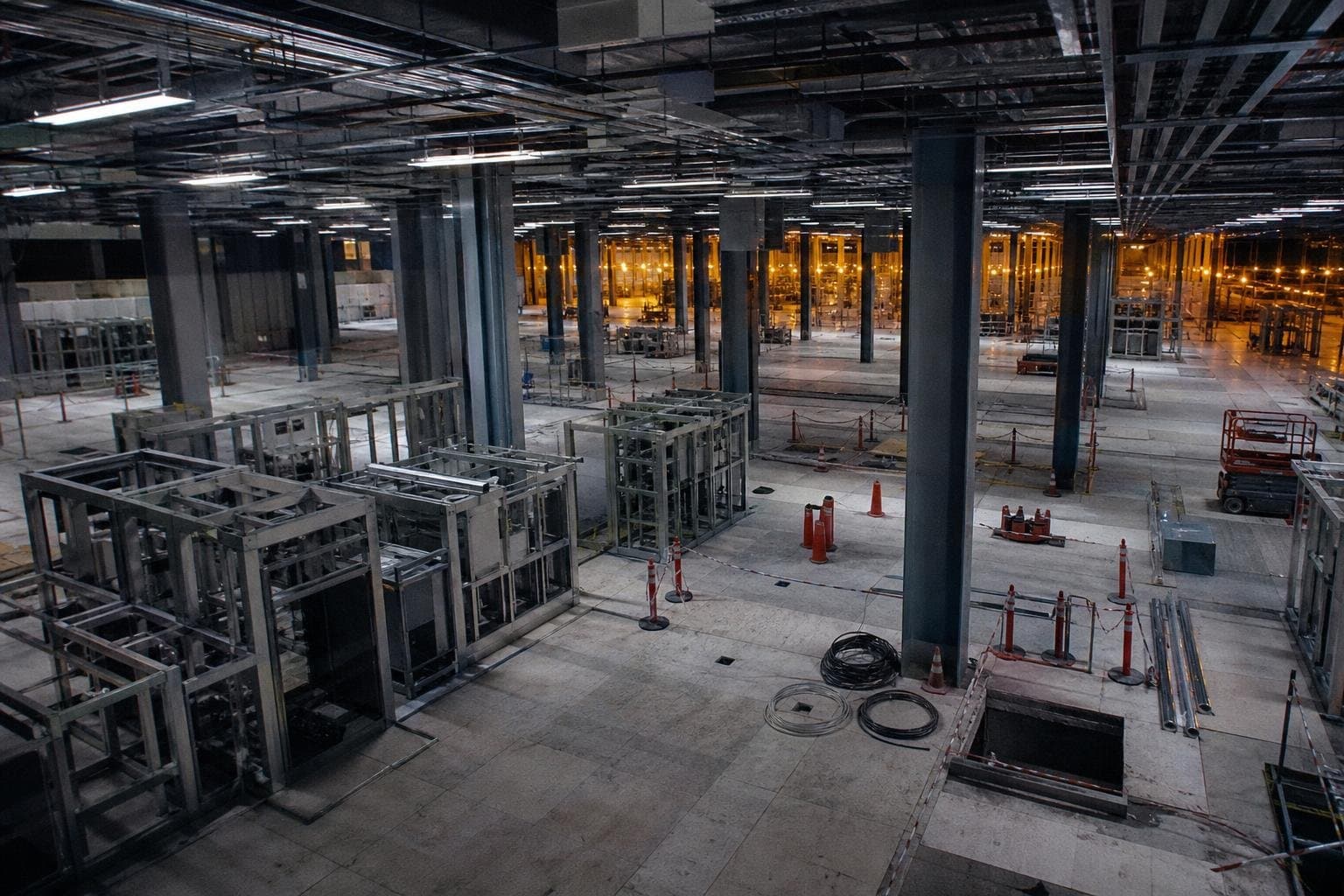

A 7.1-magnitude earthquake hit Kumamoto Prefecture on July 28. TSMC evacuated workers, ran structural inspections, and resumed operations the same day. The construction site was unaffected. That's the kind of operational resilience that doesn't make PowerPoint slides — it just happens.
What did make headlines last week was a different kind of structural risk: Nvidia potentially providing a roughly $250 billion backstop for a massive OpenAI data-center project tied to a U.S. government initiative, developed by SB Energy, a SoftBank subsidiary. Nvidia's stock fell 5% on the news. The market's reaction was the correct one, and it points to a structural question that's been building for months: what happens when the chip industry's demand signal is partly manufactured by the chipmakers themselves?
The Backstop Problem Is a Demand Verification Problem
The Nvidia-OpenAI situation is worth examining carefully, because it's not simply a financing story. It's a signal integrity problem.
When a chipmaker finances its own customer's ability to buy chips, the revenue that results doesn't tell you much about organic demand. It tells you the chipmaker was willing to take on the customer's credit risk to book the sale. That's a meaningful distinction for anyone trying to assess whether AI infrastructure buildout reflects genuine economic demand or a vendor-financed construction boom.
Nvidia shares fell 5% on July 27, with investors specifically citing concerns about "the extent to which Nvidia is investing in its own customers." That framing is polite. The blunter version: if your customer needs you to lend them a quarter-trillion dollars to buy your product, you should ask whether they're actually your customer or your inventory.
This matters for semiconductor accountability tracking because it complicates the demand picture that's supposed to justify the entire U.S. fab buildout. The CHIPS Act rationale rests on the premise that domestic chip demand is real, durable, and strategically important. Circular financing arrangements don't invalidate that premise — but they do make it harder to verify.
Commerce Is Still Writing Checks, But "Letters of Intent" Aren't Fabs
On the R&D side, the Department of Commerce announced letters of intent with seven companies for $874 million in CHIPS Act incentives targeting integrated photonics, compute architectures, advanced packaging, substrates, materials, and memory. Secretary Howard Lutnick called it "accelerating America's innovation engine."
The standard caveat applies: letters of intent are not awards. The announcement explicitly notes that "further diligence and approval by the Department" is required before final awards are made. The government will take a minority, non-controlling equity stake in each recipient company as a condition of funding — a structure that at least aligns some incentives, though minority stakes in R&D-stage companies are not a robust accountability mechanism.
The $874 million figure also deserves context. It's spread across seven companies working on foundational R&D — photonics, packaging, substrates — that won't produce commercial chips on any near-term timeline. This is the right kind of investment for long-run supply chain resilience. It's the wrong thing to cite as evidence that the U.S. semiconductor industrial base is being rebuilt. R&D incentives and fab construction are different instruments operating on different timelines, and conflating them is how "America is winning the chip race" narratives get built on thin foundations.
The Mature Node Story Is Getting More Interesting Than the Headline Node Story
While the advanced-node drama plays out, UMC raised its 2026 capital expenditure budget to $2 billion and approved a $5 billion combined budget for 2026 and 2027, covering cleanroom expansion in Singapore and a new fab building at its Tainan campus. CEO Jason Wang cited AI data center connectivity, power products, automotive electrification, and robotics as the demand drivers. UMC expects AI-related revenue to hit roughly $300 million this year and exceed $1 billion within three years.
UMC focuses on mature nodes — the unglamorous silicon that runs power management, connectivity, and analog functions in every system that the advanced-node chips sit inside. The fact that a mature-node foundry is raising capex aggressively while advanced-node players are navigating circular financing arrangements and demand questions is worth flagging. Mature node capacity is where actual supply chain vulnerability lives for most industrial and defense applications. It's also where export control enforcement gets complicated, because mature-node equipment is harder to restrict.
What to Watch
Three things to track in the next 30 days: First, whether any of the seven CHIPS R&D letters of intent convert to final awards, and what measurable deliverables are attached. Second, whether the Nvidia-OpenAI data center financing structure gets disclosed in more detail — the $250 billion figure is enormous and the terms matter enormously for understanding what kind of demand it represents. Third, UMC's Singapore Phase 4 expansion timeline, which is the most concrete mature-node capacity addition currently on the books from a foundry with a credible construction record.
The earthquake in Kumamoto was a reminder that physical infrastructure has physical risks. The Nvidia financing story is a reminder that demand signals have structural risks too. Both require the same discipline: verify before you price in.


