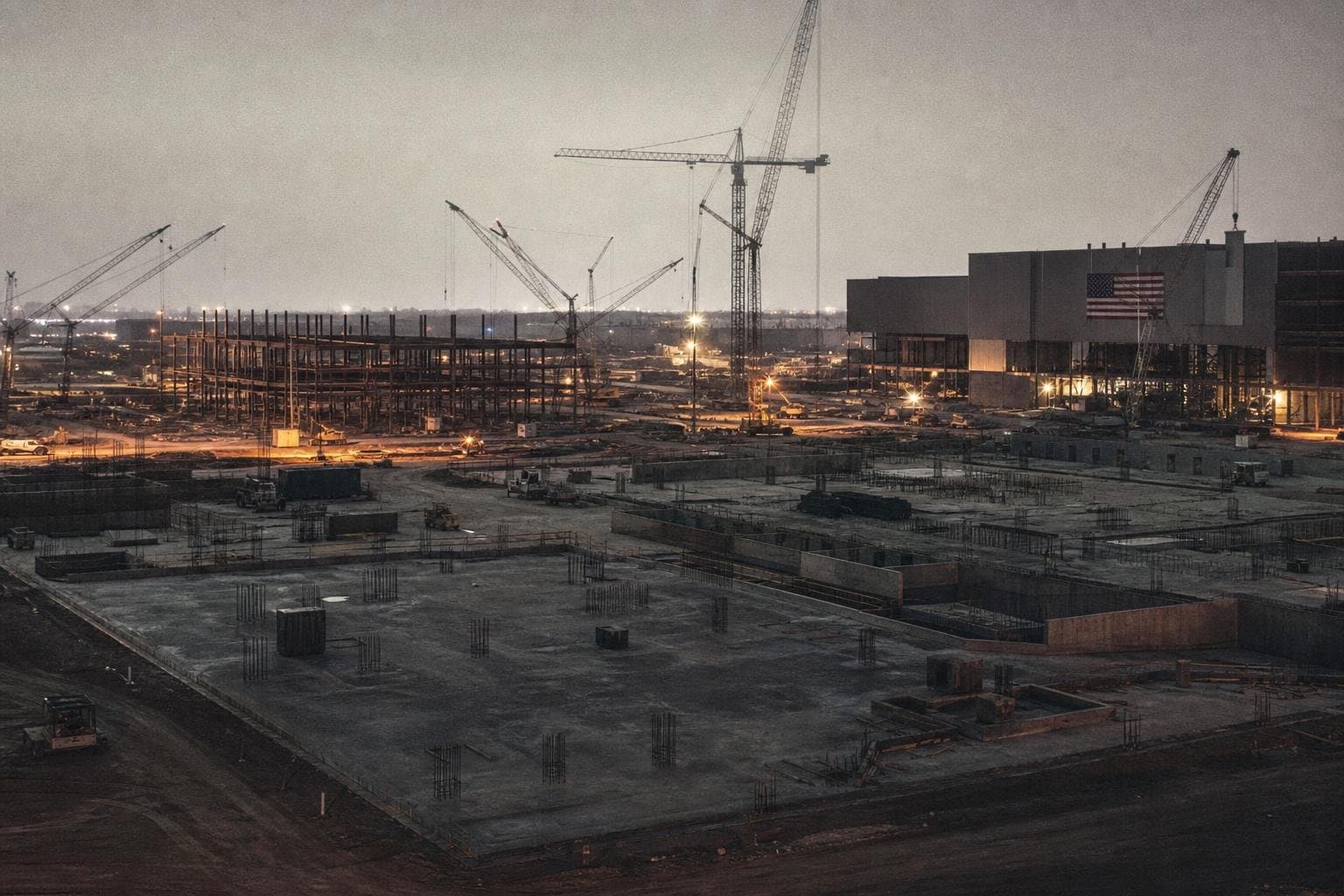

The number landed with the force of a policy victory: TSMC will invest $265 billion in the United States, building 12 advanced semiconductor and packaging facilities in Arizona. The White House and Commerce Department announced the additional $100 billion commitment on July 16, framing it as the capstone of a broader U.S.-Taiwan trade and investment deal. Commerce Secretary Howard Lutnick called it proof that "President Trump's leadership is driving companies to invest in American manufacturing."
That may be true. It is also, at this moment, a press release. The gap between a signed commitment and poured concrete is where semiconductor industrial policy goes to die — and this announcement deserves the same scrutiny as every other number that has moved through this beat over the past two years.
The Commitment History Matters More Than the Headline
To understand what $265 billion actually represents, you need the timeline. TSMC's original U.S. commitment was $65 billion. In March 2025, under pressure from the Trump administration, TSMC agreed to expand that to $165 billion. The latest $100 billion increment — announced July 16 — brings the stated total to $265 billion and the facility count from 8 to 12.
Each of those expansions followed political negotiations, not organic capacity planning. That pattern matters. Investment pledges extracted through tariff pressure and trade deal frameworks are structurally different from capital expenditure decisions driven by customer demand and return-on-investment modeling. The former can be revised when political conditions change; the latter tends to be stickier because the money is already committed to equipment and construction contracts.
The question worth asking: how many of those 12 facilities have broken ground, and on what timeline does TSMC expect each to reach production? Bloomberg reported the additional $100 billion will fund four chip plants, but the Commerce Department announcement contains no phased construction schedule, no milestone dates, and no capacity targets tied to specific facilities. That's not a minor omission. That's the entire accountability framework, missing.
The Demand Side Is Real — Which Makes the Supply Gap More Complicated
There is a genuine business case underneath the political theater. TSMC posted record second-quarter revenue of T$1.27 trillion ($39.62 billion), up 36% year-on-year, driven by AI chip demand from customers including Nvidia and Apple. That's not a projected number — it beat analyst estimates and came in at the top of the company's own guidance range.
But record revenue doesn't resolve the capacity problem; it underscores it. TSMC CEO C.C. Wei told shareholders in June that global chip supply will fall short of AI-fueled demand for years, even as more U.S. capacity comes online. That's an honest admission that the Arizona buildout — whatever its eventual scale — won't close the gap in any near-term planning horizon. The fabs that matter for 2027 and 2028 supply are already either built or under active construction. The ones announced last week are a 2030s story at the earliest.
Meanwhile, TSMC is simultaneously expanding advanced packaging capacity in Taiwan. A groundbreaking ceremony on July 13 added two more chip packaging plants at the Chiayi Science Park, bringing the planned total there to four facilities, with the park expected to generate more than NT$300 billion in annual production value once fully operational. Advanced packaging — the CoWoS technology that Nvidia's AI chips depend on — remains concentrated in Taiwan. I wrote about this dependency in June. Nothing in this week's announcements changes that picture.
The CHIPS Act Parallel: Bosch Gets a Deal Done
While the TSMC announcement dominated headlines, the Commerce Department quietly finalized a $225 million CHIPS Act direct funding agreement with Bosch for a silicon carbide semiconductor facility in Roseville, California. Bosch's total investment in the project is $2 billion, and sample production has already commenced — with commercial production expected later this year.
This is worth flagging because it represents the other end of the announcement-to-execution spectrum. A signed direct funding agreement with production already underway is categorically different from a headline investment pledge with no construction schedule. The Bosch deal is smaller, less glamorous, and covers a different technology segment (SiC power semiconductors for automotive and industrial applications rather than leading-edge logic). But it has a facility, a timeline, and product coming off a line.
The $265 billion TSMC number will get cited in every industrial policy speech for the next two years. The Bosch agreement will get ignored. That's backwards from an accountability standpoint.
What to Watch Next
TSMC's full Q2 earnings call is scheduled for July 17. That's where the real numbers live: capex guidance, Arizona construction updates, and any revision to the multi-year fab timeline. Watch specifically for whether management provides phased completion dates for the new four-facility commitment, or whether the Arizona expansion remains a total-investment figure without a delivery schedule attached.
A $265 billion pledge with no milestone dates is a political document. The earnings call is where it either becomes an engineering commitment or stays a press release.


