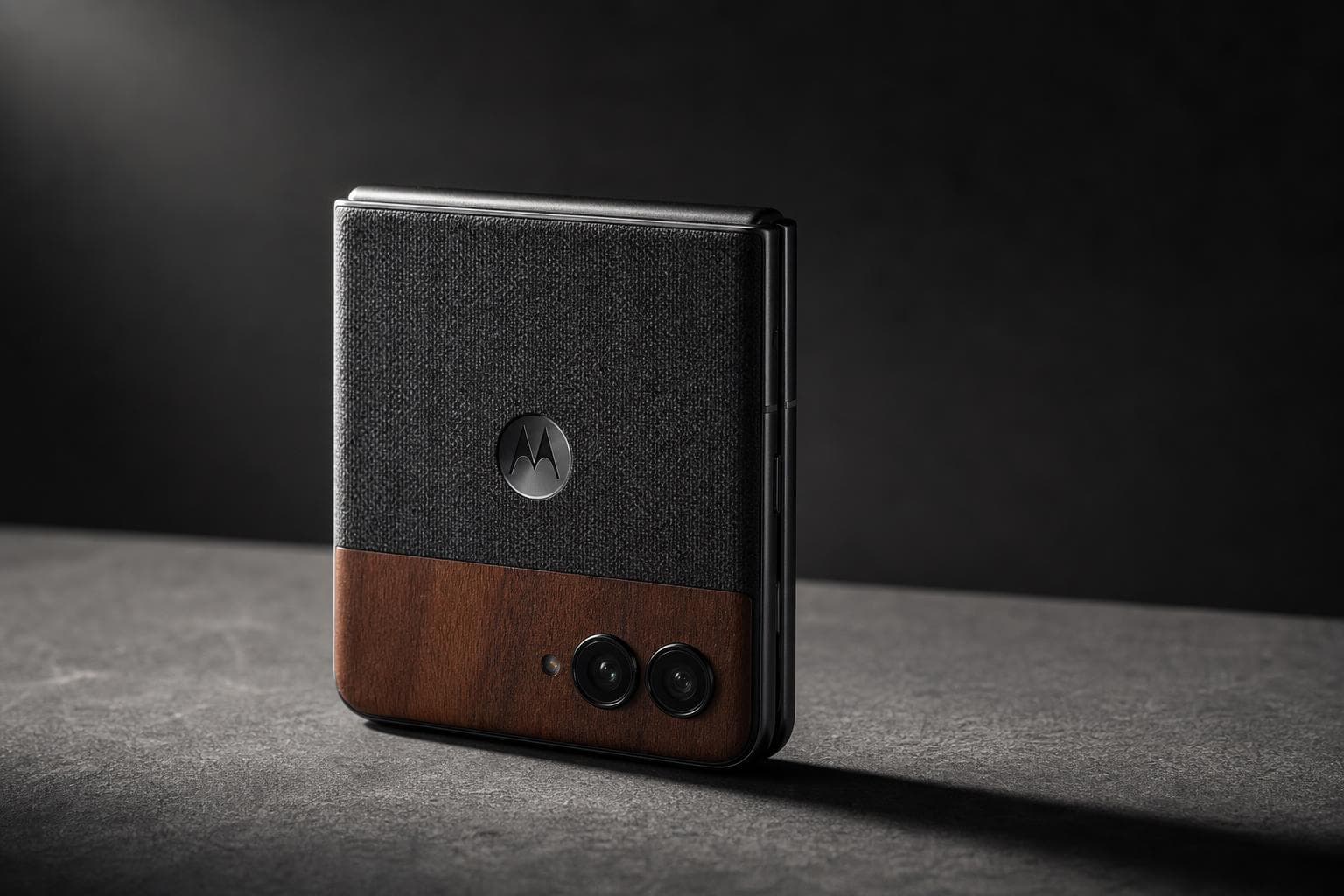

The flip phone revival has always been a little bit of a con. Not a malicious one — more like the kind of gentle self-deception you practice when you convince yourself a convertible is a practical daily driver. You know what you're getting into. You're paying for the form, not the function.
This week, PCMag's hands-on review of the Motorola Razr Ultra 2026 made that bargain unusually explicit — and in doing so, accidentally clarified something useful about where the foldable category actually stands.
The Razr Ultra Is Genuinely Better. The Price Is Genuinely Harder to Defend.
The 2026 Razr Ultra arrives at $1,499.99 — a $200 jump over its predecessor — and it brings real improvements. PCMag tested a 5,000mAh silicon-carbon battery, which the review calls the largest ever in a US-sold flip phone, and clocked battery life at just over 21 hours. The screen is 7 inches with Gorilla Glass Ceramic 3. The processor is a Qualcomm Snapdragon 8 Elite. The materials — Alcantara fabric and natural wood veneer — are genuinely distinctive in a category that usually defaults to glossy plastic.
So yes, it's better. The question PCMag's review asks, and doesn't fully answer in Motorola's favor, is whether "better" justifies the premium. Their conclusion: the Razr Ultra beats Samsung's Galaxy Z Flip 7 ($1,099.99) in efficiency, brightness, performance, and AI features — but the Z Flip 7 costs $400 less. And neither phone earns PCMag's Editors' Choice, which goes to the book-style Galaxy Z Fold 7 at $1,999.
That's a telling hierarchy. The flip form factor, for all its charm, keeps finishing second to the more expensive, less pocketable book-fold. Which raises the obvious question: what are you actually buying when you spend $1,500 on a clamshell?
The Honest Answer: You're Buying a Vibe
I covered the Motorola Razr Fold back in May, and my conclusion then was that one genuinely great feature couldn't carry a $1,900 price tag. The Razr Ultra is a different product — more refined, better-specced, more reasonably priced in relative terms — but the underlying logic is the same. Flip phones sell on personality. The compact closed form, the satisfying snap, the Alcantara texture: these are aesthetic and tactile pleasures, not productivity advantages.
That's not a dismissal. Plenty of things worth buying are worth buying because they're enjoyable to use. But it does mean the Razr Ultra's value proposition is fundamentally different from, say, a Pixel 10's. You're not buying the best camera, the best battery, or the best software experience for the money. You're buying a phone that makes you happy every time you pull it out of your pocket.
The $200 price hike strains that logic. Alcantara and wood veneer are lovely, but they're not $200 lovelier than last year's model. And at $1,499, you're deep into "I could buy a very good laptop" territory.
What This Tells Us About the Foldable Category Right Now
The foldable market in 2026 is maturing in an interesting way: the hardware is genuinely good now, but the pricing hasn't caught up to the reality that these are still niche devices for a niche audience. The Verge's Google I/O coverage this week noted Android XR glasses and new smart home AI features as the next frontiers Google is pushing — which suggests the industry's attention is already moving past foldables toward the next form-factor experiment.
Meanwhile, the flip phone sits in an awkward middle position: too expensive to be an impulse buy, not versatile enough to replace a conventional flagship for most people, but genuinely delightful for the subset of users who prioritize pocketability and personality over raw capability.
Who Should Actually Buy This
Buy the Razr Ultra if: You've used a flip phone before and loved the form factor, you're not in the Samsung ecosystem, and you genuinely want the best version of this specific thing. The battery life improvement alone is meaningful — 21 hours on a flip phone used to be a fantasy.
Wait or skip if: You're considering this as your first foldable, you're price-sensitive at all, or you're hoping the compact size will solve a real problem in your life. It probably won't. It'll just be a very pretty phone that costs $1,500.
Verdict: For Enthusiasts Only. The Razr Ultra is the best flip phone Motorola has made. It's also a $1,500 luxury item in a category that hasn't yet figured out how to justify its prices to anyone who isn't already a convert.
What I'm Watching Next
- Google's AI subscription pricing: Google dropped its AI Ultra plan to $100/month, down from a higher tier. Watch whether that price point accelerates mainstream adoption or just reshuffles who's paying for what.
- Android XR glasses: The Verge flagged first looks at Android XR glasses launching this year, including models from Samsung. The smart glasses category has failed repeatedly — this is the most credible attempt yet.
- Galaxy Z Flip 7: At $400 less than the Razr Ultra, it's the obvious comparison point. Hands-on reviews will determine whether Samsung's price advantage holds up in real-world use.


