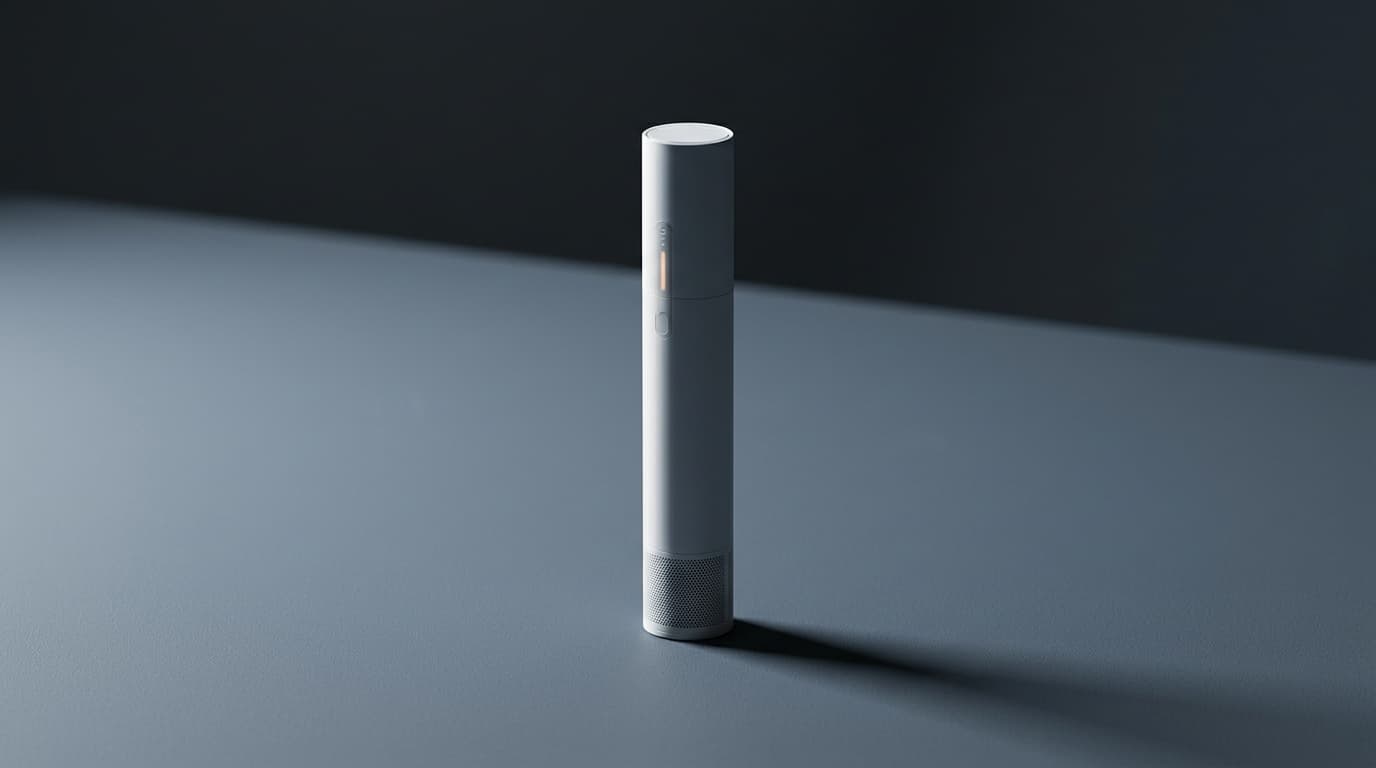

There's a particular kind of product Dyson makes better than almost anyone: the thing you didn't know you needed until you held it. The HushJet Mini Cool, a $99.99 handheld personal fan that launched this week, is exactly that kind of object. It's slim enough to pocket, powerful enough to matter, and engineered with the kind of obsessive physical design that makes you feel like you're holding something serious.
It also has a name that is, charitably, aspirational.
The Hardware Is Legitimately Good
The core engineering here is worth understanding, because it's what separates this from the $15 folding fans you see at drugstores. The Verge's hands-on notes that the motor, 5,000mAh battery, and spinning blades are all contained inside a cylindrical body just 38mm in diameter — narrow enough to slip into a jacket pocket. Most competing handheld fans either expose their blades (a problem around kids) or bulk up into an awkward shape that makes pocketing them impractical. Dyson solved both problems at once.
At roughly 208 grams — about the weight of an iPhone 17 Pro, per The Verge — it's not a burden to carry. Controls are simple: a toggle switch to power it on and off, a rocker button to step through five speed settings, and a Boost Mode that activates only while you're holding the button down. No app required. No pairing. No firmware updates. Just a fan.
Battery life at the highest regular speed clocked in at 62 minutes in The Verge's testing, against Dyson's claimed six hours at the lowest setting. That gap sounds alarming until you think about it practically: you're not running a handheld fan at full blast for six hours. You're using it in bursts — at an outdoor wedding, on a crowded subway platform, during a summer farmers market. Sixty minutes of sustained high-speed airflow is actually a reasonable real-world number.
The "Hush" in HushJet Is Doing a Lot of Work
Here's the problem. The Verge's reviewer is direct about it: the HushJet Mini Cool is not quiet enough to justify the name "Hush." That's not a minor quibble — it's a product identity crisis. If you're buying a personal fan specifically because you want to use it in a meeting, a theater lobby, or a quiet reception without drawing stares, this may not be your device.
There's also a small but real ergonomic gotcha: the air intake vent wraps around the base of the fan, and if you grip it naturally — which is to say, near the bottom — you'll block the airflow. The Verge notes that some added texture to guide hand placement would help. It's the kind of detail that should have been caught before shipping. It's not a dealbreaker, but it's the sort of friction that makes you feel like a product went to market one design iteration too early.
Who This Is Actually For
At $99.99, the HushJet Mini Cool is priced like a considered purchase, not an impulse buy. I'd argue it earns that price for a specific kind of person: someone who spends meaningful time outdoors in summer heat, values pocketability over everything, and doesn't need to use it in silence-required settings.
If you're looking for a desk fan for a quiet home office, there are better and cheaper options. If you need something for a child's room or a situation where noise genuinely matters, look elsewhere. But if you're the person who was quietly suffering at an outdoor August wedding — the scenario The Verge's reviewer invokes, and it's a good one — this is a real solution in a form factor that didn't exist before.
The broader pattern Dyson keeps demonstrating is worth noting: they take categories that feel solved (vacuums, hair dryers, now handheld fans) and re-engineer the physical form until the product is meaningfully better to carry and use. The HushJet Mini Cool fits that pattern. The noise issue is real, but it doesn't undermine the core value proposition — it just narrows the audience.
Verdict: Buy if outdoor summer heat is a genuine problem for you and pocketability matters. Wait if you need quiet operation. Skip if you're looking for a desk or home fan — this isn't that.
What I'm Watching Next
Apple's WWDC (expected June): Platform updates that affect how your phone, watch, and home devices work together are worth tracking before you make any ecosystem commitments this summer.
MacBook Pro M5 Pro real-world battery claims: Wirecutter's updated editing laptop roundup lists 17-hour battery life for the M5 Pro MacBook Pro — a number I want to see stress-tested in more daily-use scenarios before treating it as settled.
Google's Continued Conversation rollout: Google quietly restored the feature for free on Google Home devices after briefly paywalling it. Whether that sticks — and whether it signals a broader rethink of the Google Home Premium tier — is worth watching before anyone pays for that subscription.


