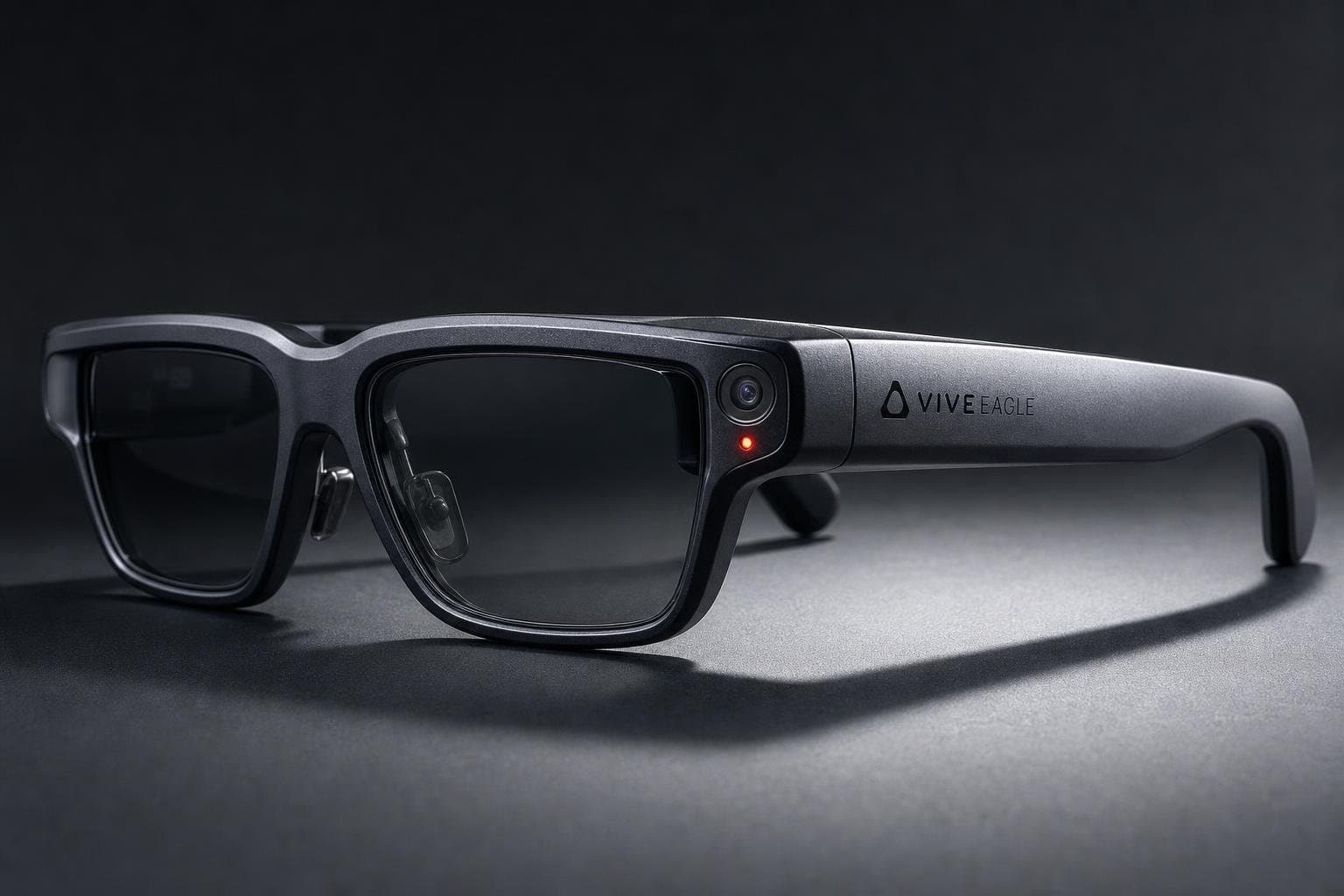

Most AI smart glasses ship with a fundamental tension baked in: they're designed to see the world around you, which means they're also designed to see the people around you — whether those people agreed to be seen or not. Meta's Ray-Bans made this uncomfortable reality mainstream. The HTC Vive Eagle, which expanded to the US, Europe, and Australia this week after a spring launch limited to Taiwan, is the first pair I've seen make a credible attempt to engineer around it.
Whether that's enough to justify a $499 price tag is a harder question.
The Privacy Features Are Genuinely Thoughtful
The Vive Eagle's two standout privacy mechanisms are worth understanding in detail, because they're not just marketing language — they're observable behaviors.
First: if you cover the LED recording indicator while the camera is active, the glasses stop capturing media and verbally announce "LED covered, recording has stopped." Other glasses, including Meta's Ray-Bans, have indicator lights too, but the reviewer at The Deep View found HTC's tamper response to be the most immediate and reliable they'd encountered. Second: the camera disables entirely when the glasses aren't being worn — a detail the reviewer only discovered when attempting to take a selfie with the glasses sitting on a table. The intent is to prevent the glasses from recording people when left lying around inconspicuously.
On top of that, HTC has pursued ISO 27001 and ISO 27701 certifications covering information security management and privacy information management respectively, which the company says no other AI glasses manufacturer currently holds. Certifications aren't a guarantee of good behavior, but they do represent a documented, auditable commitment that goes beyond a press release.
For anyone who has wanted to try AI glasses but felt genuinely uneasy about the social implications of wearing a camera on their face, this is the most thoughtful hardware response to that concern yet.
The Battery Problem Gets a Clever (If Incomplete) Fix
The other recurring complaint about AI smart glasses — battery life — gets an interesting solution here. HTC sells a magnetic "Powerboost" accessory, roughly the size of a flash drive, that clips on and charges the glasses while you're still wearing them. No removing the frames, no hunting for a cable.
The catch: the Powerboost carries a 120 mAh battery, which isn't enough to fully charge the glasses from empty. In testing, it brought the glasses from 39% to 84% before running dry. That's a meaningful top-off — enough to extend a workday — but not a full rescue if you've forgotten to charge overnight. The accessory runs an additional $49, bringing your all-in cost to $548 if you want the full experience.
Still, the concept is right. Battery anxiety is a real friction point across the wearables category — it's one reason smartwatch reviewers consistently flag endurance as a make-or-break factor when recommending devices to everyday buyers. Being able to top up glasses without removing them is a genuine quality-of-life improvement, particularly if you wear prescription lenses and want these as your daily frames. The execution just needs a bigger battery in the next version.
The AI Itself Is Still Catching Up to the Hardware
Here's where the Vive Eagle lands in roughly the same place as every other pair of AI glasses on the market: the artificial intelligence features are interesting in concept and underwhelming in practice.
HTC gives users a choice between Gemini and ChatGPT as their AI assistant — a flexibility that competitors don't offer — but the company itself acknowledges that the experience may differ from using those models on a phone or other device. The reviewer confirmed this, finding that responses through the glasses were noticeably less robust than going directly to the apps. It's a pattern visible across the broader device ecosystem right now: manufacturers are racing to embed AI into hardware before the software integration has fully caught up, whether that's in glasses, handhelds, or home appliances.
This is worth naming plainly: at $499, you are paying a significant premium over standard Meta Ray-Bans, and a meaningful portion of that premium buys you privacy architecture rather than AI capability. If you want the most capable AI assistant in a glasses form factor right now, the Vive Eagle probably isn't it. If you want the most privacy-conscious option, it's the clear leader.
Who Should Actually Consider These
The Vive Eagle makes the most sense for a specific kind of buyer: someone who has been genuinely interested in AI glasses but held back by legitimate concerns about recording other people without their knowledge or consent. Journalists, lawyers, healthcare workers, or anyone operating in environments where recording norms matter will find the tamper-detection and wear-detection features meaningfully reassuring rather than merely cosmetic.
For everyone else — people who just want a hands-free assistant for navigation, quick questions, and music — the price-to-AI-capability ratio is hard to defend. The broader phone market has conditioned buyers to expect a lot of capability per dollar: even mid-range Android flagships now ship with robust AI features baked in at a fraction of this price point. Glasses have to earn their place on your face.
Watch for whether competitors respond to HTC's privacy certifications with their own. The ISO 27701 standard in particular is a concrete benchmark that Meta and others could pursue if consumer pressure builds. IFA 2026 in Berlin is already surfacing a wave of new AI-integrated devices across categories — and notably, none of the headline announcements there appear to be leading with privacy as a differentiator. HTC has set a bar; whether the rest of the industry clears it will tell you a lot about how seriously this category takes the problem it created.


