



Apple spent nearly a decade watching Amazon and Google build an entire smart-display category before it showed up to the party. That's not my framing — it's Engadget's, in its hands-on review of the new device, which notes that Apple's debut home hub arrives nearly a decade behind its main rivals. The wait is over. The question is whether it was worth it for anyone who isn't already fully wired into an iPhone.
What HomeView Actually Is
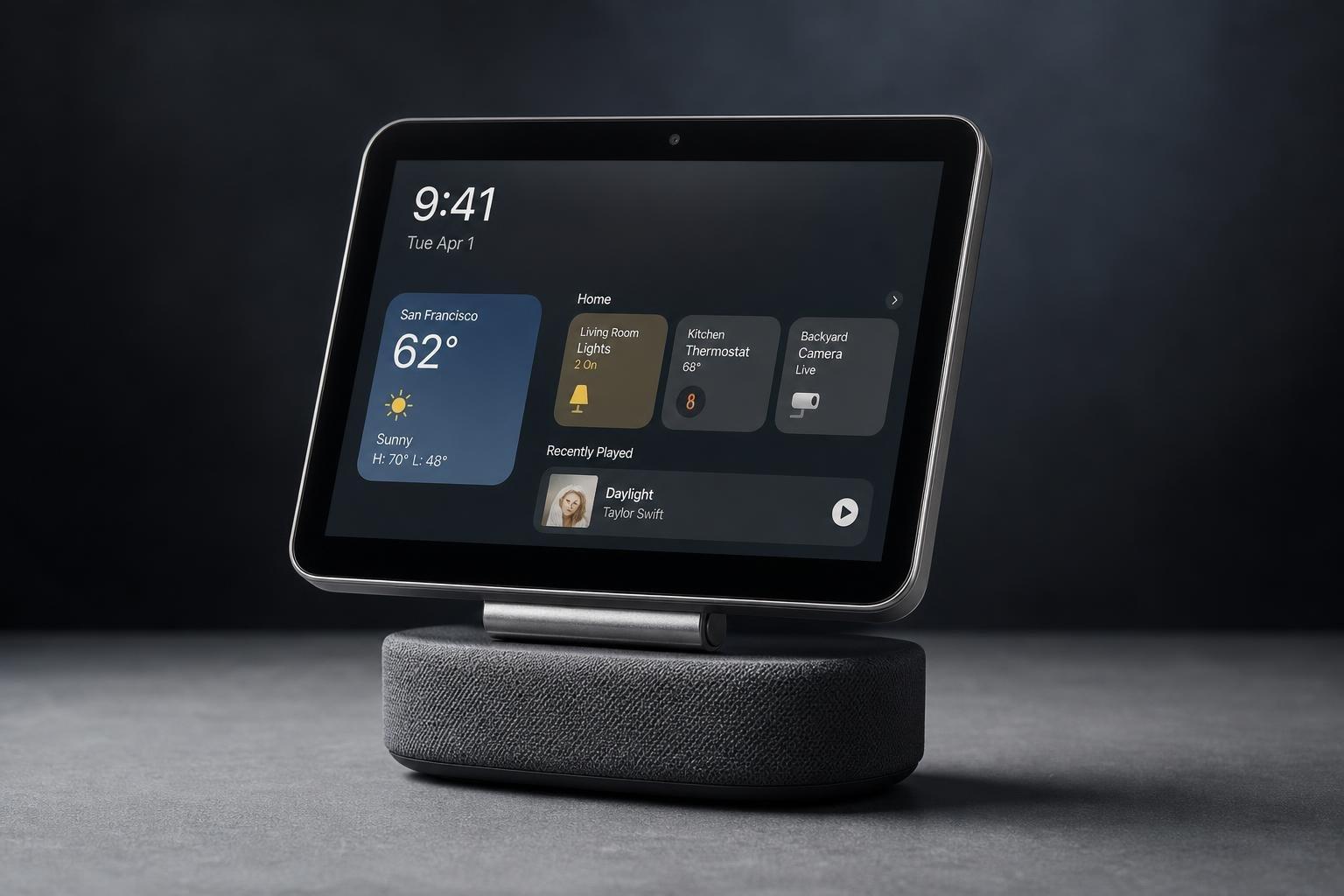
Apple HomeView is a 7-inch touchscreen on a tilting stainless-steel hinge, sitting atop a speaker base, priced at $299 and available in four colors. It launched for pre-order in October with general availability beginning November 13, per Apple's own announcement. The pitch is familiar if you've ever used an Echo Show or Nest Hub: a shared household screen that recognizes individual family members by face and shifts to show their own calendar, messages, and reminders. Apple is layering its new "Siri AI" on top, described in the company's materials as a more conversational assistant capable of drawing on personal context — your calendar, your messages, your other apps — to answer questions and surface information.
Here's where Engadget's testing gets useful, because it surfaces the catch buried under the marketing language. Unlike Amazon's or Google's displays, HomeView relies on a companion iPhone or iPad to mirror many of its apps, using a method similar to CarPlay. That's a meaningfully different architecture than "smart display" implies to most shoppers. It means the device's usefulness scales directly with how deep you already are in Apple's ecosystem — Messages, Calendar, Photos, Reminders. If you don't live in those apps, or if your household mixes Android phones with iPads, you're buying a nice screen with a shrunken feature set.
The Hardware Is Genuinely Thoughtful. The Dependency Is the Price of Admission.
Give Apple credit where the review earns it. The display adjusts brightness from a bright 500 nits down to 0.3 nits — the lowest brightness Apple has ever shipped on a display, explicitly tuned for nightstand use. The same specs show up in Apple's own release, which frames the device as built to recognize faces and personalize automatically across household members. That's a real design insight: shared gadgets in a home rarely serve one person, and most smart displays handle that badly.
But "willing to have a camera pointed at or near your bed," as Engadget puts it, is exactly the kind of tradeoff that deserves a second look rather than a shrug. A face-recognizing, always-listening screen at eye level on a nightstand is a different privacy proposition than a kitchen countertop hub, even if the hardware is identical. Apple's messaging leans hard on privacy and on-device processing, and the company's track record on that front is better than most of its rivals'. Still, the honest framing is that you're trading some surveillance tolerance for convenience, not eliminating the tradeoff.
Apple shipped this alongside a refreshed Apple TV 4K, also available starting November 13, which gets the same conversational Siri AI treatment plus far-field microphones for hands-free control — effectively the same software brain in a box meant for your TV instead of your counter. Together they read less like two products and more like one strategy: put a capable new Siri everywhere in the house, gated behind an Apple device you already own.
Who Should Actually Buy This
If your household already runs on iPhones and iPads, HomeView is a legitimately interesting answer to a hub that's historically treated Apple users as an afterthought — and the design sensibility, down to colorways and that tilting hinge, shows real craft. If your household is mixed, or Android-first, this isn't your device, full stop; you'll get a smaller slice of what the screen promises and still pay $299. Worth noting the category context: The Verge's year-end product roundup and CNN Underscored's weekly gift coverage both show a crowded holiday field of niche, well-executed gadgets rather than one dominant platform winner — HomeView enters that field as a strong option for a narrow audience, not a mass-market verdict.
My advice heading into gift season: don't buy this for someone outside the Apple ecosystem hoping it'll convert them. Buy it for the household that's already all-in, where the dependency isn't a bug — it's just the bill for a very polished shared screen.