


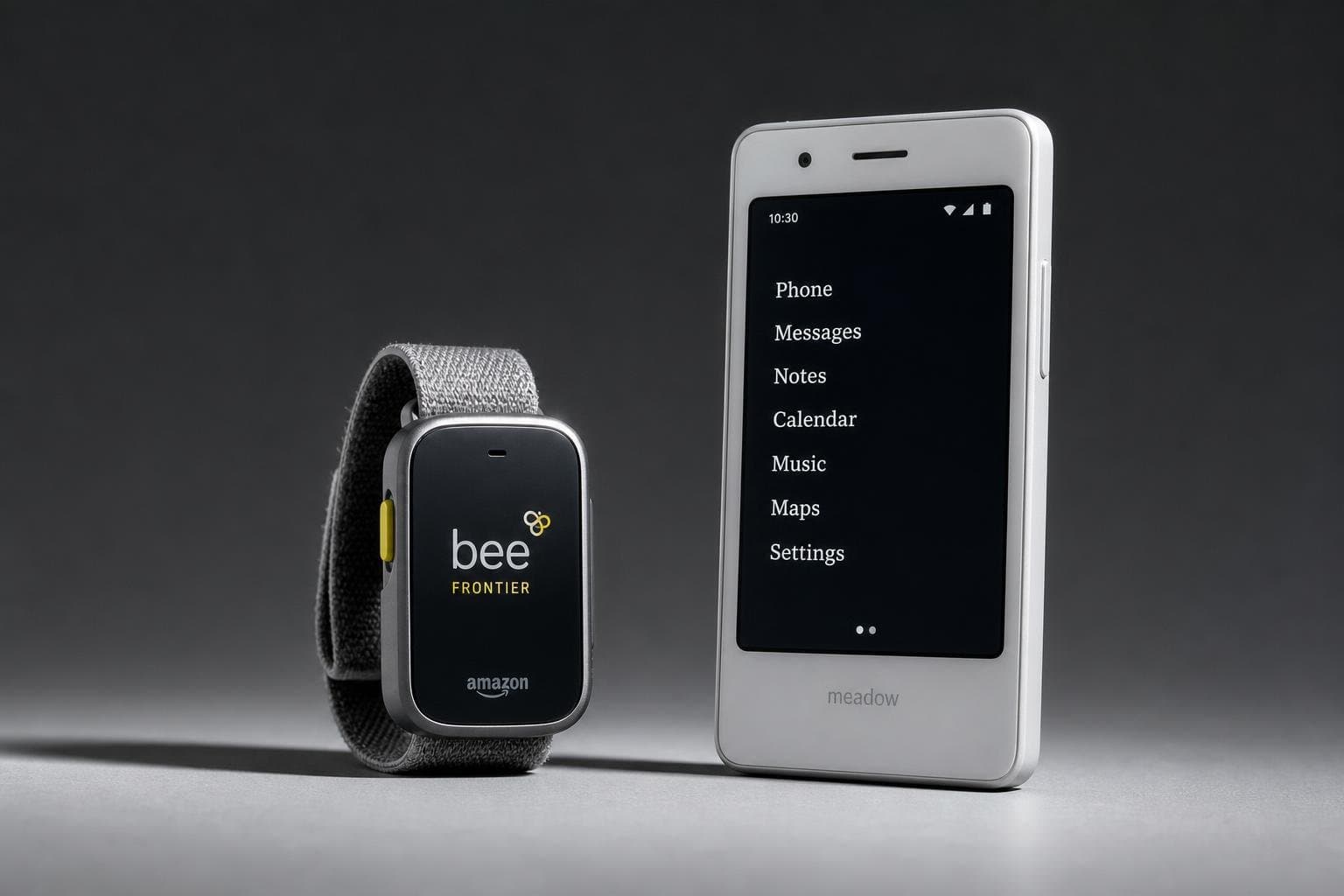

Two devices launched this week that couldn't be more opposite in what they think your relationship with technology should look like. One wants to listen to your entire day and turn it into a to-do list. The other wants you to leave your smartphone at home and just go live your life. Neither is fully proven yet, but together they tell you something real about where the "secondary device" category is headed — and it isn't toward one clean answer.
Bee Wants to Be Your Second Brain (For $75)
Amazon's Bee, the personal-AI wearable maker it acquired last year, announced its first new hardware on Thursday: the Bee Frontier, a wrist- or clip-worn successor to the original Bee priced at $74.99, and the Bee Eclipse, a $99.99 credit-card-sized puck that magnetically clips to the back of your phone. The pitch is simple: the devices listen to your conversations and turn them into calendar invites, to-do lists, and summaries, with a paid $11.99-a-month tier adding unlimited summaries and hooks into Alexa+ and Amazon.com.
That's a meaningfully lower price than the competition — the Plaud Note runs $159 and the Plaud Note Pro $189, while the Pocket AI device is $129, according to TechCrunch. Undercutting the field by $50-plus is the kind of move that gets a new category into normal people's hands, and that's where Bee's real advantage might sit — not the AI itself, but the price of admission.
The part worth taking seriously, though, is the privacy architecture. Bee says it doesn't store raw audio — conversations are processed in real time and then deleted, with transcripts encrypted using keys your device controls, so that, per the company, not even Amazon employees can access them without you explicitly sharing. If that holds up under outside scrutiny, it's a genuinely better default than "we vacuum up your conversations and figure out the privacy policy later," which has been the unspoken MO of this category since AI pins first showed up. The optional Alexa tie-in, which uses Voice ID to recognize your voice and trigger recording, is the one feature I'd want independent security researchers to poke at before I'd recommend it to anyone who isn't already comfortable with Alexa listening in their home.
What's missing is any actual usage data. No outlet has worn a Bee Frontier for a week yet, so claims about how well it captures a conversation, how often it mishears a name, or how much battery it burns are still unknown. I'd treat this as a promising spec sheet, not a verdict.
Meadow Bets You'll Pay to Carry a Second, Dumber Phone
The opposite instinct showed up in a device TechCrunch's Sarah Perez went hands-on with last month: Meadow, a minimalist Android phone meant to supplement — not replace — your main one. It runs real apps (Maps, Uber, Spotify, Strava) but skips social media and browsing, and it requires its own phone plan and number, which is the catch that will trip up a lot of people who think they're just buying a gadget.
Founder Shreyas Narlanka frames it against the dumbphone crowd — the Light Phone, the Wisephone, flip-phones like the Commodore Callback — by arguing Meadow isn't about digital asceticism. "We're all about getting outside and unplugging and having a sick social life," he told TechCrunch. The idea of recommending iPhone's built-in "driving" focus mode to quietly tell contacts you're unreachable is a smart workaround, but it also underlines the real cost here: a second number, a second bill, and a second thing to charge, all to solve a problem (phone addiction) that a focus mode or an app timer might solve for free.
The Real Signal This Week
Neither of these products is a phone launch, which tracks with what Engadget's reviewers have been noting all month — the big fall hardware cycle (Apple's rumored smart display, new Amazon tablets, a new Surface laptop) hasn't landed on desks yet, so this is a lull week for mainstream devices and a busy one for category experiments, per Engadget.
My read: Bee is worth watching once reviewers actually test its memory accuracy and privacy claims in the wild — the price and the stated architecture are both right, which is rarer than it should be in this category. Meadow is a harder sell for most people; a second subscription and a second number is a lot of friction to solve a problem a Screen Time setting half-solves already. Watch for the first independent hands-on tests of the Bee Frontier's always-listening accuracy, and for whether Meadow's subscription model survives contact with people who just want their main phone to behave.