
Three governments want you to believe that linking carbon markets is mostly a technical plumbing exercise — align some rules, hold a joint auction, let the invisible hand do the rest. The numbers from Washington's own rulemaking this fall suggest the hand had some help.
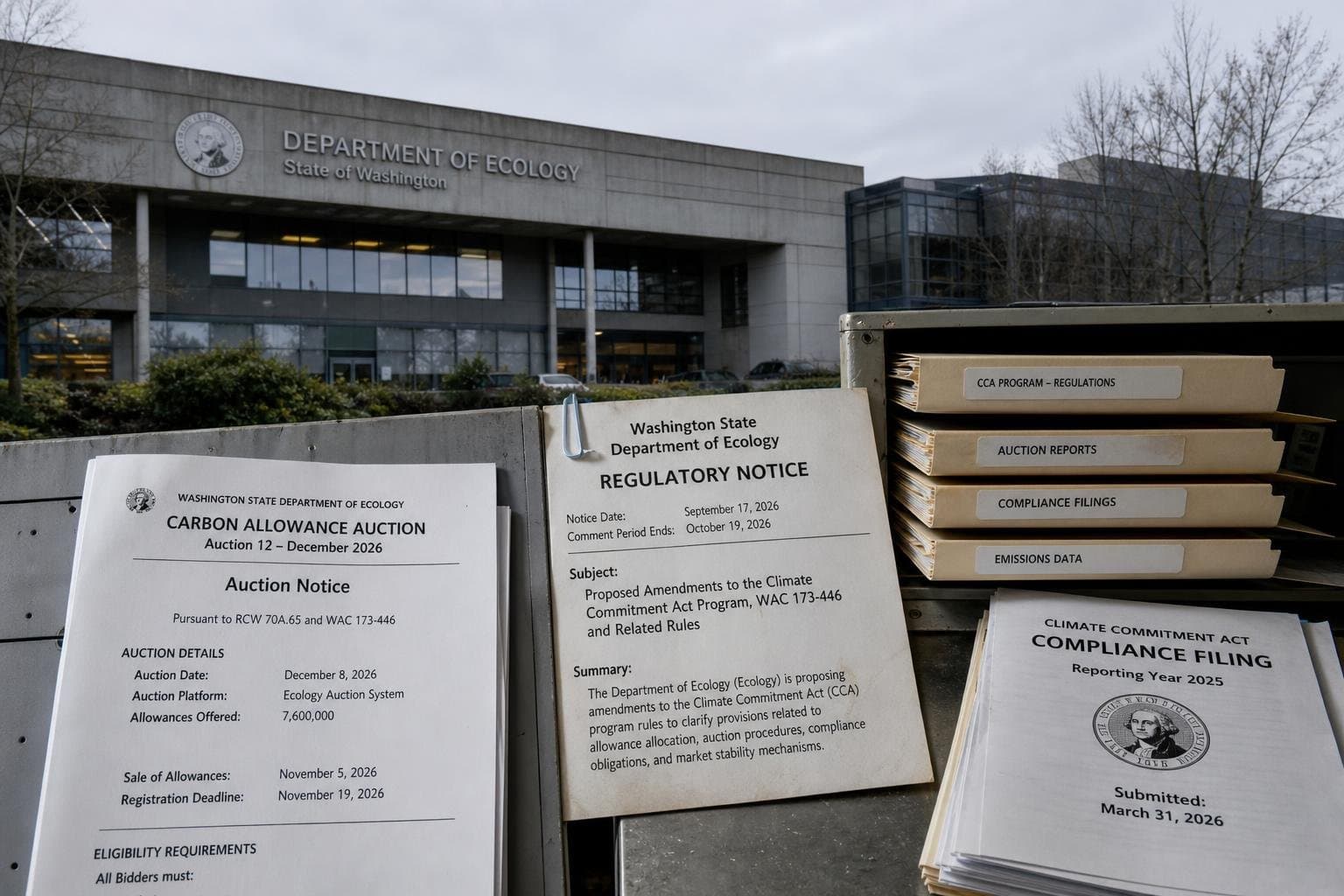
Washington, California, and Québec signed an agreement on June 25, 2026 to merge their cap-and-trade programs into a single market, with joint operation targeted for 2027 and combined coverage that would rank the bloc as the third-largest economy in the world by GDP. Washington finished its side of the regulatory work on September 17, when the Department of Ecology signed updated cap-and-invest rules that take effect October 24 (Clear Blue Markets). California's governor made the legal findings needed to let the Air Resources Board begin its own public rulemaking days later, which both governors framed as the next-to-last step before full linkage (Governor of California). Québec, notably, sat out the New York announcement entirely — its government is mid-campaign ahead of October provincial elections (Clear Blue Markets).
The Price Gap Linkage Is Supposed to Close Already Narrowed — By Washington's Own Hand
The case for linkage rests on a documented price gap. Washington's program, which began trading in 2023, has historically posted higher and more volatile allowance prices than the California-Québec market it's joining (policyinterns.com). That volatility wasn't abstract. When a 2024 ballot initiative threatened to repeal the entire program outright, Washington's carbon price collapsed from $51.89 to $25.76 while voters deliberated, only recovering once the repeal was rejected (policyinterns.com). That's a 50% price swing driven entirely by political risk, not by anything happening in actual emissions.
Here's the part that should bother anyone tracking market integrity rather than press-release optics: Washington didn't wait for the linked market to smooth that volatility. Its own September 17 rulemaking did it first. The new rules hold the price ceiling flat at $80 per allowance through 2026 and 2027, retroactively enlarge the 2023–2026 emissions budgets by about 6 million metric tons — a 2.68% increase — to relieve near-term scarcity, and raise the cap on how much allowance supply a single covered business can buy at auction from 10% to 25%, with a separate new 4% ceiling carved out for financial and other non-compliance buyers (Clear Blue Markets). The cost-containment mechanics, including that flat ceiling, are explicitly designed to align with the California-Québec system once linkage takes effect.
Read that sequence plainly: before Washington's price ever gets the benefit of pooling with a larger, more liquid market, the state has already loosened its own cap, padded the allowance supply, and widened who can accumulate allowances in volume. That's convergence by regulatory fiat, arriving months ahead of the actual market merger it's supposedly a prerequisite for.
Lower Compliance Costs for Business Is a Revenue Problem for Olympia
None of this is necessarily bad policy — a program that produced 50% price swings on political rumor wasn't delivering reliable price signals to anyone trying to plan capital investment. But the fiscal trade-off is straightforward and rarely stated out loud by either governor's office: if linkage pulls Washington's price down toward the historically cheaper California-Québec level, compliance costs fall for Washington's roughly 100 covered large emitters, and auction revenue — the money that funds the state's climate investments — falls with it. Washington's own announcement leans entirely on the upside language: unlocked emissions reductions, cheaper clean technology, good-paying jobs (Governor Bob Ferguson's office). What it doesn't quantify is how much state auction revenue a converged, lower price actually costs Olympia's budget once the pool opens.
What to Watch Before Calling This Done
Québec's absence from the September announcement isn't cosmetic — a change in provincial government after the October election could reopen terms that Washington and California have already locked in on their end. Watch for Québec's post-election position on the 2027 timeline, and watch California's forthcoming CARB rulemaking docket for whether it adopts Washington's enlarged allowance budget and loosened ceiling without modification, or pushes back on terms that look more like pre-linkage accommodation than genuine price convergence.


