
The One Big Beautiful Bill Act didn't just trim the IRA's clean energy credits — it turned a complicated subsidy regime into something closer to an administrative obstacle course. And the cost-per-ton math, already uncomfortable when I last wrote about it in June, has gotten harder to track, not easier.
Here's the core problem: the U.S. clean energy credit system was never designed around abatement cost discipline. It was designed around deployment incentives. Those are related goals, but they're not the same thing — and the gap between them is where the fiscal exposure lives.
The Credits That Ballooned Without a Cap
The structural issue with uncapped tax credits is that the government doesn't know what it's buying until after the fact. The Section 45Q carbon capture credit is the canonical example: Treasury's original ten-year cost estimate came in at $3.2 billion, and independent analysts subsequently put the long-run exposure north of $800 billion. That's not a rounding error. That's a program whose cost-per-ton calculation was essentially unknowable at the time of passage because the credit quantity was uncapped and the uptake was unpredictable.
The argument for competitive allocation — replacing flat per-unit subsidies with bid-based auctions — is straightforward: if you want to know what you're paying per ton of CO2 avoided, you need a mechanism that reveals that price. A flat credit doesn't do that. It pays the same rate whether the marginal abatement cost is $30 or $300, which means you're almost certainly overpaying for some projects and potentially underpaying for others.
The OBBBA didn't fix this. It accelerated phaseouts for wind and solar credits and restructured several provisions, but it didn't introduce competitive allocation or hard budget caps that would force cost-per-ton discipline into the system.
When the Map Changes, So Does the Math
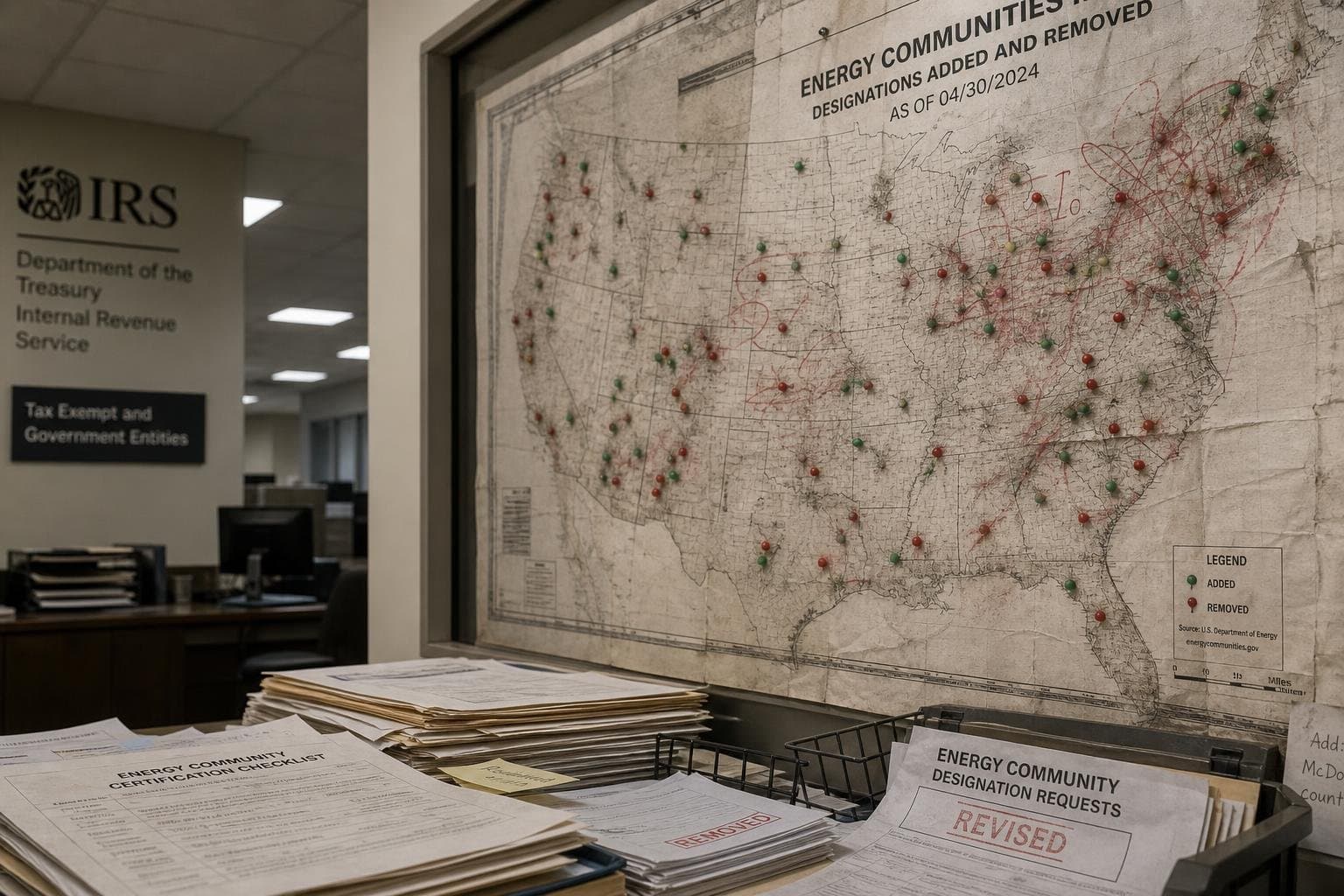
The administrative complexity layered on top of the credit structure adds another dimension to the cost problem. Forbes reported that the IRS recently issued Notice 2026-39, updating the "energy community" maps that determine whether a project qualifies for bonus credit rates — a 10% increase for production credits, or 10 percentage points for investment credits. In the latest update, 170 counties gained energy community status while 154 lost it, based on unemployment data.
That churn matters for cost-per-ton analysis in a way that rarely gets discussed. When project economics turn on whether a county is on one side or the other of an annually redrawn map, developers price in what Forbes aptly called "bureaucratic weather." That risk premium doesn't reduce CO2. It compensates investors for navigating administrative uncertainty — and it shows up in the effective cost per ton of abatement without appearing anywhere in the official credit rate.
The IRS, as Forbes noted, is still issuing these annual updates even as Congress dismantles the underlying credit regime. The result is a system where developers are chasing eligibility maps for incentives with uncertain shelf lives. That's not industrial policy. That's a procurement process that forgot to specify what it was procuring.
The OBBBA Preserved Most of the Emissions Math — But Not the Efficiency Math
The research memo framing here is that the OBBBA preserves roughly 67% to 74% of the power sector emissions reductions initially projected under the IRA. That's a meaningful retention — the bill didn't gut the program entirely. But the emissions retention figure and the cost-efficiency figure are different questions, and conflating them is a common error in coverage of this legislation.
You can preserve most of the projected emissions reductions while simultaneously making the cost-per-ton worse, if the credits that survived are the ones with the highest abatement costs and the ones that got cut were the cheapest. Whether that's what happened requires project-level data that isn't yet available. What is available is the structural picture: the OBBBA accelerated phaseouts for mature, cost-competitive technologies (wind and solar) while leaving in place credits for technologies like carbon capture that have historically shown poor cost discipline.
Meanwhile, the PwC analysis of the Section 45Z clean fuel credit — updated by DOE's June 2026 GREET model revision — illustrates how the OBBBA's statutory changes are rippling through credit calculations in ways that affect which fuel pathways qualify and at what rates. Feedstocks are now restricted to North American sources after 2025, indirect land-use change no longer factors into emissions scores, and negative emissions rates generally reset to zero except for animal-manure pathways. Each of those changes shifts the effective cost-per-ton for different producers, but the aggregate effect on total abatement cost is not something the credit structure itself reveals.
What to Watch
The honest answer is that the U.S. still doesn't have a reliable mechanism for tracking cost-per-ton across the IRA credit portfolio in real time. Treasury's energy community data and the IRS's annual map updates are administrative outputs, not abatement accounting. The next meaningful data point will be Treasury's revised credit uptake estimates — watch for those in the fall budget process — which should show whether the OBBBA's phaseout acceleration actually reduced fiscal exposure or just shifted it toward the credits that remained.
If the uptake numbers come in high on carbon capture and low on wind and solar, the cost-per-ton picture will look considerably worse than the 67-74% emissions retention figure implies. That's the number worth waiting for.


