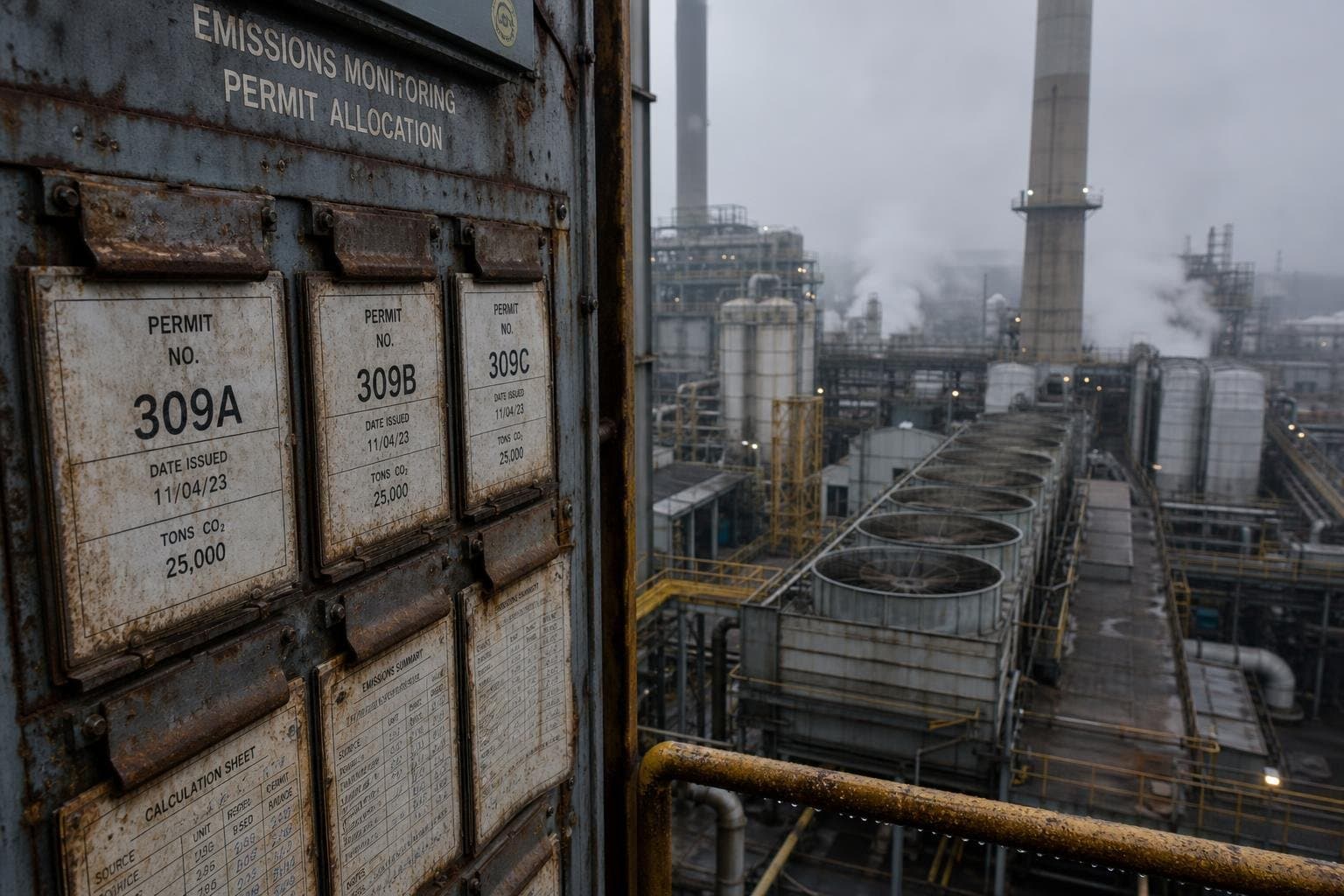

The European Commission's ETS overhaul lands Thursday. The direction of travel is already clear, and it runs directly against the logic that made the carbon market work in the first place.
Reuters reported on July 8 that the Commission plans to extend the ETS timeline so companies can keep emitting into the 2040s — effectively pushing back the current 2039 hard stop — while also handing industry an additional €6 billion in free permits in exchange for decarbonization investment commitments. Bloomberg confirmed Tuesday that the overhaul will slow cuts to emission limits over the next decade, giving heavy industry more runway to roll out clean technologies.
The framing from Brussels is "balance." The math says something else.
The Linear Reduction Factor Is the Whole Ballgame
The ETS works by shrinking the pool of available permits each year. That shrinkage rate — the linear reduction factor — is currently set at 4.3–4.4% annually. It's the mechanism that makes carbon pricing a credible long-run signal rather than a tax that politicians can quietly defang.
The Commission is now proposing to lower it. According to ENDS Europe's briefing on the revision, an official indicated the proposed LRF would sit somewhere between 3% and 4.4% over the next decade — a wide range that tells you the internal fight isn't settled. The European People's Party has called for cutting it to 3.4% from 2030, with an "even more moderate trajectory" from 2035. The chemicals industry body Cefic wants it slowed "as soon as possible, before 2030."
Germany's coalition government, notably, has taken a more cautious line — calling for LRF reductions only from 2036, not immediately. That's a meaningful distinction. Slowing the reduction factor now, before clean energy infrastructure and low-carbon feedstocks are available at scale, removes the pressure that was supposed to accelerate their deployment. Slowing it later, once alternatives exist, is a different proposition entirely.
The difference between a 3.4% and a 4.4% annual reduction compounds over a decade into a substantially larger cumulative permit pool. More permits in circulation means lower prices, which means weaker incentive to invest in abatement. The Commission is proposing to solve an industrial competitiveness problem by making the carbon signal less credible — which is precisely the signal that was supposed to solve the industrial competitiveness problem over the long run.
Free Permits and the CBAM Contradiction
The other major move is extending free allocation to industries covered by the Carbon Border Adjustment Mechanism beyond 2034. This is where the reform gets genuinely incoherent.
CBAM was designed as the replacement for free permits. The logic: once a carbon border levy charges importers for the carbon embedded in their goods, domestic producers no longer need free allowances to compete — the playing field is leveled at the border instead. Brussels had previously committed that free permits for CBAM-covered sectors would phase out as CBAM fully applied.
Reuters reported that the Commission is now finding "a way to give free CO2 permits to industries covered by the EU's carbon border tax for longer." Running both simultaneously — CBAM at the border and free permits for domestic producers — means domestic industry gets double protection while the ETS revenue that was supposed to fund the transition gets diverted back to the same companies paying it.
I wrote about CBAM's structural tensions in May and the EU ETS safety valve reform in June. The pattern is consistent: each successive reform adds flexibility mechanisms that reduce the market's tightening pressure. Individually, each adjustment has a defensible rationale. Cumulatively, they add up to a carbon market that is increasingly designed not to bite.
What the ESMA Data Actually Shows
The European Securities and Markets Authority's 2026 carbon markets report, published July 9, covers 2025 market behavior and provides the clearest independent read on ETS dynamics. ESMA's mandate is market integrity and transparency — price evolution, trading volumes, participant behavior — which makes it a more dispassionate source than either industry lobbying or Commission communications.
The report's existence matters here: ESMA monitors the ETS specifically because carbon allowances are financial instruments that can be gamed, and the market's price signal depends on participants believing the supply trajectory is credible. Reforms that introduce discretionary flexibility — more free permits conditional on investment commitments, a softer LRF subject to competitiveness reviews — create exactly the kind of policy uncertainty that suppresses long-run carbon prices and, with them, long-run abatement investment.
The Thursday Test
When the Commission publishes Thursday, the number to watch is the specific LRF proposal — not the headline framing about "balance" or "flexibility." A rate above 4% preserves most of the market's tightening trajectory. A rate at or below 3.5% is a structural retreat dressed in competitiveness language.
The free permit extension is worth watching too, but the LRF is the load-bearing mechanism. Everything else — CBAM coherence, MSR design, revenue recycling requirements — is secondary to whether the cap actually tightens fast enough to matter. If it doesn't, the rest is accounting.


