



The grid reliability debate has a framing problem. Critics of wind and solar point to high-penetration grids and ask: what happens when the wind doesn't blow? The more useful question is what the outage data actually shows — and it doesn't tell the story either side wants.
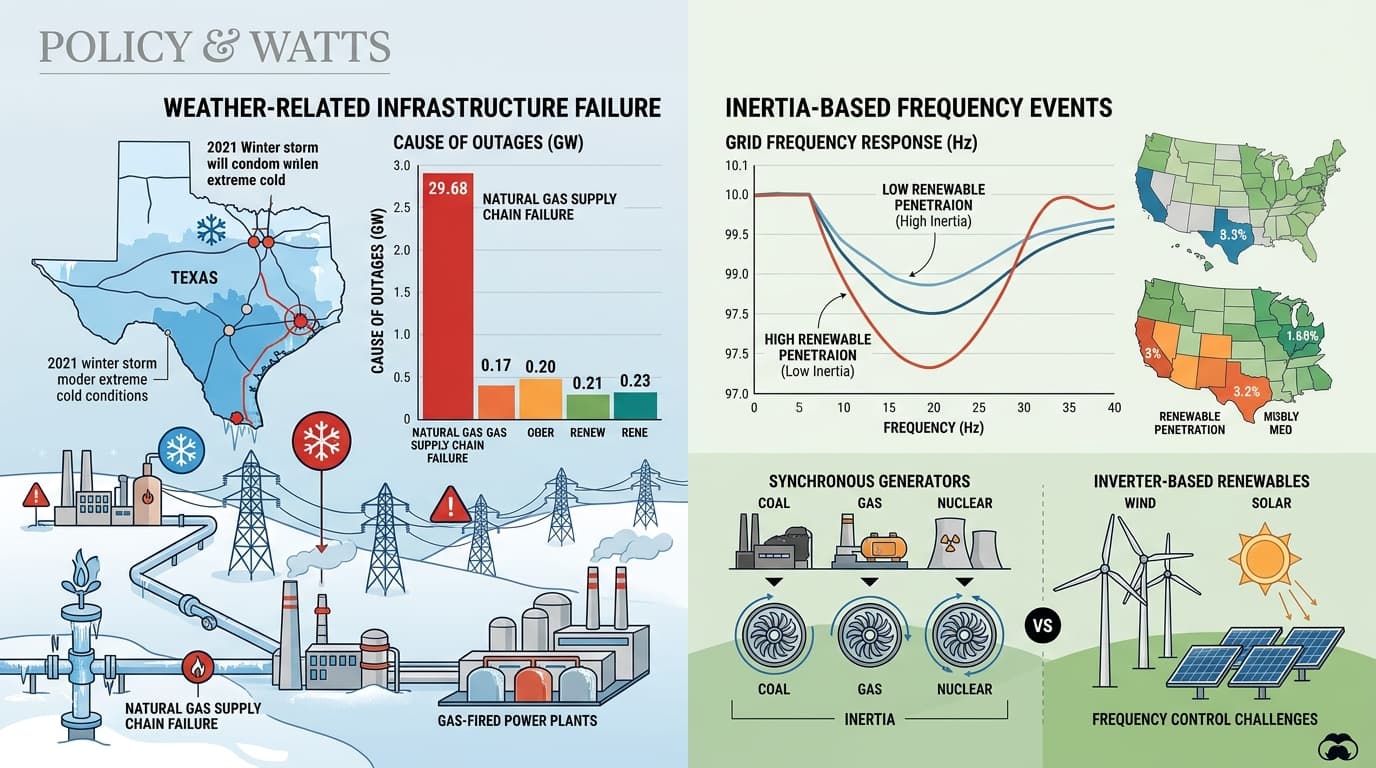
Start with the most cited example of grid failure in recent memory. The 2021 Texas winter storm knocked out record outages exceeding 50 GW, with over 20,000 MW of load shed. The culprit wasn't renewable penetration. It was natural gas supply chain failure — frozen wellheads, unweatherized compressors, fuel delivery constraints across all thermal generation types simultaneously. Wind turbines failed too, but they were a secondary contributor to a crisis that was fundamentally about fossil fuel infrastructure unprepared for weather extremes.
That matters because the policy conversation keeps treating reliability as a capacity problem — do you have enough megawatts on standby? — when the physics increasingly point elsewhere. Most outages don't begin as multi-hour energy shortages; they start as frequency crises. When a large generator trips unexpectedly, grid frequency begins to decay within seconds. Traditional synchronous generators — coal, gas, nuclear — provide inertia that slows that decay and buys time for corrective response. High shares of inverter-based renewables reduce that inertia. That's a real engineering challenge. It's also a solvable one, through grid-forming inverters, synchronous condensers, and battery storage providing synthetic inertia — none of which require keeping gas plants running at part-load as permanent insurance.
The broader outage trend cuts against the "renewables destabilize grids" narrative in a different way. US electricity customers lost an average of 11 hours of power in 2024, nearly double the annual average from the prior decade. Heat-related outages rose 60% over that period; cold-related outages rose 97%. These are climate-driven failures hitting transmission and distribution infrastructure — lines, transformers, substations — not generation mix failures. The grid is getting less reliable as extreme weather intensifies, and that's happening regardless of how much solar is on the system.
The pattern suggests the reliability conversation is being fought on the wrong terrain. The real cost-benefit question isn't "how much backup gas capacity do we need to backstop renewables" — it's "how much of the reliability problem is generation-mix and how much is aging wires and weather-exposed infrastructure?" If the answer is mostly the latter, then doubling down on gas peakers is an expensive non-solution to a problem that lives in the distribution system.
Watch FERC's ongoing proceedings on inertia and frequency response requirements — those technical standards will do more to shape the actual reliability calculus than any legislative debate about which fuel sources count as "firm" capacity.