


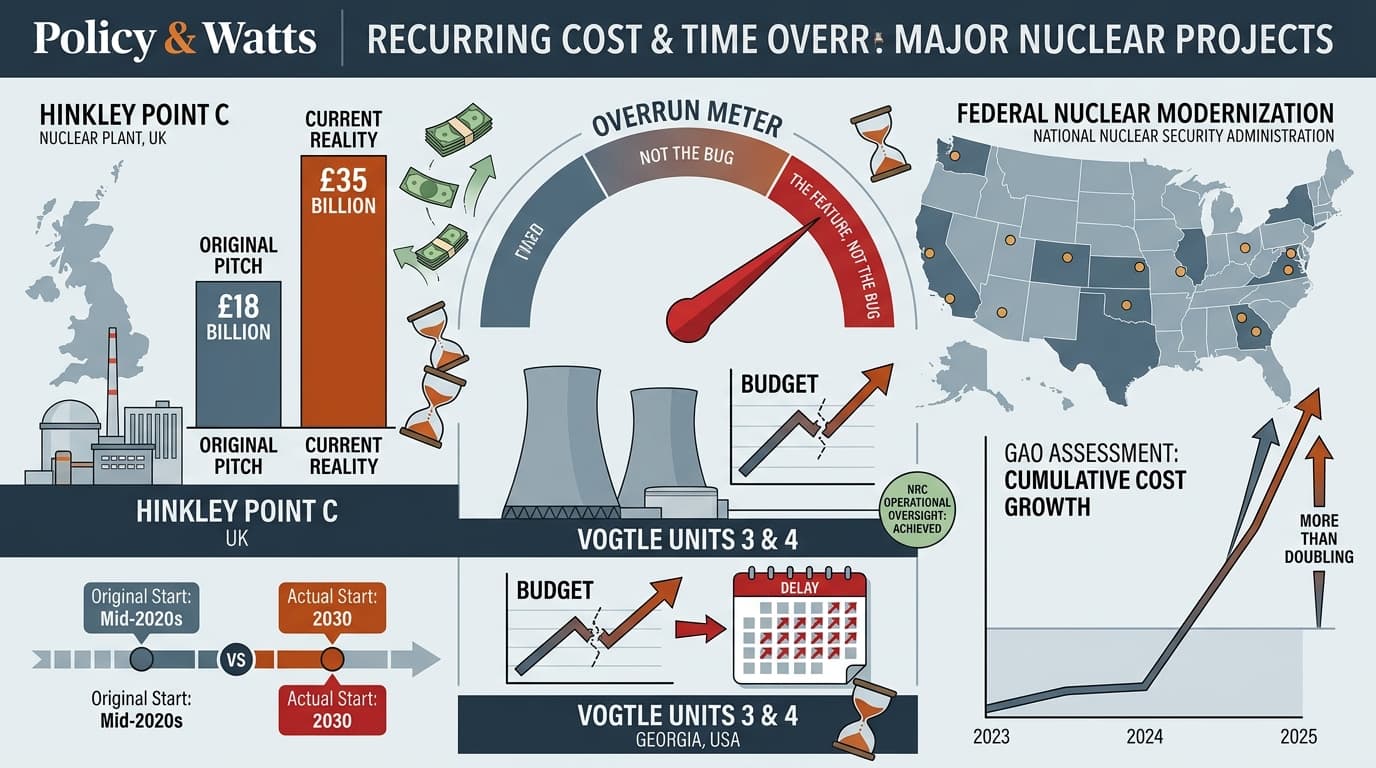

The original pitch for Hinkley Point C was £18 billion and a reactor humming by the mid-2020s. The current reality, per EDF's 2025 financial statements, is £35 billion — nearly double the original estimate — with Unit 1 now scheduled to come online in 2030. That's 13 years from groundbreaking to first power, assuming the 2030 date holds. EDF itself notes that a further 12-month slip — the "worst case" — would add roughly another £1 billion.
At some point, "worst case" stops being a scenario and starts being the base rate.
The Pattern Holds Across Every Major Project
Hinkley isn't an outlier. It's the template.
Vogtle Units 3 and 4 in Georgia — the first new U.S. nuclear reactors in decades — came online years behind schedule and billions over budget. The NRC's most recent inspection report from August 2025 documents the plants in routine operational oversight, which means the construction saga is over. But the financial damage is baked in: ratepayers and investors absorbed a project that bore almost no resemblance to its original cost and timeline projections.
Now zoom out to the federal nuclear weapons modernization portfolio. A February 2026 GAO assessment of National Nuclear Security Administration construction projects found cumulative cost growth across key facilities rose from roughly $2.1 billion in 2023 to approximately $4.8 billion as of June 2025 — more than doubling in two years. The NNSA manages 28 major construction projects worth at least $30 billion. GAO found 17 facing challenges including delays, redesigns, or cost overruns. Nine are projected to exceed their approved budgets by at least 20%. Some projects originally scoped for nine years could stretch to 30.
House Armed Services Committee staff, speaking on background to Engineering News-Record, put it plainly: "Every project NNSA has when it comes to construction has been over-budget and very much delayed schedule-wise."
Every project. That's not a quality control problem. That's a structural condition.
Why the Math Keeps Breaking
Nuclear megaprojects fail at the estimate stage, not the construction stage. The initial numbers are produced in a political and commercial environment that rewards optimism — developers need financing, governments need to justify approvals, and no one gets a contract by leading with the realistic scenario. By the time the engineering reality asserts itself, the project is too far along to cancel without absorbing sunk costs that dwarf the overrun.
EDF's Hinkley situation illustrates the compounding dynamics. The project has been financed solely by EDF's voluntary equity contributions since the end of 2023, after initial joint commitments with China General Nuclear Power Group were exhausted. CGN's ownership stake has since been diluted from 33.5% at the final investment decision to 23.31% at end of 2025 — a quiet signal of how capital obligations have shifted as costs escalated. EDF has also signed an agreement with Apollo for up to £4.5 billion in bond financing to keep the project moving.
That's the financial architecture of a project that has long since outrun its original business case.
What This Means for the Nuclear Revival Narrative
There's genuine policy momentum behind nuclear right now — small modular reactors, data center power demand, bipartisan interest in low-carbon baseload. Some of that interest is well-founded. But the cost and schedule record of large-scale nuclear construction is not a historical artifact from an earlier era of regulatory complexity. It's happening now, with modern project management, at Hinkley and across the NNSA portfolio.
The honest question for any new nuclear proposal isn't whether the technology works — it does — but whether the cost estimate in front of you reflects engineering reality or political necessity. The gap between those two numbers is where ratepayers and taxpayers tend to end up.
Watch EDF's next Hinkley progress update and whether the 2030 date for Unit 1 holds through mid-year. If electromechanical work slips further, the £1 billion worst-case adder becomes the new baseline — and the conversation about what large-scale nuclear actually costs per delivered megawatt-hour gets harder to avoid.