
A lowest bid of INR 3.42 per kilowatt-hour sounds like a triumph of competitive auction design. Look at the spread between that number and the ceiling bid, and the story gets more complicated — and more useful.
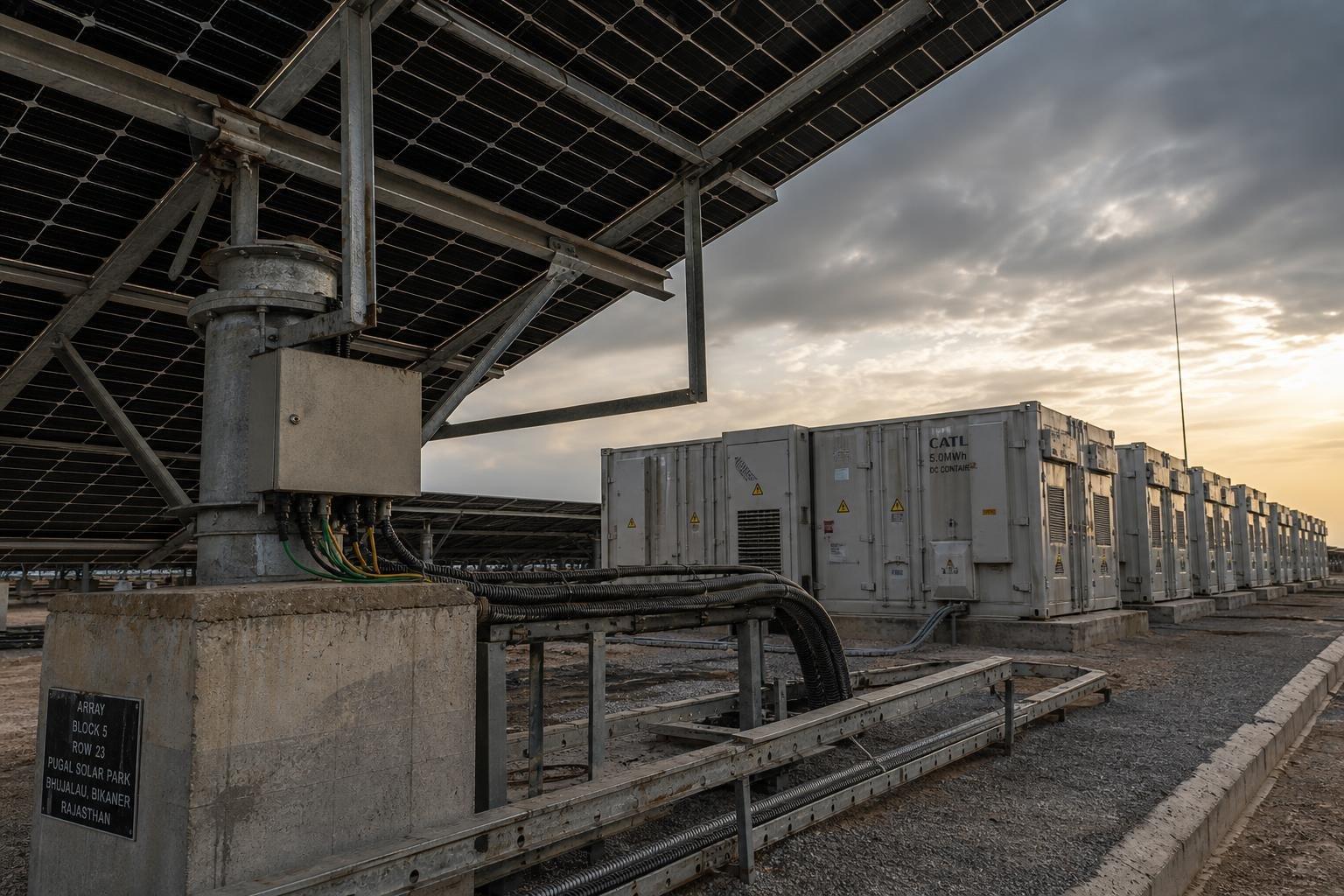
Rajasthan Solar Park Development Co. just closed India's largest solar-plus-storage reverse auction, awarding 2,450 MW of solar paired with 1,600 MW / 6,400 MWh of battery storage at Pugal Solar Park (pv magazine India). The tender split into two lots. Lot 1, 2,000 MW with a starting tariff of INR 4.03/kWh, pulled in 31 bids and cleared at INR 3.53/kWh for NLC India and Rama Reflection India, with Coal India taking the remaining capacity at INR 3.54/kWh — a discount of roughly 12.4% off the ceiling (pv magazine India). Lot 2, the smaller 450 MW slice, is where the headline number came from: Coal India won 225 MW at INR 3.42/kWh and LEO Energies took the balance at INR 3.43/kWh, after 17 bids (pv magazine India).
The Spread Tells You More Than the Floor
The number that should catch an analyst's eye isn't the winning bid — it's the gap between it and the rest of the field. The highest quoted tariff in the auction came in at nearly double the lowest clearing price (pv magazine India). IESA president Debmalya Sen called this out directly, noting that with the top bid almost 2x the L1 price, "a lot of margins and assumptions were squeezed" to arrive at the winning numbers. That's a tell. In a reverse auction, a 2x spread between winner and loser usually means either wildly different cost structures between bidders — plausible, given Coal India and NLC India are state-backed entities with access to cheaper capital than private developers — or that the winners are underwriting assumptions on battery and module costs that may not hold up through construction and operation.
The timing matters here too. This auction cleared against a backdrop of renewed investor enthusiasm for the sector globally — renewable energy stocks rallied this month after Democrats won control of both chambers of the US Congress, a result markets read as favorable for clean energy policy (Bloomberg). That kind of sentiment shift makes aggressive bids easier to justify on paper, even when the underlying input-cost math hasn't actually improved. Rising capital costs and supply-chain pressure are showing up elsewhere in the critical-minerals chain that feeds battery storage: Lithium Americas just raised the projected cost of its flagship Nevada mine by almost $900 million, citing tariffs, labor costs, and logistics expenses (Bloomberg) — a reminder that the battery half of any solar-plus-storage bid is exposed to cost pressures well outside a developer's control.
Who Can Actually Carry That Price
It's worth noting who won. Coal India and NLC India are not scrappy independent power producers betting the balance sheet on a single project — they're state-linked firms that can absorb thinner margins on one tender as part of a broader portfolio or strategic mandate to diversify away from coal. The presence of a company called Rama Reflection India and smaller player LEO Energies among the winners suggests the field wasn't limited to state giants, but the fact that a coal-sector PSU is the single largest capacity winner in a solar-plus-storage auction is itself a signal about who can price aggressively and still sleep at night.
The structural tension here is one I've tracked across markets all year: auction design rewards the lowest number a bidder is willing to put on paper, not the number that reflects actual delivered cost. Whether INR 3.42/kWh survives contact with battery procurement, module sourcing, and construction timelines is a question the auction result itself cannot answer. The IEA's annual renewables outlook treats the financial health of project developers as a distinct line of analysis this year, separate from deployment volume (IEA) — exactly the kind of scrutiny a tariff this aggressive deserves before it gets treated as a benchmark. It's the same scrutiny that's increasingly applied to renewable megaprojects in other markets, where planning and financing decisions can unwind headline numbers long after the auction closes (FT).
What to Watch
The number to track from here isn't the auction price — it's the commissioning timeline and any renegotiation requests that surface before Pugal Solar Park reaches financial close. Reverse auctions in power markets have a long history of producing headline-grabbing lows that quietly get revised, delayed, or partially defaulted on once construction costs meet contract terms. If INR 3.42/kWh holds through delivery, it's a genuine data point on where solar-plus-storage costs are heading in India. If it doesn't, it joins a pile of auction results that looked better on the day of the bid than on the day of the ribbon-cutting.


