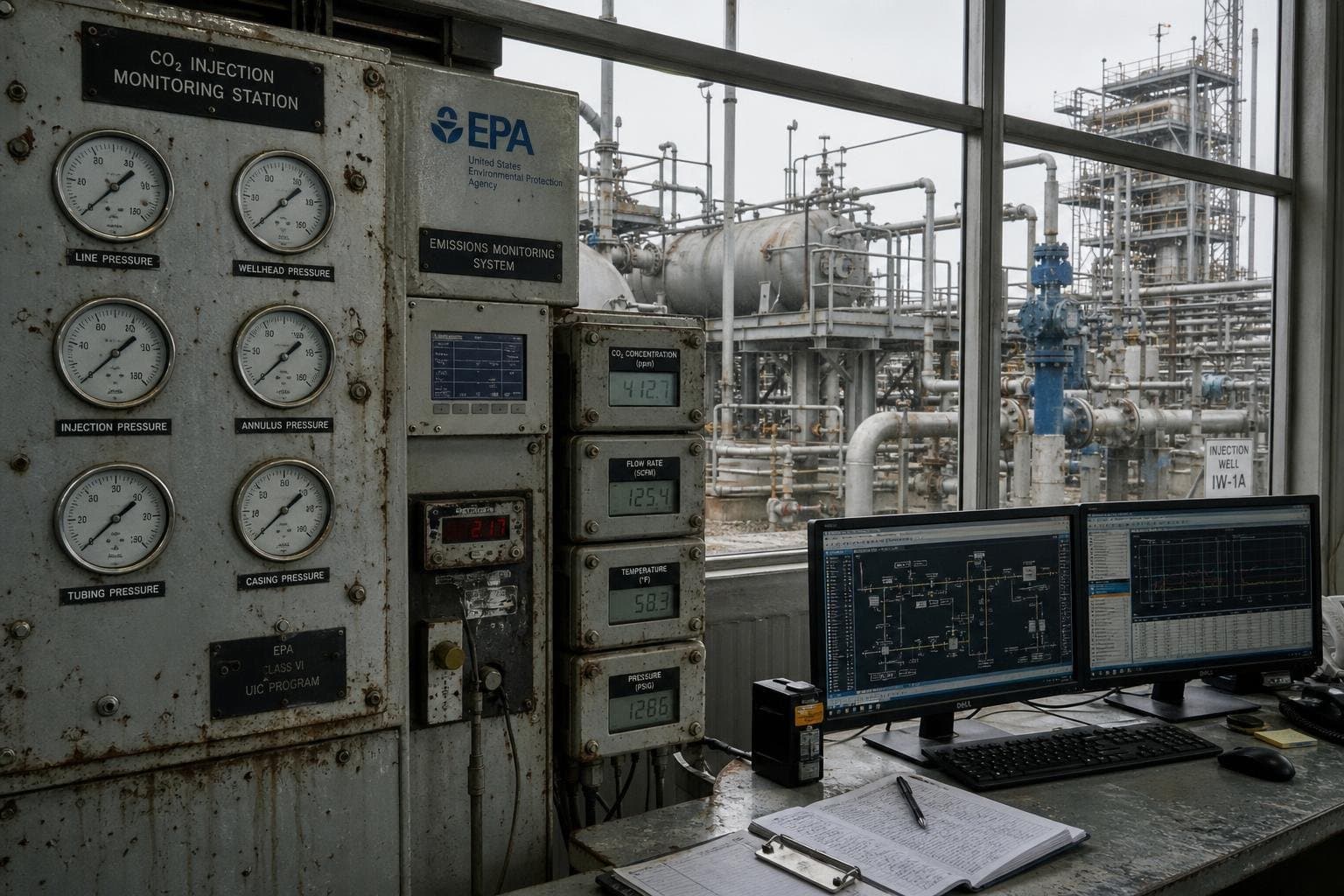

Carbon capture tax credits only mean something if somebody is actually measuring the carbon. That sounds obvious, but it's the part of the 45Q conversation that gets skipped in favor of debates over the per-ton subsidy rate. The rate is the easy number. The hard number — how much CO2 actually stays underground, verified by whom, using what data — is the one that determines whether the federal government is buying real abatement or buying paperwork.
The Verification Backbone Nobody Talks About
The infrastructure that's supposed to answer that question is the EPA's Greenhouse Gas Reporting Program, which has required roughly 8,000 direct-emitting facilities, fuel suppliers, and CO2 injection sites to report annual emissions data since 2011, covering an estimated 85-90% of U.S. greenhouse gas output Congressional Research Service. For most industrial categories, reporting kicks in above a 25,000-metric-ton threshold. For CO2 injection facilities — the ones actually claiming 45Q credits for stored carbon — there's no threshold at all. Every ton injected has to be reported CRS.
That zero-threshold rule is the right instinct: if you're going to hand out a tax credit per ton sequestered, you need reporting on every ton, not a sample. But a reporting requirement is only as good as the agency's capacity to enforce it, and EPA has been actively reconsidering aspects of the program's own structure CRS — which means the measurement system underneath the credit is not static. When the yardstick moves, the credibility of every "tons captured" claim built on top of it moves with it.
The Capture-Utilization-Storage Pipeline Is Wider Than the Credit Implies
The Department of Energy's own description of carbon capture, utilization, and storage is worth sitting with: CO2 can be captured, then either reused or stored in geologic formations that include oil and gas reservoirs, unmineable coal seams, and deep saline reservoirs DOE. That "reused" branch matters more than it sounds. A lot of captured carbon doesn't go into permanent geologic storage — it goes into enhanced oil recovery, where it helps push more oil out of a depleting well. Whether that counts as equivalent climate benefit to permanent saline storage is a real methodological argument, not a rounding error, and it's one that determines whether a 45Q credit dollar is buying a ton removed from the atmosphere or a ton temporarily parked on its way to helping produce more oil.
The IRS has in fact issued new guidance this year updating the Carbon Oxide Sequestration Credit as part of the recent tax legislation IRS — confirmation that the rules governing how credits get calculated and verified are actively being rewritten, not settled. The same legislative package also reworked the adjacent Section 45Z clean fuel production credit, including new emissions-rate tables and lifecycle accounting rules IRS, which is a useful reminder that Treasury is simultaneously rewriting the measurement plumbing for several climate-linked credits at once. What the 45Q guidance changes in practice — verification standards, treatment of EOR volumes, recapture rules for leakage — is the part that will actually decide whether the credit's environmental math holds up, and that level of project-specific detail hasn't yet made it into the public reporting I can point readers to with confidence.
For context on how much capital is chasing climate-labeled infrastructure generally right now, note that institutional investors are still moving real money toward climate-related private-market deals — New York City's pension system recently outlined a $5 billion allocation aimed partly at climate goals Bloomberg. That's a separate pool of capital from federal tax credits, but it underscores that the appetite for climate-branded assets — carbon capture included — isn't waiting for the verification questions to get resolved first.
What "Cost Per Ton" Actually Requires
Here's the uncomfortable truth for anyone trying to run a clean cost-per-ton calculation on 45Q right now: you need three numbers you can trust simultaneously — the credit dollars disbursed, the tons independently verified as captured, and the tons independently verified as permanently stored rather than cycled through EOR. The GHGRP is built to supply the middle number, assuming its reporting infrastructure holds up under the agency reconsideration mentioned above CRS. The IRS's own count of credits paid out is knowable in principle from tax data, though it isn't broken out publicly at the project level in a way that makes a clean divide-by-tons calculation straightforward IRS. And the permanence question — how much of what's captured is actually sequestered versus pushed into oil wells — is the one most likely to get glossed over in any headline "tons captured" figure, especially given how broadly DOE itself defines the utilization-versus-storage split DOE.
None of that means 45Q is failing. It means the credit's environmental claims are only as strong as an auditing system that's currently being rewritten, reported through a data program under active reconsideration, feeding into a tax credit whose per-project cost-effectiveness isn't yet visible in public data. Anyone citing a clean cost-per-ton number for 45Q right now is citing more confidence than the underlying paper trail supports.
The thing to watch is the public comment period on long-term verification standards, which shapes whether the next round of reporting rules tightens or loosens the link between credit dollars and verified tons. Until that settles, treat any 45Q cost-per-ton claim — including the flattering ones — as provisional.


