


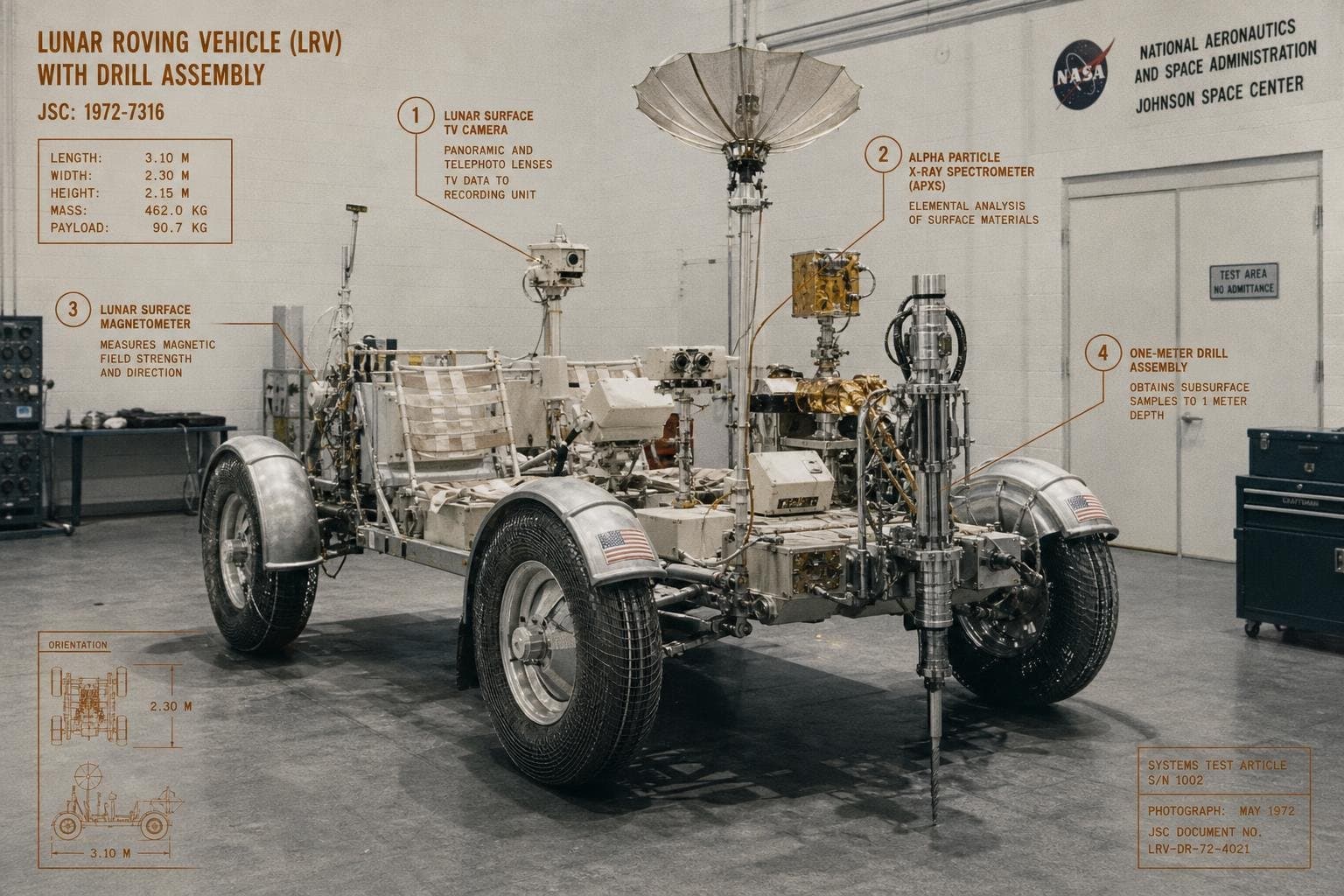

If you've been tracking NASA's lunar water rover off secondhand headlines, you could be forgiven for thinking it's been killed, resurrected, killed again, or some combination of the three. The real status, as of NASA's own October 20 progress update, is less dramatic and more useful: VIPER is finished. The hardware is built, it's in final testing at Johnson Space Center, and NASA is now targeting a 2027 launch aboard Blue Origin's Blue Moon Mark 1 lander, according to New Space Economy's reporting on the update.
That's worth sitting with, because the assumption floating around — that NASA quietly scrapped a completed mission — doesn't match what the agency actually said last month. VIPER has had a genuinely rocky institutional history, including a well-publicized cancellation scare and reversal in 2024. But the current status isn't cancellation. It's a finished rover with a launch date on the calendar.
What "Finished" Actually Means Here
The Volatiles Investigating Polar Exploration Rover — VIPER — exists to answer a question more specific than "is there water on the Moon." Orbital instruments already confirmed ice deposits near the lunar South Pole years ago. What nobody has measured directly is where those deposits sit, how concentrated they are, what physical form they take, and what else is mixed in with them, per New Space Economy. That distinction matters enormously for anyone planning to actually use the water — for drinking, for breathing, for rocket propellant. A map that says "ice exists somewhere in this crater" is scientifically interesting. A map that says "ice exists at this depth, at this concentration, mixed with this regolith" is an engineering document.
That's the job of the rover's one-meter drill and three science instruments: sample below the surface, at multiple sites, across a planned traverse of more than 30 kilometers, and build a dataset that distinguishes a one-off detection from an actual distribution pattern. Permanently shadowed craters near the pole stay cold enough to preserve volatiles that would otherwise sublimate away in sunlight, which is exactly why the traverse plan threads through that terrain.
The Bottleneck Was Never the Rover
Here's the part that should temper any optimism: finishing the rover was arguably the easy half of this mission. VIPER still needs a ride, and that ride is Blue Origin's Blue Moon Mark 1 — the robotic cargo variant of Blue Origin's lander family, distinct from the larger Mark 2 human landing system being developed for crewed Artemis flights, per New Space Economy. Mark 1 doesn't need to support astronauts, which simplifies its design relative to Mark 2, but it still has to execute a precision landing near the pole, in terrain chosen specifically because it's cold, shadowed, and therefore harder to navigate and communicate with than equatorial sites.
This is the pattern I keep coming back to in lunar coverage this year: the spacecraft that does the science is rarely the long pole in the schedule. The landing system is. VIPER's hardware being complete and in testing at Johnson Space Center doesn't collapse the 2027 timeline into something you should treat as locked — a lander flying people and cargo to the lunar surface for the first time is still, fundamentally, an unproven vehicle until it's done it. Mission operations will run out of Ames Research Center, where teams are already running surface simulations ahead of the actual landing, which is the kind of preparatory work you do precisely because the real thing is unforgiving of surprises.
What to Actually Watch
The milestone that matters next isn't another VIPER status update — it's Blue Moon Mark 1's own flight test record. A robotic cargo lander demonstrating a safe landing, ideally more than once, is the thing that converts "2027" from a planning target into a credible date. Separately, watch for VIPER's move from Johnson Space Center to Kennedy Space Center for launch processing — that transfer is usually the clearest signal that a mission has cleared its remaining ground-test risk and is in the final stretch before integration.
The water itself isn't the open question anymore. Where it sits, how much there is, and whether a lander can get a rover anywhere near it intact — that's still the whole story.