



Every few months, a new JWST result arrives with the same implicit promise: we're getting closer to understanding how planets form and whether any of them might host life. The honest version of this week's news is more interesting than that — and more unsettling. Three separate studies, using different telescopes and different techniques, are producing atmospheric data that doesn't fit the models we built to explain it.
That's not a failure. That's the job working.
TOI-5205 b: When a Planet Breaks Its Own Formation Story
The most striking result this week comes from a planet that shouldn't exist — or at least, shouldn't look the way it does. TOI-5205 b is a Jupiter-sized world orbiting a star roughly 40 percent the mass of our Sun. The planet's sheer size relative to its host is already difficult to explain; current formation models struggle to produce gas giants around stars this small.
But the atmosphere is the real puzzle. New JWST observations published in The Astronomical Journal, led by Caleb Cañas of NASA's Goddard Space Flight Center, found that TOI-5205 b's atmosphere contains fewer heavy elements than its own star — the opposite of what standard planet formation theory predicts. Giant planets are supposed to be enriched relative to their host stars, because they accumulate heavy material from the disk they form in. This one apparently didn't, or something else happened that we don't have a model for yet.
The team behind this result is part of JWST's largest Cycle 2 exoplanet program, Red Dwarfs and the Seven Giants, which is systematically targeting these rare "forbidden" worlds — giant planets around small stars — precisely because they stress-test formation theory. TOI-5205 b is doing exactly that.
WASP-96 b: Chemistry Gets Complicated
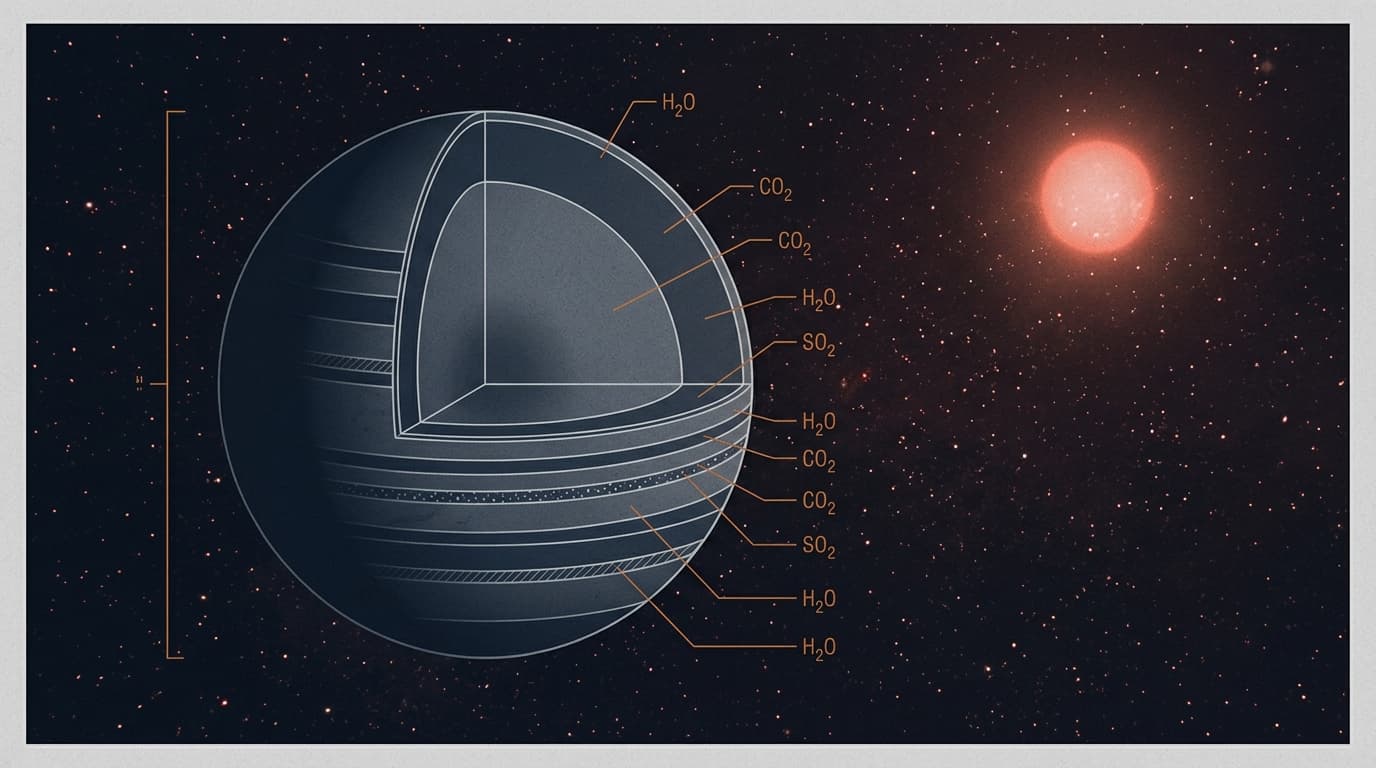
Meanwhile, a separate team revisited WASP-96 b — one of the first exoplanets JWST observed, and already something of a benchmark case. A new study combining JWST NIRSpec data with archival NIRISS and ground-based VLT observations found clear signatures of water, carbon dioxide, and sodium in the atmosphere, and tentative evidence for sulfur dioxide — a molecule whose presence hints at active photochemistry driven by the host star's radiation.
The SO₂ detection matters because it's not just a compositional data point; it's a process indicator. Photochemical reactions in an atmosphere tell you something about how that atmosphere behaves dynamically, not just what it's made of. The study also finds a broadly super-stellar metallicity — the atmosphere is enriched in heavy elements relative to the star — which is the expected result for a hot Saturn that formed via core accretion. So WASP-96 b is, in some ways, better-behaved than TOI-5205 b. But the authors flag that optical scattering from aerosols and hazes is complicating the picture, and they're explicit that future observations are needed to disentangle the effects.
That kind of methodological honesty is worth noting. The data is good enough to generate real constraints — and good enough to reveal how much ambiguity remains.
Direct Imaging Adds a Third Angle
A third result, published April 14 in The Astrophysical Journal Letters by a Johns Hopkins and Space Telescope Science Institute team, takes a different approach entirely: direct imaging of CO₂ absorption in the atmosphere of a super-Jupiter. Rather than catching the planet as it transits its star, the team imaged the planet directly and detected CO₂ — a signature consistent with enhanced metallicity and formation within a protoplanetary disk.
Direct imaging is hard. It works only for planets that are far enough from their stars to be spatially resolved, which means it samples a very different population than transit spectroscopy. The fact that CO₂ shows up clearly here, using JWST's coronagraphic capabilities, is a demonstration of technique as much as a discovery — and it suggests the method will become increasingly useful for characterizing planets that transit-based approaches simply can't reach.
What's Actually Changing
The through-line across these three results isn't any single discovery. It's the accumulation of atmospheric data from multiple techniques — transit spectroscopy, transmission spectroscopy combined with ground-based data, and direct imaging — each probing different kinds of planets in different configurations. The picture emerging is that atmospheric chemistry varies enormously, and that our formation models, built largely on the planets we could see before JWST, are being stress-tested at every turn.
ESA's PLATO mission, scheduled to launch in December 2026 or January 2027, is designed to extend this work toward smaller, Earth-sized planets around Sun-like stars — targets that are currently beyond what JWST can characterize atmospherically. PLATO's 26-camera array will survey nearby, bright stars specifically chosen to be close enough for follow-up spectroscopy. The pipeline from detection to atmospheric characterization is getting built, piece by piece.
The rules keep breaking. That's the point — each broken rule is a constraint on what actually happened four billion years ago when these systems formed. We're reading the fossil record of planetary chemistry, and it's stranger than the textbooks predicted.