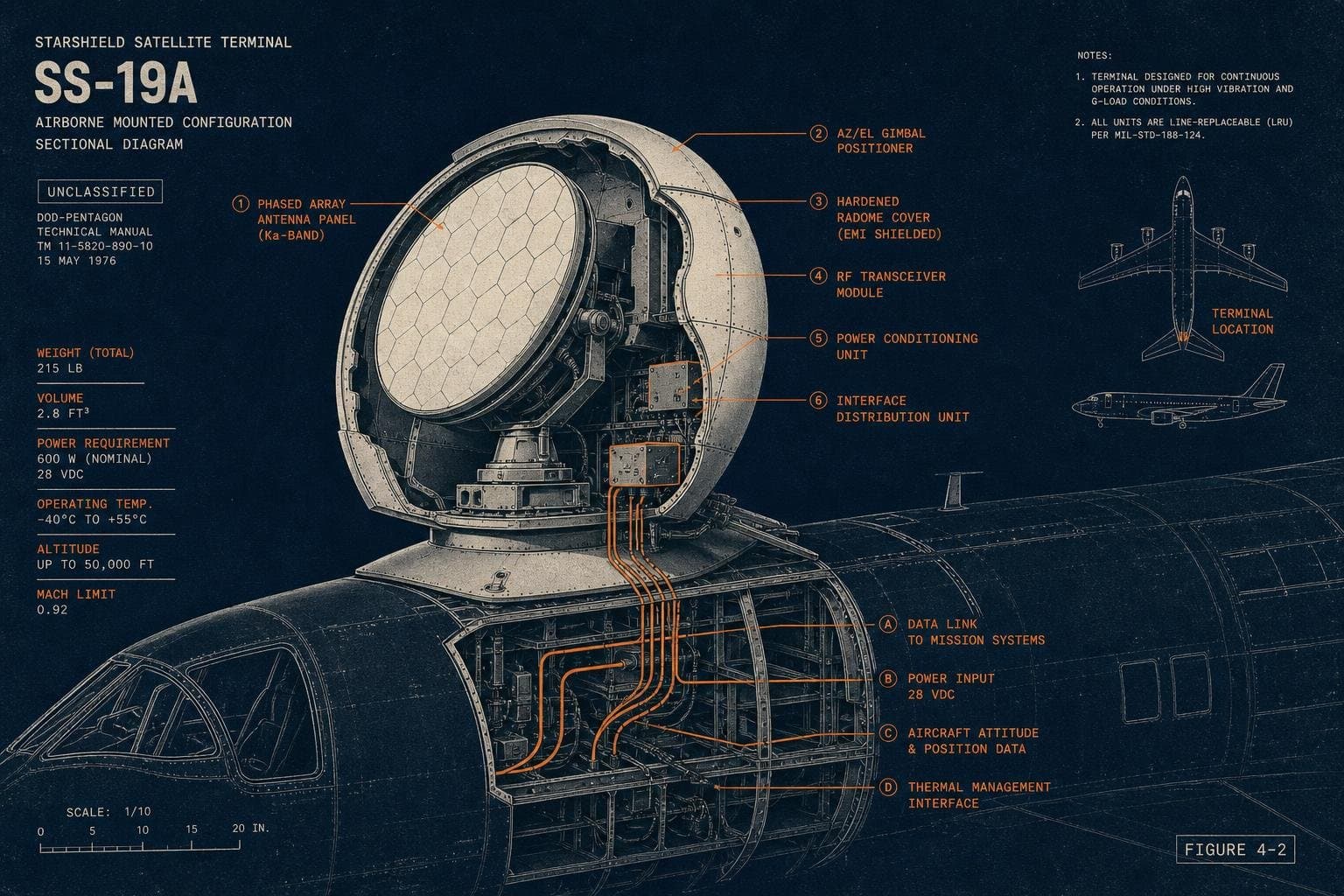

The acquisition document is unusually candid. When the Space Force's Commercial Space Office posted its award notice for "Starshield Custom Fleet Aviation Services" on August 25, the supporting paperwork didn't just describe what the Pentagon was buying — it explained why it felt it had no choice but to keep buying from SpaceX. Acquisition officials cited the government's prior investment as a primary reason that switching providers would involve substantial duplicated costs. That's not a ringing endorsement of a competitive market. It's a lock-in acknowledgment dressed in procurement language.
The contract itself covers satellite subscription services for military aircraft equipped with SpaceX's Starshield Tile and Tile Mini terminals, with data rates of at least 500 megabits per second downlink and 100 megabits per second uplink. The award was made July 28, runs through July 2027, and carries an option extending through July 2028. The dollar value was redacted.
$51.9 Million in Sunk Costs Is a Moat, Not Just a Number
Here's what the filing actually reveals about how deep the integration runs: eleven government organizations participated in development of the Tile Mini aviation-compatible terminal during 2024 and 2025, and the Space Force estimates the government has spent roughly $51.9 million on development and qualification of those terminals — covering prototype fabrication, aircraft integration, interoperability assessments, and testing. The filing separately cites groups of 140, 90, and another 140 aviation terminals, though redactions obscure which aircraft or organizations those numbers correspond to.
That $51.9 million figure matters less as a budget line than as a structural fact. Every dollar spent qualifying Starshield hardware for a specific airframe is a dollar that would need to be spent again — on a different provider's hardware, on different integration work, on different testing — before any competitor could realistically step in. The Pentagon has, perhaps not entirely by design, built a switching cost into its own aviation communications infrastructure.
This is the pattern that SpaceX's broader business strategy has been executing across multiple domains simultaneously. The company has moved up through every layer of the space stack — from launch vehicle to satellite network to connectivity sold directly to consumers, enterprises, and governments. SpaceNews analysis puts the revenue split in stark terms: in 2025, launch services generated about $2.6 billion against $11.4 billion from connectivity — a ratio that explains why SpaceX keeps climbing rather than staying a launch provider. Starshield is the government-facing expression of that same logic: a hardened, classified-capable version of Starlink that gives the Pentagon high-bandwidth airborne connectivity while simultaneously making SpaceX harder to displace.
What This Means for Launch Cadence — and Why It's Complicated
The Starshield contract doesn't directly dictate how many rockets SpaceX launches. But military contracts of this kind shape the underlying demand that drives launch planning, and that's where things get genuinely interesting right now.
SpaceX is in the middle of a significant operational pivot. According to Kiko Dontchev, the company's vice president of launch, a Falcon 9 launch in late August was the last planned Starlink mission from Cape Canaveral until SpaceX begins flying Starship from Florida. The Florida launch rate is expected to drop from roughly eight or nine missions per month to perhaps two per month — a dramatic reduction at what has been the world's busiest spaceport. Future Starlink missions from Florida will fly on Starship; Falcon 9 Starlink launches will continue from Vandenberg.
The practical consequence: Falcon 9's remaining Florida manifest is now almost entirely customer payloads and government missions. The next major payload out of Kennedy Space Center is NASA's Nancy Grace Roman Space Telescope, set to launch August 30 on a Falcon Heavy from Launch Complex 39A — a reminder that the rocket SpaceX built its cadence record on is now primarily a vehicle for other people's priorities in Florida. Starshield satellite replenishment and expansion will increasingly depend on Starship's readiness timeline. Ars Technica reports that SpaceX aims to launch Starship from Florida by end of year, though outside observers consider 2027 a more realistic target.
That gap matters. If Starshield's constellation needs to grow to support expanding military aviation contracts — and the filing's reference to "additional installations planned" suggests it does — the pace of that growth is now tied to Starship's schedule in a way it wasn't before.
The Dependency Runs Both Ways
There's a version of this story where SpaceX's military entanglement is simply good business: recurring government revenue, locked-in customers, and a moat built from the Pentagon's own investment decisions. That's accurate as far as it goes.
But the dependency runs in both directions. The U.S. military has now structured its airborne communications around a commercial provider whose launch cadence, constellation health, and corporate trajectory are not under government control. The broader questions this raises — about governance, about what happens when commercial space infrastructure becomes load-bearing for national security — are serious enough that the National Academies convened a meeting in late August specifically to address governance and economic frameworks for emerging space infrastructure. That meeting wasn't about Starshield specifically, but the underlying tension is the same: the government is increasingly dependent on commercial systems it doesn't control.
Watch for whether the next Starshield contract renewal includes any provisions around constellation continuity or government data rights — the kind of language that would signal whether acquisition officials have started thinking seriously about what happens if SpaceX's priorities shift. So far, the filings suggest they haven't.


