



The case for lunar water ice has been building for decades — orbital spectrometers, impact plume analysis, neutron detectors — and the scientific consensus has hardened considerably. We're not debating whether ice exists at the lunar south pole anymore. The debate has moved to something harder and more consequential: whether any of it is accessible enough to matter for exploration economics.
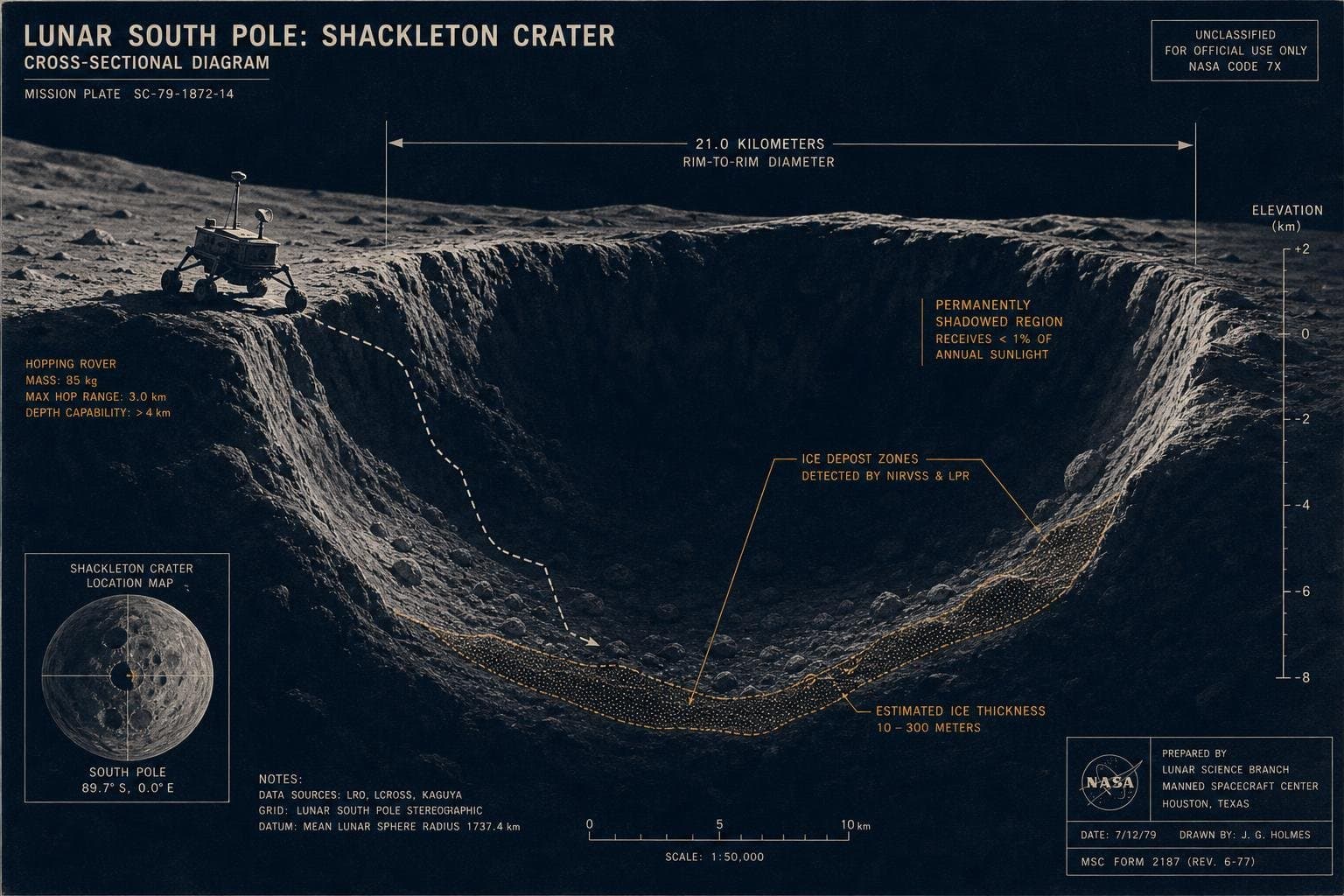
That shift is what makes China's Chang'e 7 mission worth watching closely. As Scientific American reported, the mission is designed to land near Shackleton Crater — a 21-kilometer-wide pit whose rim grazes the lunar south pole — and search for ice trapped in permanently shadowed depressions nearby. Norbert Schorghofer of the Planetary Science Institute put it plainly: "There has never been a landed mission to find water on the moon." Whatever Chang'e 7 finds, it will be the first ground-truth data we've ever had.
The Gap Between "Ice Exists" and "Ice Is Useful"
The permanently shadowed regions at the lunar poles are among the most hostile environments in the solar system. Temperatures sit a few dozen degrees above absolute zero. The terrain is broken, steep, and — by definition — never illuminated. As The Conversation's coverage of the mission notes, we don't yet know how deeply the ice is buried, what concentration it exists in, or whether it could realistically be extracted. Those unknowns aren't minor footnotes — they're the entire engineering problem.
This is why Chang'e 7's hopping robot is the genuinely novel element. A wheeled rover can't descend into a permanently shadowed crater; the walls are too steep and the terrain too fractured. The hopper is designed to leap over broken ground and drop into craters where conventional vehicles simply cannot go. It's a direct acknowledgment that the ice, if it's there in useful quantities, won't be sitting conveniently on a flat surface waiting to be scooped up.
The resource economics of lunar water depend entirely on answers that don't exist yet. Water ice at the poles could theoretically be split into hydrogen and oxygen — rocket propellant — making the Moon a refueling depot rather than a dead end. That's the version of the story that gets repeated in every lunar base proposal. But the math only works if the ice is concentrated enough to extract efficiently, shallow enough to reach without prohibitive drilling, and located somewhere a human or robotic mission can actually operate. None of those conditions are confirmed.
What This Means for Artemis
NASA's lunar ambitions are running on a compressed timeline that doesn't wait for Chang'e 7's results. Ars Technica reported this week that NASA is redesigning its lunar spacesuit — simplifying it into a "Sortie Suit" variant developed with Axiom Space — specifically to accelerate the program toward a south pole landing as early as 2028. The agency is meeting with Axiom six days a week, often in person, to address schedule and performance concerns. That's not a comfortable cadence; that's a program under pressure.
The spacesuit decision is a useful window into how NASA is thinking about the ice question. The south pole target isn't chosen for its hospitality — it's chosen because that's where the water is hypothesized to be. But the initial Artemis landings are sortie missions: short-duration surface stays focused on demonstrating capability, not resource extraction. The ice economics don't kick in until there's sustained presence, and sustained presence requires infrastructure that doesn't exist yet.
So NASA is racing to reach the place where the ice might be, before it knows whether the ice is usable, with suits that are being simplified to make the schedule work. That's not irrational — you have to land somewhere, and the south pole is the scientifically motivated choice — but it means the resource economics argument is running ahead of the resource economics evidence.
What Chang'e 7 Actually Changes
If China's mission lands successfully and its hopper returns data showing concentrated, accessible ice deposits near the surface, that genuinely reshapes the planning calculus for every subsequent mission. It would be the first empirical confirmation that the south pole's water is where the models suggest and in a form that matters for engineering. That's not a small thing.
If the data comes back ambiguous — ice present but patchy, deeply buried, or in concentrations too low to extract economically — that's equally important, and considerably more likely to be the answer. The Moon has had billions of years to complicate the picture.
Either way, Chang'e 7 is doing something no mission has done before: putting instruments directly into the environment where the ice is supposed to be. Watch for the November landing attempt and, more importantly, the first data releases from the hopper's descent into shadowed terrain. That's when the resource economics conversation gets its first real evidence to work with — and when the gap between the promotional version of lunar water and the engineering reality will start to close.