
The Artemis II crew returned from their lunar flyby earlier this month to a hero's welcome. What got less attention: the geopolitical architecture around that mission is more contested than the mission itself.
Sixty-one nations have now signed the Artemis Accords, a U.S.-led framework establishing norms for lunar operations — transparency, interoperability, resource extraction rights. Meanwhile, Russia's Academy of Sciences just approved the concept for its segment of the International Lunar Research Station, a competing Chinese-Russian program with its own vision for who builds what and where. Two frameworks, zero overlap, one Moon.
This is the situation that actually matters right now.
The South Pole Is the Prize, and Everyone Knows It
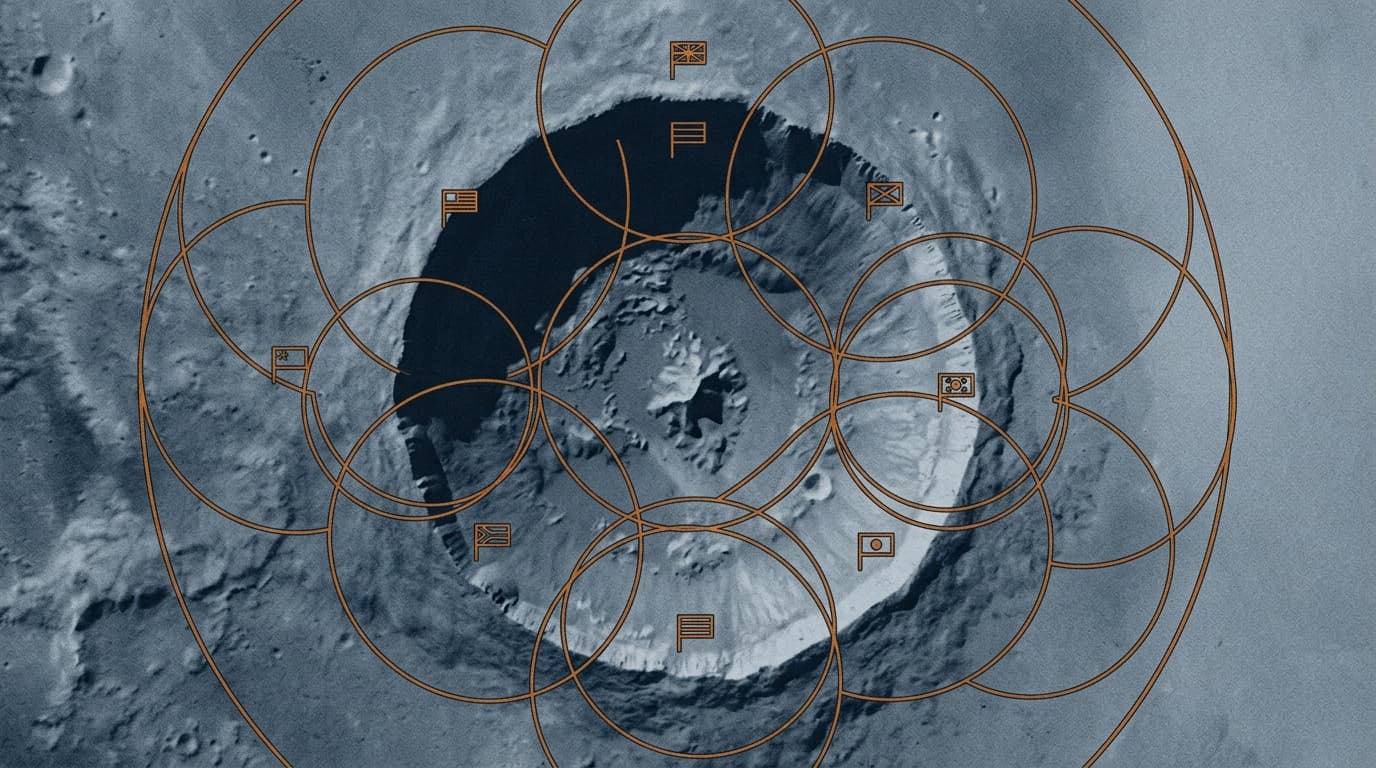
The lunar south pole isn't scientifically interesting by accident. Permanently shadowed craters there are believed to hold water ice — which means rocket propellant, drinking water, and oxygen for long-duration operations. As the Lowy Institute's analysis puts it, the goal isn't to return material to Earth. It's to use resources in situ to support sustained presence. Whoever establishes durable operations at the south pole gains a compounding advantage: resources fund more presence, which secures more resources.
That circular logic is why the geopolitics are so sharp. The 1967 Outer Space Treaty prohibits national appropriation of the Moon. But it was written before anyone seriously planned to mine it, and it says nothing useful about safety exclusion zones, operational boundaries, or what happens when two missions want the same crater.
The Open Lunar Foundation's recent analysis frames this precisely: a mission planner who announces a 100-kilometer operational zone around Shackleton Crater for legitimate safety reasons looks, from the outside, identical to one executing a territorial land grab. There's currently no institutional mechanism to tell the difference. The Outer Space Treaty forbids appropriation but doesn't define it. The Artemis Accords establish norms but carry no enforcement authority. The result is a coordination vacuum at exactly the moment when multiple actors are planning to arrive.
Two Programs, No Common Framework
The Artemis architecture is genuinely commercial in a way Apollo never was. NASA awarded SpaceX $2.9 billion for a Starship-derived Human Landing System and Blue Origin $3.4 billion for its Blue Moon MK2 lander — neither vehicle designed exclusively for NASA, both companies positioning lunar capability as infrastructure for broader commercial ambitions. The Accords framework around this is explicitly designed to make the U.S. "one of many customers in a lunar transportation market."
The Chinese-Russian ILRS is built on a different premise: a state-led station with a power plant memorandum already signed, a Russian segment concept now formally approved, and a roadmap oriented toward long-term unmanned operations with eventual human presence. TASS reported that Roscosmos head Dmitry Bakanov confirmed the RAS approval at a Federation Council meeting.
These aren't just competing programs. They're competing visions of how lunar presence gets legitimized — through commercial frameworks and bilateral accords, or through state-built infrastructure and parallel diplomatic alignment. Getting the U.S. and China to coordinate, as the Lowy Institute drily notes, "is science fiction for the time being."
What Actually Needs to Happen Before Anyone Lands
The Open Lunar Foundation's proposal for Designated Lunar Areas — operational zones that function as coordination infrastructure rather than territorial claims — is the most concrete governance idea currently circulating. The analogy to FCC radio-silent zones is useful: you're not claiming the spectrum, you're establishing that your instruments need protection from interference. Same logic, different body.
Whether that framework gets traction depends on whether Artemis Accords signatories treat it as a template or a talking point. The window is genuinely narrow. Once hardware is on the surface and operations are underway, the first-mover advantage calculus changes dramatically — and so does the incentive to negotiate.
Watch for two things in the next 12 months: whether NASA's Commercial Lunar Payload Services missions establish any operational precedent around exclusion zones, and whether the ILRS partners publish site selection criteria that overlap with Artemis target locations. The legal ambiguity is abstract right now. It won't stay that way.
Elsewhere this week: Artemis II's successful lunar flyby continues to generate downstream analysis — New Space Economy's breakdown of the commercial architecture around the mission is worth reading if you want the economic context behind the geopolitical competition. The short version: the commercial lander contracts alone represent a structural shift in how space infrastructure gets built, which is exactly why the governance question matters more than it did during Apollo.


