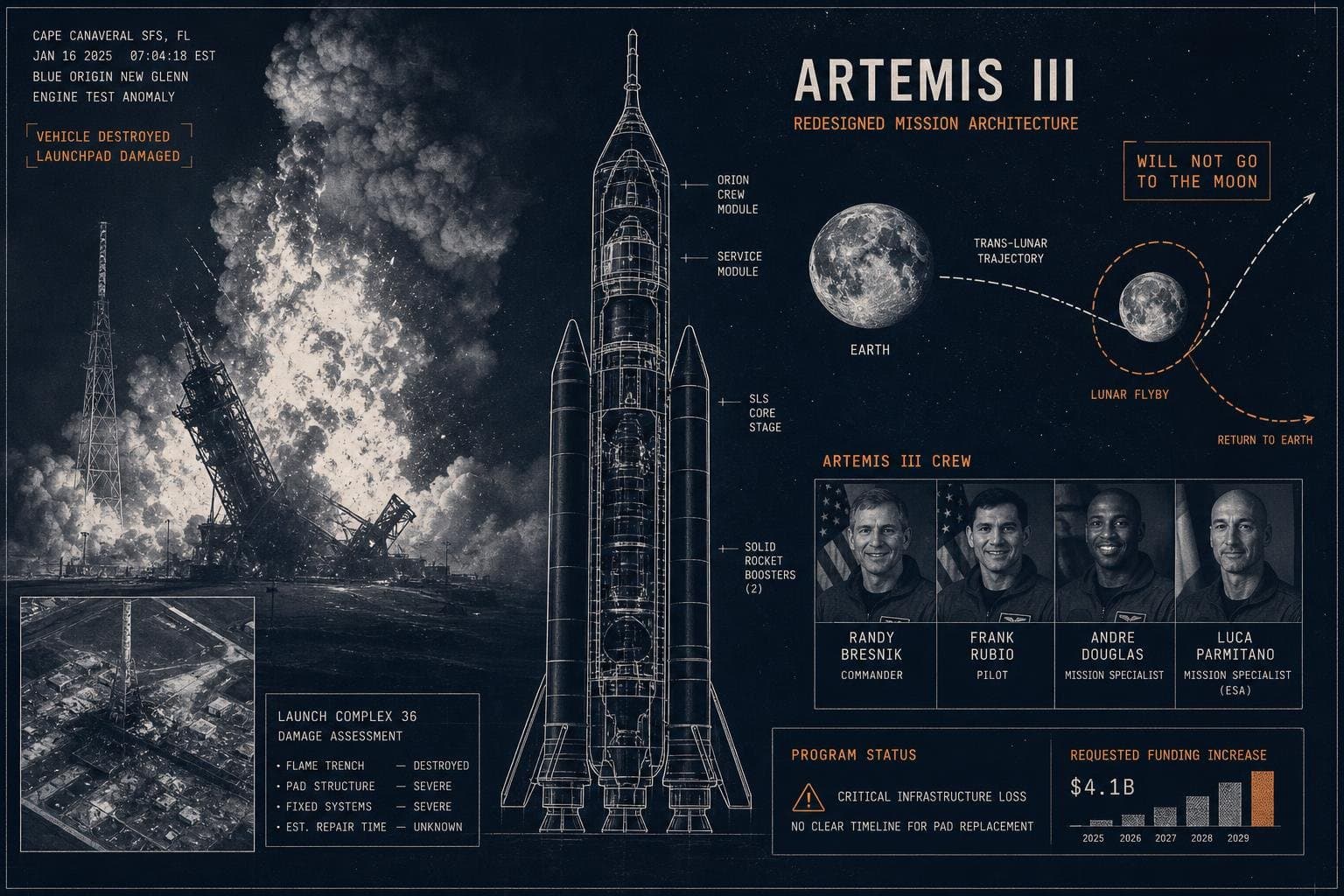

Six weeks ago, a Blue Origin New Glenn rocket exploded during a routine engine test at Cape Canaveral, destroying the vehicle and damaging the company's only launchpad. NASA responded last week by announcing the Artemis III crew, redesigning the mission architecture, and quietly lobbying Congress for a multi-billion-dollar cash infusion. That's a lot of activity for a program that just lost a critical piece of infrastructure with no clear timeline for its replacement.
The crew announcement was real news — Randy Bresnik, Frank Rubio, Andre Douglas, and ESA's Luca Parmitano are a credible team for a genuinely difficult mission. But the announcement also served as a confidence signal for a program that badly needed one. The harder story is what's actually blocking the path forward.
Artemis III Is No Longer What It Was
The mission has been substantially redesigned, and it's worth being precise about what it now is. Artemis III will not go to the Moon. The Orion spacecraft will launch on SLS into low Earth orbit, where it will rendezvous and dock with prototype versions of both the Blue Origin Blue Moon Mark 2 lander and SpaceX's Starship — in sequence, as a docking choreography exercise. No lunar surface. No South Pole. That mission is now Artemis IV, currently targeted for 2028.
This is the right call given where the landers actually are. But it means the program is running a high-stakes orbital test in 2027 to validate procedures for a lunar landing in 2028 — with less than 18 months between them, assuming everything goes to plan. That's a tight margin for a mission NASA itself describes as "one of the most highly complex missions NASA has undertaken."
On the SLS side, the hardware picture is actually reasonable. Artemis program manager Jeremy Parsons told Ars Technica that the mobile launcher came through Artemis II in good shape, boosters have arrived at the processing facility, and stacking is expected to begin in July. A short-stack wet dress rehearsal is planned to validate redesigned cryogenic seals — a sensible precaution given the seal issues on Artemis I and II. The rocket is not the problem.
The Launchpad Problem Has No Public Answer
The problem is Blue Origin's launchpad, and the silence around it is conspicuous.
On May 28, a New Glenn rocket exploded during a standard engine fire test, destroying the vehicle and damaging Blue Origin's only launch facility at Cape Canaveral. The cause remains unclear. At the Artemis III crew announcement, Blue Origin's John Couluris said the company had "redoubled our efforts and are moving forward" — and offered nothing more specific about repair timelines. NASA administrator Jared Isaacman told reporters he was "extremely confident" in the program timeline, without explaining the basis for that confidence.
That's not reassurance — that's a press event. A launchpad is not a software bug. Rebuilding or repairing launch infrastructure takes time measured in months to years, and Blue Origin has no backup facility. The Blue Moon lander needs to reach orbit before Orion can dock with it. If the launchpad isn't ready, the Artemis III mission sequence — which begins with Blue Origin's lander launching first — cannot proceed as designed.
The Money Gap Is Real, and Congress Isn't Certain
Meanwhile, NASA has begun quietly lobbying Congress for what one staffer described as "a few billion dollars" in supplemental funding — money needed to cover lander redesign costs and the fallout from the Blue Origin explosion. The discussions are preliminary, the legislative vehicle is uncertain, and GOP leaders have expressed skepticism about another partisan spending package before August recess.
This is the structural bind: the program needs money to accelerate, the political window for that money is narrow, and the technical problems don't pause while Congress deliberates.
Starship's role has also shifted in ways that reduce some risk while introducing new complexity. SpaceX's revised plan for Artemis IV has Starship docking with Orion in low Earth orbit — not near-rectilinear halo orbit — and then performing the trans-lunar injection burn with the crew aboard. That eliminates demanding loiter requirements and simplifies propellant logistics. But it's a significant architectural change, and NASA has been explicit that no launch date will be committed to until Starship's uncrewed demonstration flight meets its risk-reduction objectives. The schedule is gated on test results, not calendar targets.
What to Watch
The next six months are genuinely diagnostic. SLS stacking in July will confirm whether the rocket side stays on track. Blue Origin's launchpad repair progress — or lack of public updates about it — will tell you more about the 2027 timeline than any press conference. And the Congressional supplemental funding question will likely resolve, one way or another, before the fall.
I wrote in June 2026 that Artemis has a schedule problem, not a contractor problem. The New Glenn explosion has made that harder to sustain


