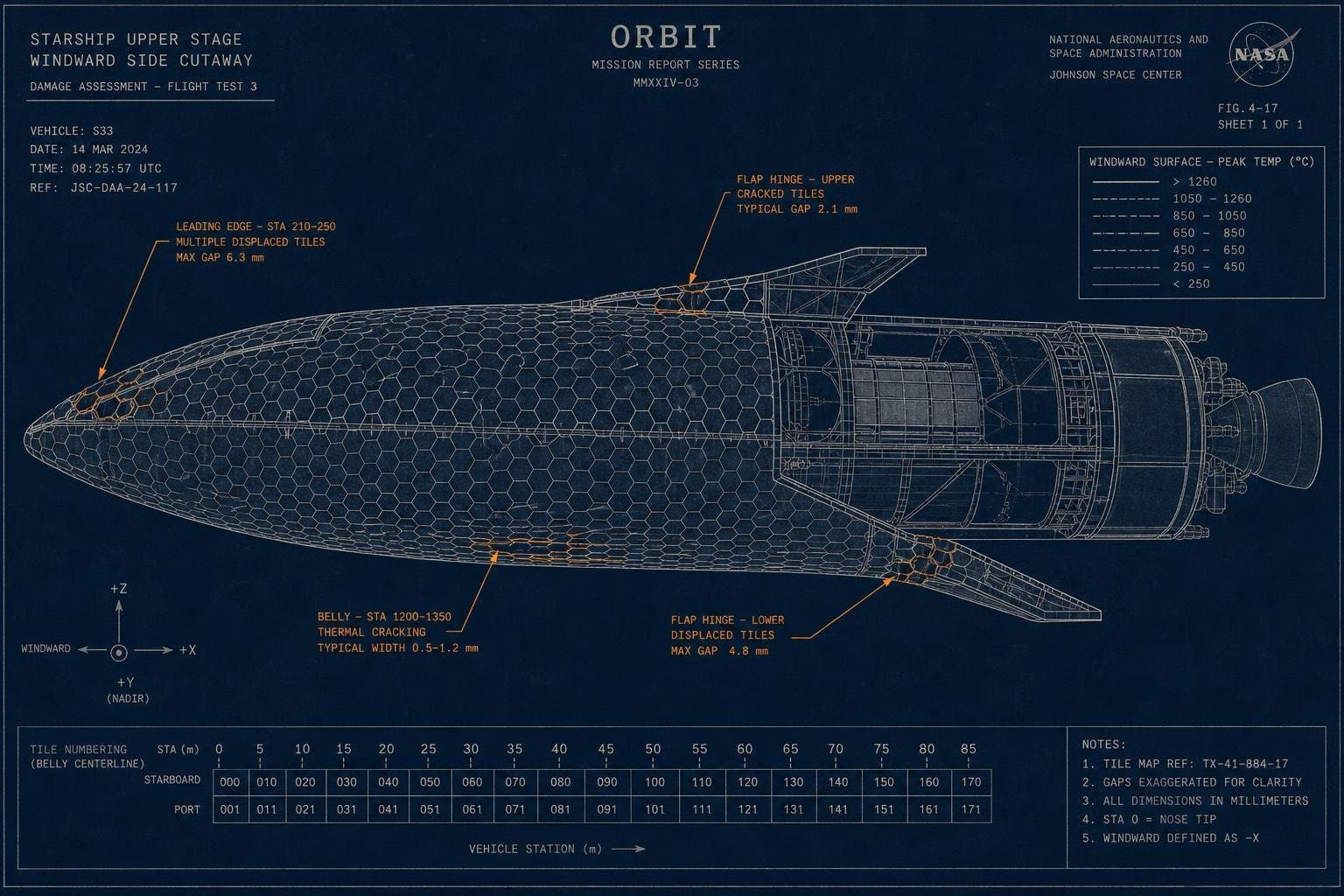

The booster failure on Starship's twelfth flight got most of the headlines. Eight Raptor 3 engines failing during the boostback burn, Booster 19 hitting the Gulf of Mexico at 1,450 kilometers per hour — that's a dramatic image, and it earned the attention. But buried in the same flight data was a quieter success that deserves its own scrutiny: Ship 39 survived reentry and achieved a controlled splashdown in the Indian Ocean.
That's the part worth watching. Because Starship's reentry protection problem is older, harder, and less discussed than its engine problems — and the Flight 12 ship data doesn't resolve it so much as defer it.
What Flight 12 Actually Showed About Reentry
Ship 39 completed its sub-orbital trajectory, executed the belly-flip maneuver, and splashed down successfully. SpaceX called the ship's performance a success, and on the narrow question of whether the vehicle survived reentry, that's fair.
But "survived" is doing a lot of work in that sentence. The heat shield on Starship's upper stage uses a tile-based thermal protection system — hundreds of individual ceramic tiles covering the vehicle's windward surface. The engineering challenge is formidable: tiles must survive peak heating, handle the mechanical stress of the belly-flip maneuver, and do all of this on a vehicle that SpaceX intends to refly rapidly. A tile that cracks, pops off, or degrades faster than expected doesn't just create a repair bill. It creates a question about whether the vehicle can be turned around on any practical schedule.
SpaceX has not published detailed post-flight tile inspection data for Flight 12. What we know from the flight report is that the ship performed well enough to complete the mission. What we don't know is what the heat shield looked like afterward — how many tiles needed replacement, how much labor that required, and whether the damage pattern was better or worse than previous flights.
That gap matters enormously for the cadence argument.
The Cadence Problem Is Also a Heat Shield Problem
The case for Starship's commercial viability rests on rapid reusability. Launch cadence — the rhythm of prepare, launch, learn, repair, and fly again — is what separates a capable prototype from an operational system. A vehicle that survives reentry but requires weeks of tile replacement between flights isn't reusable in any economically meaningful sense. It's a very expensive single-use rocket with a complicated cleanup procedure.
This is where the Orion heat shield comparison becomes instructive, even though the vehicles are solving different problems. During the uncrewed Artemis I test flight in 2022, engineers discovered over 100 cracks and craters in Orion's Avcoat heat shield — damage that wasn't anticipated and that prompted NASA to change the reentry profile for the crewed Artemis II mission. The lesson isn't that Starship and Orion share the same failure mode. It's that reentry heating consistently produces surprises, and those surprises tend to be discovered only in flight.
Starship's tile system is architecturally different from Orion's ablative Avcoat, but the underlying physics is unforgiving for both. Reentry heating is one of those environments — like ascent loads and stage separation dynamics — that ground tests cannot fully reproduce. You learn what you learn in flight, and you learn it one flight at a time.
What "Unsolved" Actually Means Here
To be precise: Starship's heat shield is not failing catastrophically. The vehicle has survived reentry multiple times. The problem is subtler — it's that the tile system hasn't yet demonstrated the durability and repairability that rapid reuse requires. That's a different kind of unsolved.
SpaceX's approach has always been to iterate in flight rather than certify on the ground, and that philosophy has real advantages. Each flight gives engineers evidence about structures, engines, software, plumbing, avionics, heat shielding, and ground systems that no test stand can replicate. The tile system will improve. The question is the rate of improvement relative to the operational timeline SpaceX has committed to.
The FAA grounded Starship after Flight 12 to investigate the booster failure. That grounding was announced five days after the May 22 flight. When flights resume, the engine reliability story will dominate the coverage again — Raptor 3's ignition sequencing issues are dramatic and legible. The heat shield story will continue to accumulate quietly in post-flight inspection data that SpaceX doesn't publish.
Watch for whether SpaceX begins releasing tile inspection metrics as the program matures. If they do, it signals confidence. If the data stays internal, the question stays open. Either way, the next few flights will tell us more about reentry durability than any press release — which is, at this point, the only honest way to assess it.


