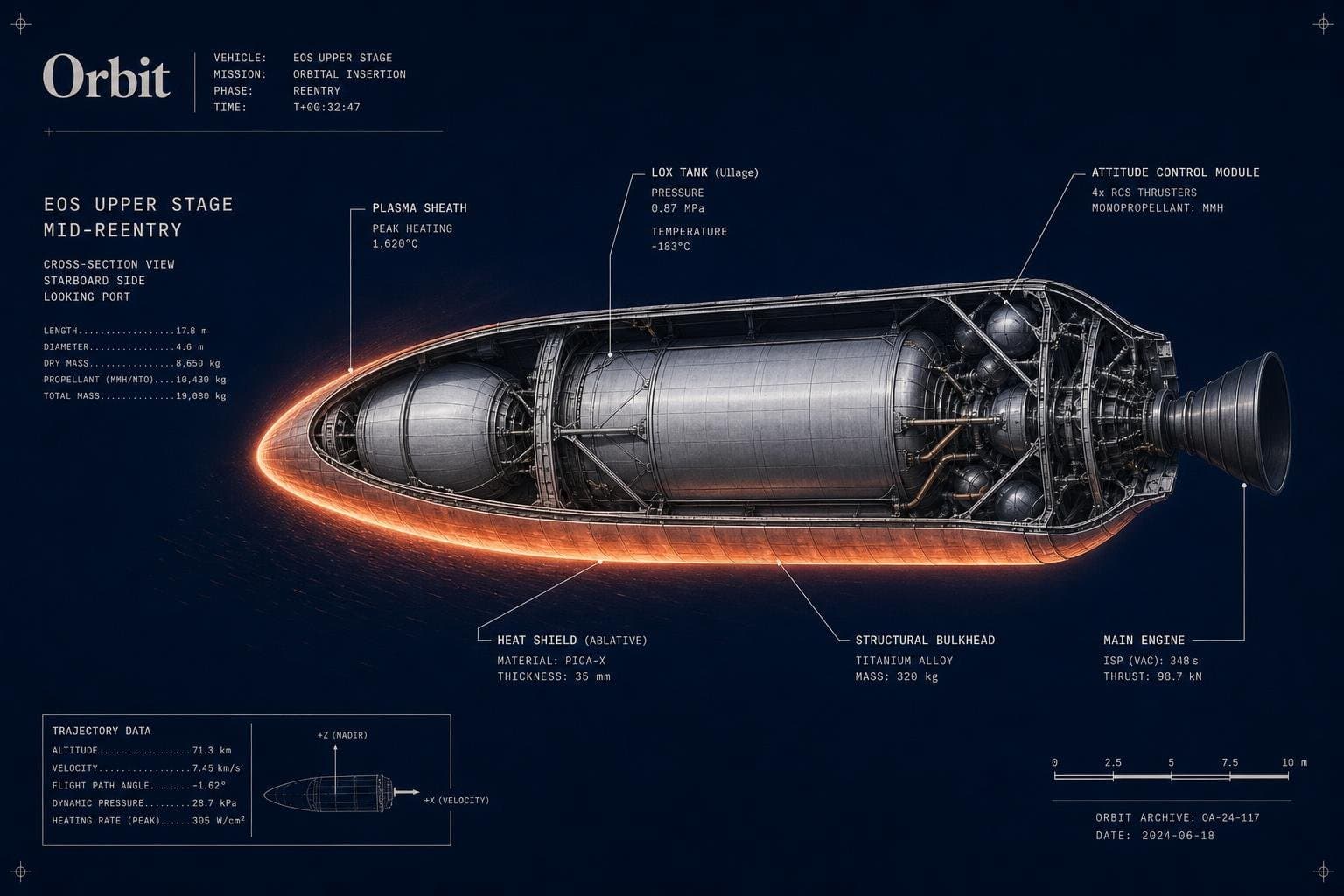

SpaceX engineers deliberately broke their own heat shield on Flight 12. They removed a single tile before launch to see what would happen to the tiles around it when superheated plasma came rushing in. That's not recklessness — that's how you learn when you don't yet have a complete model of how your thermal protection system behaves under real reentry conditions. It's also a quiet admission that, after twelve test flights, reentry remains the part of Starship's development that keeps generating surprises.
The broader Flight 12 results were mostly encouraging on the Ship side: the heat shield held, the aerodynamic flaps stayed intact through the fiery descent over the Indian Ocean, and the vehicle completed its banking maneuvers before a successful splashdown northwest of Australia. But the Super Heavy booster suffered Raptor engine failures during its boostback burn, hit the Gulf at close to 1,500 kilometers per hour, and triggered an FAA mishap investigation that now grounds Starship until SpaceX completes a root-cause analysis and the agency approves corrective actions. One half of the system worked. The other didn't. That's the current state of Starship reusability.
The Heat Shield Is a Diagnostic Problem, Not Just an Engineering One
What makes reentry so persistently difficult isn't that SpaceX lacks smart engineers — it's that the physics are genuinely hard to simulate on the ground. Plasma heating during atmospheric reentry creates conditions that wind tunnels and test chambers can only approximate. The real data comes from flying.
That's why Flight 12 deployed two modified Starlink satellites specifically to scan Starship's heat shield from outside the vehicle and transmit imagery back to ground controllers during reentry. SpaceX also painted certain tiles white to serve as visual reference targets. The goal was to build a diagnostic capability — a way to assess heat shield condition from orbit before committing to a return — that future operational missions would need anyway. The inspector satellites represent a genuine methodological advance: instead of waiting until after splashdown to examine tile damage, engineers can now observe the shield while it's under load.
The deliberately removed tile added another data layer. SpaceQ reported that engineers wanted to measure how aerodynamic loads shift to adjacent tiles when one is missing — information that matters enormously for understanding failure cascades. If one tile pops off during reentry, does it take neighbors with it? The answer shapes how conservatively SpaceX needs to design tile attachment and spacing across the entire vehicle.
This is the kind of incremental, empirical work that doesn't generate headlines but actually moves programs forward. Past Starship flights saw flap damage and tile loss that wasn't fully understood until after the fact. Flight 12 was the first time SpaceX built the diagnostic infrastructure into the mission itself.
The Booster Problem Is Separate — and Currently More Urgent
While the Ship's reentry performance was the headline SpaceX wanted, the booster failure is the one that matters most for the program's near-term schedule. The FAA's mishap classification isn't a formality: the agency requires SpaceX to identify the root cause and receive FAA approval of corrective actions before Flight 13 can proceed. Given that the Raptor 3 engine failures occurred during the boostback burn — a maneuver the booster had performed successfully on previous flights — the investigation will need to determine whether this was a hardware defect specific to the V3 booster, a software or sequencing issue, or something about the new engine variant's behavior under those conditions.
The irony is that SpaceX chose not to attempt a tower catch on Flight 12 precisely because they wanted to gather data on the redesigned booster without risking the launch pad infrastructure. The conservative choice still produced a mishap. That's not a knock on the decision — it was the right call — but it illustrates how much uncertainty remains in the V3 architecture even after the extended development period between flights.
What the Starfall Capsule Tells Us About the Broader Problem
Reentry difficulty isn't unique to Starship. FAA documents published May 29 revealed that SpaceX has been quietly developing a separate reentry vehicle called Starfall — a disk-shaped capsule designed for returning payloads from orbit to support in-space manufacturing. The capsule's heat shield is a carbon-fiber structure covered in thermal protection material; the vehicle has no independent deorbit capability and relies entirely on its heat shield geometry and parachutes for recovery. Aviation Week noted that the FAA approved two demonstration reentries in the Pacific Ocean, with recovery by ship.
Starfall is a much simpler vehicle than Starship — no flaps, no landing burn, no reuse of the heat shield itself in the same way. But the fact that SpaceX is developing a dedicated reentry capsule alongside Starship suggests the company understands that controlled atmospheric return is a distinct engineering discipline, not a solved problem that scales automatically from one vehicle to another.
The watch item now is the FAA investigation timeline. SpaceX's Flight 13 readiness depends entirely on how quickly the agency accepts the root-cause findings and corrective actions for the booster failure. Meanwhile, the heat shield diagnostic data from Flight 12's inspector satellites is presumably being analyzed — and whatever it shows will shape how aggressively SpaceX pushes toward orbital flight and, eventually, the full reusability the Artemis lunar lander contract requires.
Reentry is where physics bills come due. Flight 12 showed SpaceX is getting smarter about reading the invoice.


