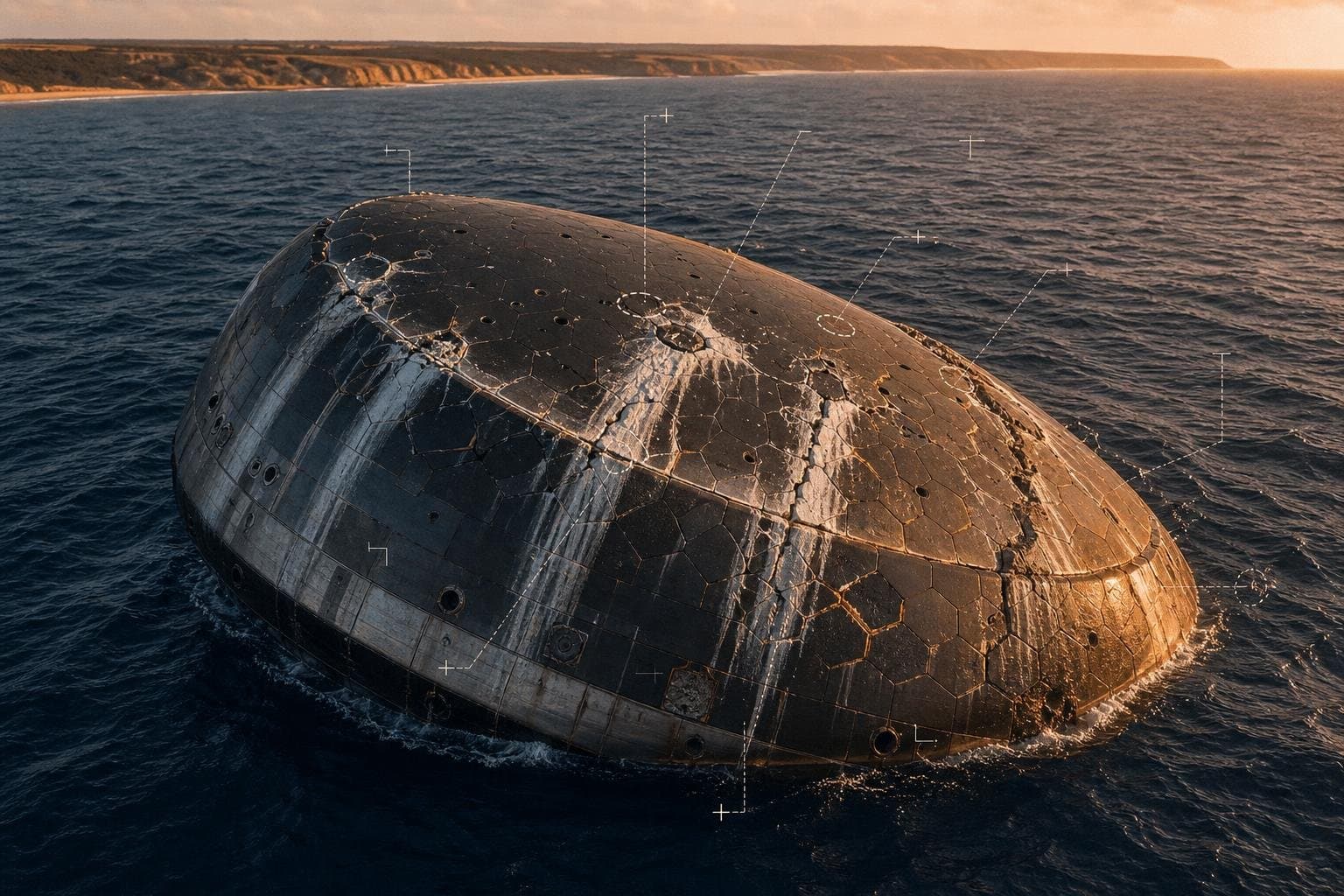

SpaceX's 13th full-scale Starship test flight ended with something the program had never managed before: a vehicle floating intact in the Indian Ocean, heat shield largely intact, gently tipped on its side in calm water west of Australia. Previous splashdowns ended in fireballs. This one ended with drone footage of a recognizable rocket.
That's genuinely significant. But the same footage that showed a buoyant, intact Starship also showed white streaks across the heat shield, cracked tiles, and broken edges — all appearing to originate at tile boundaries, suggesting hot gas had penetrated the gaps. The picture-perfect ending and the engineering problem are the same image.
What Flight 13 Actually Demonstrated
The headline achievement is the splashdown itself. SpaceX communications manager Dan Huot called it "a dream scenario for the team trying to get this heat shield data" — and he's right, for reasons that go beyond optics. Because the vehicle survived intact, SpaceX engineers can now fly drones over the actual heat shield and inspect roughly 18,000 ceramic tiles that just survived temperatures up to 2,600° Fahrenheit on the way back through the atmosphere. They may even be able to tow the rocket to shore in Australia for more detailed examination. Every previous splashdown destroyed the evidence.
Elon Musk moved quickly to announce the next step: unless post-flight data review turns up problems, SpaceX will attempt to catch Starship with the launch tower's mechanical arms on the following flight. The mechanical infrastructure already exists — SpaceX has demonstrated tower catches with the Super Heavy booster, the larger, heavier first stage that returns at a fraction of Starship's reentry speed. Catching the ship itself would close the full reuse loop the program requires.
That trajectory — intact splashdown, tower catch attempt, eventual orbital operations — represents real progress. The program is advancing in a recognizable direction. It's worth noting that SpaceX has been running its Falcon 9 booster fleet on a similar iterative logic: the same first-stage booster that launched a Starlink mission on July 31 was flying its 26th flight, a reuse cadence Starship's program is ultimately trying to match or exceed.
The Heat Shield Problem Hasn't Gone Away
I've written about this twice before — in June and again in July — and Flight 13 doesn't change the underlying analysis so much as sharpen it.
The tile damage visible in the drone footage prompted a pointed response from Dan Rasky, a former NASA engineer who spent nearly four decades studying heat shield materials at NASA Ames and co-invented PICA, the material used in Crew Dragon's heat shield. His assessment: "Starship's current thermal protection system is a dead-end for all missions that require full and rapid reusability."
That's a credible voice saying something specific. The concern isn't whether the tiles work — they clearly do, well enough to bring the vehicle home. The concern is whether they can work repeatedly, without extensive post-flight inspection and replacement, at the turnaround cadence SpaceX's business model requires. The Space Shuttle faced the same problem: each tile required post-flight inspection, and rapid reuse was never achieved — not for lack of trying, but because the physics of ceramic tile inspection don't compress easily.
SpaceX has one genuine advantage the Shuttle lacked: Starship's stainless steel structure can tolerate significant heating even where tiles fail, raising the acceptable threshold for tile damage. But it doesn't eliminate the inspection requirement, and it doesn't make cracked edges and gas-penetrated boundaries disappear from the data. NASA and SpaceX have been conducting joint wind tunnel tests on Starship's aerodynamic and thermal behavior as part of the Human Landing System program — work that reflects how seriously both organizations treat the reentry problem, and how much remains to be characterized.
What the Next Flight Actually Tests
The tower catch attempt — if it happens — will generate its own headlines. Mechanically catching a vehicle the size of a 20-story building as it hovers over a launch pad is a remarkable engineering feat, and the booster catches suggest the system works. Success there would be worth celebrating.
But the more consequential data will come from the heat shield inspection of Flight 13's vehicle, and from whatever tile condition the next ship shows after its own reentry. The question worth watching isn't whether SpaceX can catch Starship — it's whether the tile damage pattern improves flight over flight, or plateaus at a level that still requires significant post-flight work.
Rasky's analysis, co-authored with former NASA astronaut Charles Camarda and space industry official Charles Miller, noted that tile loss on Flight 13 was minimal — an improvement on prior flights. The trend line is moving in the right direction. Whether it's moving fast enough, toward a solution that enables rapid reuse rather than just survivable reuse, is the question that will define whether Starship becomes what SpaceX needs it to be. For context on how ambitious that standard is: the Roman Space Telescope team just completed more than 1,100 hours of operational readiness testing to prepare for a single launch. Starship is aiming for a cadence where launches are routine enough to skip that kind of ceremony entirely.
Flight 13 was a genuine milestone. The heat shield data it produced may matter more than the splashdown itself.


