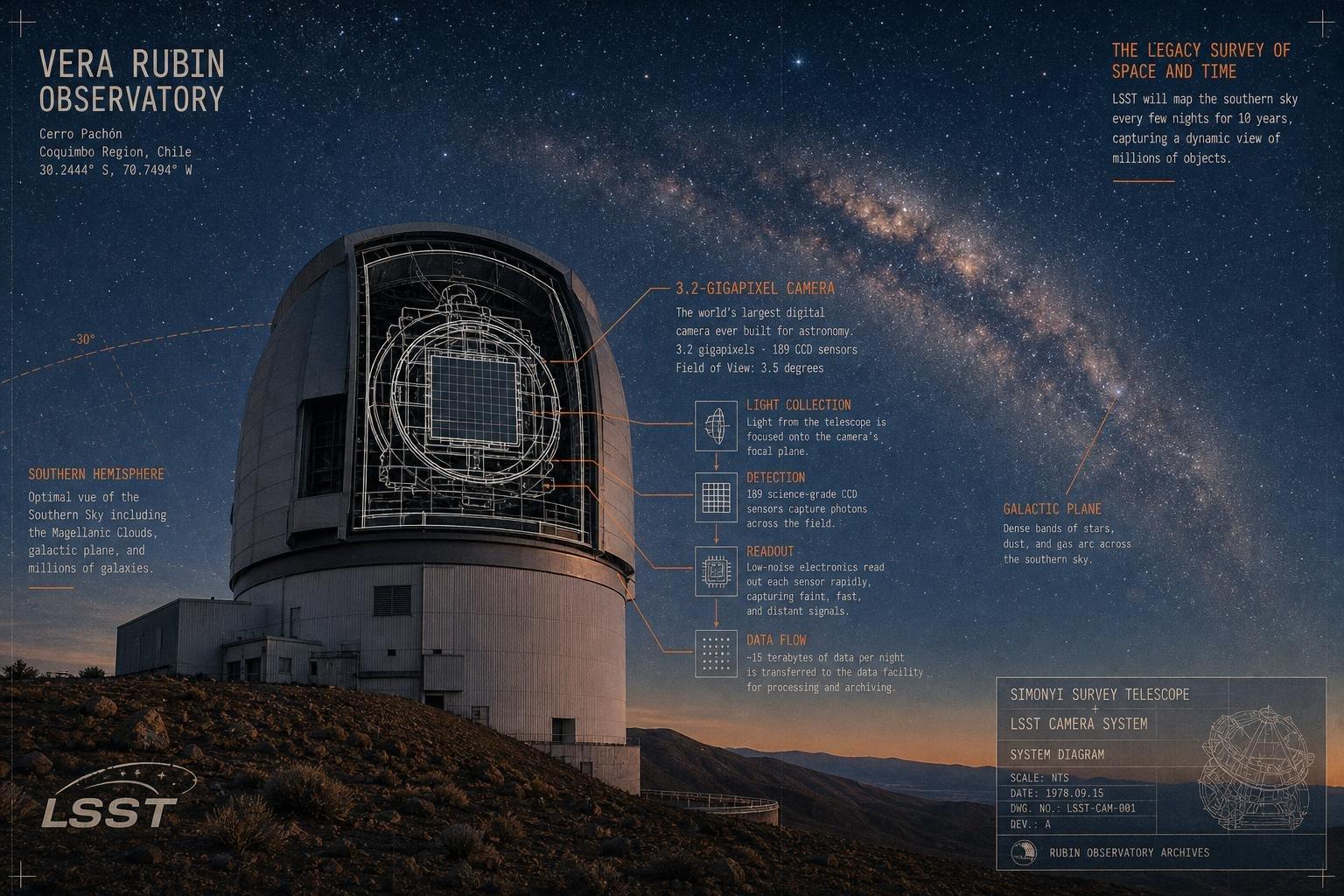

A new telescope's first announcements are usually a camera test chart and a pretty picture of a nebula everyone's seen a thousand times before. Vera Rubin Observatory skipped that step. Working from preview data covering just 15% of its eventual survey footprint, astronomers using the Simonyi Survey Telescope have already found two previously unknown satellite galaxies of the Milky Way and two ultra-rare asteroids trailing Neptune — discoveries that would have taken other instruments years, if they came at all (UW News, Live Science).
That's the actual headline here. Not "Rubin works" — everyone expected that. It's that the fraction of sky it hasn't even gotten to yet is already producing science a specialized survey couldn't. It's a useful contrast to how most big observatories actually earn their keep: JWST spent its early years chasing a single narrow question — how far back can we see the first galaxies — before the broader payoff showed up (NASA Science). Rubin is doing the opposite, turning up unrelated finds across two completely different subfields before its main survey has properly started.
The Milky Way Has More Neighbors Than We've Counted
Large galaxies drag smaller companions around with them — star clusters, dwarf galaxies, faint clumps of stellar debris left over from mergers billions of years old. Astronomers know of roughly 65 of these around the Milky Way, but models of galaxy formation predict hundreds more should exist, too faint and too diffuse for most telescopes to pick out from background noise (UW News).
Rubin's preview data turned up two: a galaxy called Aquarius IV in the Milky Way's distant outskirts, and a star cluster called Rubin-GC1 hiding behind a dust-choked patch of sky on the galaxy's far side. Peter Ferguson, a University of Washington postdoctoral scholar who co-authored both studies, put the real achievement in unglamorous terms — it's not raw sensitivity, it's catalog hygiene. "A handful of misclassified galaxies or spurious detections can wash out the signal entirely," he said, "so much of our work at the UW was about making sure that when Rubin tells you a point of light is a star, you can believe it" (UW News).
That's worth sitting with. The 3.2-gigapixel camera gets the attention, but the discoveries depend on more than 20 researchers building a clean stellar catalog so the telescope's firehose of detections doesn't drown in false positives. Hardware finds candidates; people decide what's real. Rubin began its 10-year Legacy Survey of Space and Time in June, and these two objects came from data gathered between April 2025 and January 2026 — before the main survey was even underway (UW News). It's a reminder that the unglamorous validation work behind a discovery often matters as much as the discovery itself — the same quiet diligence that let a Columbia-led team confirm a once-in-a-generation stellar merger only after cross-referencing years of ground and space telescope data before trusting the result (Ars Technica).
Fossils From the Outer Solar System, Finally Visible
The second find is smaller in scale but arguably stranger in what it says about timing. Neptune, like Jupiter, has Trojan asteroids — bodies locked into stable points 60 degrees ahead of and behind the planet by a gravitational balancing act with the Sun. Jupiter's Trojan population numbers in the thousands. Neptune's should be comparably rich — a 2005 study suggested up to ten times more Trojans than Jupiter carries — but astronomers had identified only 28 of them before now, and just two in the trailing L5 group over the long term (Live Science).
The reason wasn't a lack of telescopes. For nearly 15 years, the L5 Trojan population sat in front of the crowded core of the Milky Way, and bright background stars swamped the faint asteroids. It took the group's slow drift away from the galactic plane, combined with Rubin's southern-sky survey starting up at exactly the right moment, to make two new L5 Trojans visible — the first new ones found in 15 years, according to the study published Oct. 15 in The Astrophysical Journal Letters (Live Science). These rocks are thought to be leftover building blocks from the solar system's formation, locked in place for billions of years — the same kind of primordial material that Europe's Hera mission is now examining up close at Dimorphos, piecing together what asteroids are actually made of rather than just where they sit (ESA). Finding more Neptunian Trojans is effectively finding more primary-source material on how the outer planets assembled.
What to Actually Watch
The honest caveat is that both results come from a fraction of Rubin's promised coverage, and researchers are explicit that this is a preview, not a verdict. Ferguson called the two Milky Way satellites "a preview of what the next decade will look like," and that's the right level of claim — not a revolution yet, a proof that the method works at scale (UW News). The next real test isn't another isolated discovery — it's whether Rubin's data pipeline keeps producing clean, trustworthy detections as the survey area balloons from 15% toward 100% and the data volume grows by an order of magnitude. If the cataloging discipline UW's team described holds up at that scale, the "hundreds of undetected satellites" prediction stops being speculation and starts being a countdown.